Blue Terra Journal

  • Home
  • Spaceflight
    SpaceflightShow More
    Menstruation cups
    Menstruation Cups May Be The Giant Leap Needed For Women’s Health In Space
    December 7, 2025
    Blue Origin NS-37 mission
    Blue Origin Will Launch First Wheelchair User To Space On New Shepard Mission
    December 4, 2025
    Jared Isaacman SpaceX
    Jared Isaacman Defends Ties With Elon Musk And SpaceX: ‘No Different Than NASA’
    December 4, 2025
    China Zhuque-3
    China’s Private Rocket Fails To Land After Successful Liftoff; Crash Video Surfaces
    December 3, 2025
    NASA Roscosmos
    NASA Drops Russian Cosmonaut From Crew-12 Amid Reports of ‘Leaked’ SpaceX Secrets
    December 3, 2025
  • Astronomy
    AstronomyShow More
    Alaknanda galaxy gravitational lensing
    What is ‘Gravitational Lensing’ That Made Alaknanda Galaxy’s Discovery Possible?
    December 6, 2025
    NASA telescope
    NASA’s Incredible Nancy Grace Roman Telescope Is Assembled – Here’s What It Will Do
    December 6, 2025
    Bennu asteroid
    Asteroid Bennu Has More Than Just Ingredients Of Life – What NASA Found
    December 6, 2025
    ESA comet 3I/ATLAS
    ESA Drops Surprise Preview Of Comet 3I/ATLAS Images From JUICE Spacecraft
    December 5, 2025
    Alaknanda galaxy
    Alaknanda: Why This Ancient Spiral Galaxy’s Discovery By Indian Scientists Matters
    December 6, 2025
  • India
    IndiaShow More
    ISRO NISAR satellite
    ISRO Releases Image Of Godavari Delta Captured By $1.5 Billion NISAR Satellite
    December 2, 2025
    Skyroot Aerospace Vikram-I rocket.
    Skyroot Aerospace’s First Commercial Rocket Vikram-I Unveiled; Launch Soon
    November 27, 2025
    ISRO LVM3.
    ISRO Gears Up To Launch SpaceX Rival’s Broadband Satellite On Dec 15
    November 24, 2025
    ISRO
    ISRO’s Bahubali Milestone: Cryogenic Edge To Power Multiple Satellite Injections
    November 17, 2025
    ISRO Gaganyaan drop test.
    ISRO Completes Parachute Air Drop Test Of Gaganyaan Crew Module | Video
    November 21, 2025
  • Artemis
    ArtemisShow More
    NASA Artemis IV
    NASA Picks $50 Million Tools To Unlock The Moon’s Secrets On Artemis IV Mission
    December 7, 2025
    Jared Isaacman NASA
    NASA Chief Nominee Jared Isaacman Reiterates Pledge To Beat China In Moon Race
    December 3, 2025
    NASA Artemis 2 Orion spacecraft.
    Artemis 2: Unraveling NASA Orion Capsule – Humanity’s Ride To The Moon
    November 26, 2025
    NASA Artemis 2
    NASA Stacks Artemis 2 Spacecraft On Moon Rocket; Here’s What’s Next
    December 4, 2025
    Artemis vs apollo suit
    Artemis Vs Apollo: Why New Prada Spacesuits Are Better For NASA Astronauts
    November 27, 2025
  • More
    • About
    • Privacy Policy
    • Terms
    • Contact

Blue Terra Journal

  • Home
  • Spaceflight
  • Astronomy
  • India
  • Artemis
Search
  • Pages
    • About
    • Contact
    • Privacy Policy
    • Terms

Home - Astronomy - NASA’s Incredible Nancy Grace Roman Telescope Is Assembled – Here’s What It Will Do

Astronomy

NASA’s Incredible Nancy Grace Roman Telescope Is Assembled – Here’s What It Will Do

The telescope is on track for a 2026 launch.

Harsh Vardhan
Last updated: December 6, 2025 2:16 PM
Harsh Vardhan
Share
5 Min Read
NASA telescope
The Nancy Grace Roman Telescope at Goddard Space Flight Center. Image: NASA
SHARE

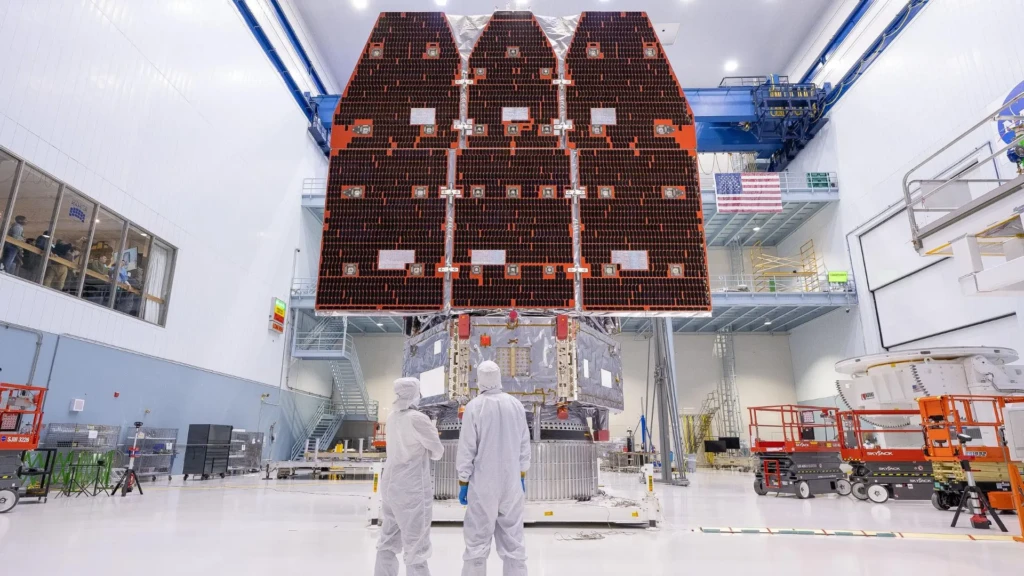
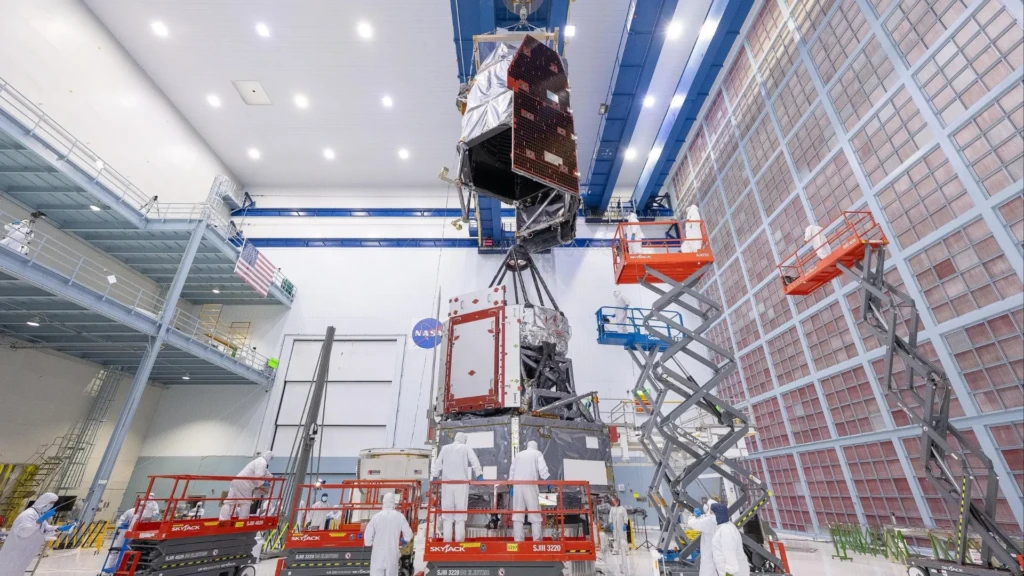
NASA has completed the construction of the Nancy Grace Roman Telescope that will soon change how we view the universe. The agency announced on Thursday that the telescope’s assembly was complete at Goddard Space Flight Center in Maryland, marking a major step toward key phases of testing. NASA says the telescope will be moved to its launch site at Kennedy Space Center after tests, and it’s on track to launch as early as fall 2026.

Rome wasn’t built in a day, but Roman just came together in one! The Nancy Grace Roman Space Telescope has finished final integration at the @NASAGoddard Space Flight Center.

Learn more about this historic milestone: https://t.co/KnOqjxoWEX

1/2 pic.twitter.com/DXGzJBauJ6

— Nancy Grace Roman Space Telescope (@NASARoman) December 4, 2025

The Roman telescope, named after NASA’s first chief astronomer, measures over 42 feet (12.7 meters) long and carries a primary mirror 2.4-meters in diameter. Despite weighing 80% lighter than Hubble telescope’s primary mirror, Roman’s will offer a field of view 100 times larger.

Here’s all you need to know about this game-changing observatory.

NASA’s powerful new eye on the universe

The Roman telescope is designed to answer fundamental questions about the dark universe, how common planetary systems like ours are and how many planets have potential to harbour life. The Roman telescope has a five-year primary mission and 75% of its operation will focus on conducting three surveys.
NASA Nancy Grace Roman Telescope
NASA’s Nancy Roman Grace Telescope at Goddard Space Flight Center. Image: NASA

First is the High-Latitude Wide-Area Survey to trace the evolution of the universe in order to probe dark matter. Dark matter and dark energy, which together form the dark universe, is believed to make up 95% of the known universe but they’re detectable only by their effects on observable matter. NASA says the Roman telescope will combine the powers of imaging and spectroscopy to discover more than a billion galaxies across a vast swath of space. It will observe a patch of the sky bigger than the apparent size of a full Moon.

Scientists expect that Roman will discover 100 billion stars, 80,000 supernovae (exploding stars), hundreds of forming planetary systems and more than 1,00,000 exoplanets. Roman is carrying two main instruments – the Wide Field Instrument and the Coronagraph Instrument. The Wide Field Instrument’s 288-megapixel camera will unveil the cosmos all the way from our solar system to near the edge of the observable universe, whereas the Coronagraph will carry out direct imaging of exoplanets by blocking the glare of stars they orbit.

The second called the High-Latitude Time-Domain Survey will observe the same region multiple times to notice changes in celestial objects over time. This survey will help study dark energy which scientists believe is accelerating the universe’s expansion.

The third survey is the Galactic Bulge Time-Domain Survey for the Milky Way. Roman will track hundreds of millions of stars in the heart of our galaxy in search of microlensing event – a phenomenon where the gravity of a foreground star briefly bends and magnifies the light of a background star. This process could reveal large exoplanets with orbits bigger than Earth’s around the Sun. Microlensing may also unveil rogue planets that are not bound to a star along with isolated black holes.

“With Roman now standing as a complete observatory, which keeps the mission on track for a potentially early launch, we are a major step closer to understanding the universe as never before,” Nicky Fox, associate administrator of NASA’s Science Mission Directorate, said in a statement.  The Roman telescope will be installed 1.5 million kilometers away from Earth at the second Earth-Sun Lagrange Point. It is the same spot where the James Webb Space Telescope is parked. Both telescopes are designed to gather infrared light, allowing them to peer deep into space, even through thick clouds of dust and gas.

ALSO READ: Alaknanda: Why This Ancient Spiral Galaxy’s Discovery By Indian Scientists Matters

ALSO READ: Asteroid Bennu Has More Than Just Ingredients Of Life – What NASA Found
TAGGED:Dark matterexoplanetsJames Webb Space TelescopeNancy Roman Grace TelescopeNASA
Share This Article
Facebook Pinterest Whatsapp Whatsapp LinkedIn Copy Link Print

Latest News

Menstruation cups
Menstruation Cups May Be The Giant Leap Needed For Women’s Health In Space
Spaceflight
NASA Artemis IV
NASA Picks $50 Million Tools To Unlock The Moon’s Secrets On Artemis IV Mission
Artemis
Alaknanda galaxy gravitational lensing
What is ‘Gravitational Lensing’ That Made Alaknanda Galaxy’s Discovery Possible?
Astronomy
Bennu asteroid
Asteroid Bennu Has More Than Just Ingredients Of Life – What NASA Found
Astronomy

You Might Also Like

NASA OSIRIX-APEX
Spaceflight

NASA’s Deep Space Probes Send Stunning Images Of Earth, Moon And Uranus

November 29, 2025
Comet 3I/ATLAS
Astronomy

Comet 3I/ATLAS May Have Broken Into 16 Or More Pieces, Says Scientist

November 17, 2025
NASA ESCAPADE Mars spacecraft.
Spaceflight

ESCAPADE: Why It May Be NASA’s Most Important Mars Mission In Years

November 19, 2025
Image 9
Astronomy

Comet 3I/ATLAS: Should We Take Avi Loeb’s Alien Theory Seriously?

November 6, 2025
© 2025, Blue Terra Journal
  • About
  • Privacy Policy
  • Terms
  • Contact
Welcome Back!

Sign in to your account

Username or Email Address
Password

Lost your password?