Blue Terra Journal

  • Home
  • Spaceflight
    SpaceflightShow More
    NASA's SR-1 Freedom spacecraft.
    What Is NASA’s SR-1 Freedom Mission? The First Nuclear Reactor In Space Explained
    March 27, 2026
    Artist's impression of a NASA Moon base.
    NASA Moon Base: How The US Will Spend $20 Billion On This Ambitious Project
    March 25, 2026
    Russia's Soyuz rocket ascending to space.
    Russia’s Progress Spacecraft Suffers Mystery Glitch On Its Way To ISS; What Happened?
    March 23, 2026
    Robert Goddard
    Celebrating Robert Goddard – The Man Who Changed Rocketry 100 Years Ago
    March 17, 2026
    International Space Station gets extension to beat China
    Watch Out China! US Proposes Extending International Space Station Lifespan To 2032
    March 10, 2026
  • Astronomy
    AstronomyShow More
    Meteor spotted over Houston.
    Video Captures 1-Ton Meteor Exploding Over Houston Skies, NASA Releases Statement
    March 22, 2026
    NASA black hole simulation
    Fall Into A Black Hole With This Incredibly Scary Simulation Made By NASA
    March 18, 2026
    Comet C/2026 A1 MAPS
    Comet C/2026 A1 MAPS: What Are ‘Sun-Grazer’ Comets And Why Are They Special?
    March 12, 2026
    Moon is safe from asteroid 2024 YR4.
    The Moon Is Safe! James Webb Space Telescope Rules Out Asteroid 2024 YR4’s Collision
    March 6, 2026
    NASA Moon orbiter
    NASA Prepares To Save Its Orbiter During Total Solar Eclipse On The Moon
    March 3, 2026
  • India
    IndiaShow More
    Shubhanshu Shukla aboard the ISS.
    ISRO Astronaut Shubhanshu Shukla Awarded Ashoka Chakra For Heroic Ax-4 Mission
    February 9, 2026
    ISRO's PSLV lifts off to space.
    ISRO’s PSLV Rocket Suffers Third Stage Failure After Successful Liftoff; Payloads Lost
    January 23, 2026
    Dhruva Space team at ISRO facility.
    India’s Dhruva Space To Launch 10 Missions, Including 1st Northeastern Satellite, On ISRO’s PSLV
    January 12, 2026
    ISRO's PSLV rocket
    ISRO To Seek Redemption With PSLV-C62 Mission Launch On January 12
    January 12, 2026
    ISRO SSLV
    ISRO’s SSLV Rocket Just Got Better After Latest Third Stage Test Fire
    December 31, 2025
  • Artemis
    ArtemisShow More
    NASA Artemis II crew
    NASA’s Christina Koch Turns ‘Space Plumber’ To Fix $30 Million Toilet On Artemis II Mission
    April 3, 2026
    NASA Orion spacecraft
    NASA’s Artemis II Astronauts Are Moon-Bound After Successful Trans-Lunar Injection Burn
    April 3, 2026
    NASA Artemis II lifts off.
    Artemis II Lifts Off! NASA Launches 4 Astronauts To The Moon After Over 50 Years
    April 2, 2026
    NASA's Artemis II astronauts
    NASA Artemis II Launch Live: Watch Humanity Return To The Moon On April 2
    April 2, 2026
    NASA Apollo 8 image
    NASA Artemis II: Why This Moon Mission Is Our Generation’s Apollo 8
    March 30, 2026
  • More
    • About
    • Privacy Policy
    • Terms
    • Contact

Blue Terra Journal

  • Home
  • Spaceflight
  • Astronomy
  • India
  • Artemis
Search
  • Pages
    • About
    • Contact
    • Privacy Policy
    • Terms

Home - Astronomy - Jupiter Just Got Smaller: NASA’s Juno Probe Reveals Gas Giant Is Smaller Than We Thought

Astronomy

Jupiter Just Got Smaller: NASA’s Juno Probe Reveals Gas Giant Is Smaller Than We Thought

Juno reveals Jupiter's true size.

Harsh Vardhan
Last updated: February 7, 2026 9:37 PM
Harsh Vardhan
Share
4 Min Read
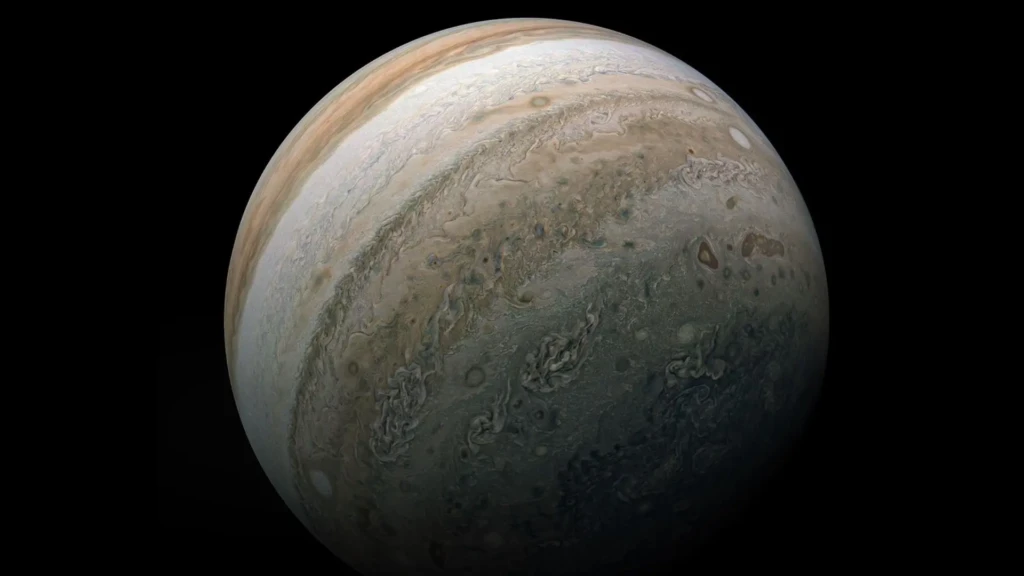
Jupiter by Juno probe.
Jupiter photographed by Juno spacecraft. Image: NASA
SHARE

Jupiter’s size just got updated. Astronomers have discovered that this gas giant is not as big as previously thought, thanks to data beamed by NASA‘s Juno spacecraft. A team of scientists from the Weizmann Institute in Israel revealed in a study published in the journal Nature Astronomy that Jupiter is about 8 km (five miles) less wide at the equator and 24 km (15 miles) flatter at the poles.

Turns out Jupiter is slightly smaller and more “squashed” than we orginally thought.

NASA’s Juno mission found the planet is 5 miles narrower at the equator and 15 miles flatter at the poles — key info that will help us study worlds beyond our solar system.

More 👇…

— NASA Marshall (@NASA_Marshall) February 4, 2026

According to existing data, Jupiter is around 1,42,984 km ( 88,846 miles) across at its equator, and 1,33,708 km (83,082 miles) from pole to pole. Due to its fast rotation [approx. 9 hours 55 minutes], the planet experiences strong centrifugal force which causes it to bulge at the equator and flattens the polar regions – causing it to take an oblate spheroid shape.

The latest measurements were taken more than five decades after observations by NASA’s Voyager and Pioneer missions. But the Juno probe, which is orbiting Jupiter since 2016, collected radio occultation data during its 13 flybys of the planet and made 26 new measurements.
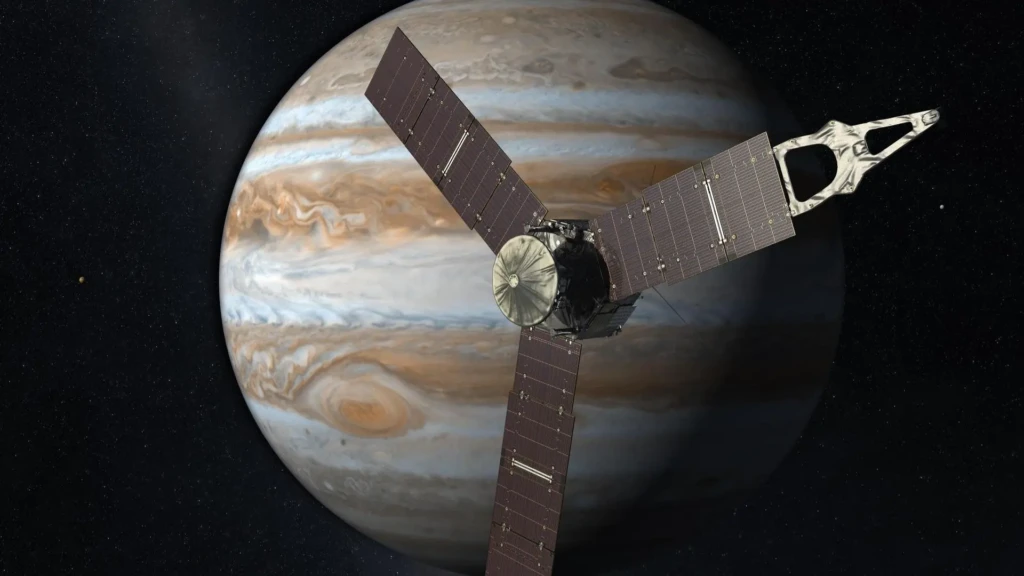
NASA's Juno probe orbiting Jupiter
Artist’s concept of NASA’s Juno probe orbiting Jupiter. Image: NASA

Using radio occultation, Juno peered through the dense and opaque clouds of Jupiter’s atmosphere to understand its internal structure. During a radio occultation experiment, the spacecraft sends signals to NASA’s Deep Space Network from behind Jupiter and as these signals pass through the planet’s atmosphere, they bend and get blocked.

Juno is following a new trajectory since receiving a mission extension in 2021 which takes it behind Jupiter from Earth’s point of view, making the occultation process possible.

“We tracked how the radio signals bend as they pass through Jupiter’s atmosphere, which allowed us to translate this information into detailed maps of Jupiter’s temperature and density, producing the clearest picture yet of the giant planet’s size and shape,” Maria Smirnova, a member of the research team said in a statement.

Prof. Yohai Kaspi of Weizmann’s Earth and Planetary Sciences Department explained that this research would help scientists understand how planets form and evolve because Jupiter was likely the first planet in our solar system. Besides, it also inspires models for studying structures of other giant planets in our solar systems as well as around other stars.

Since Jupiter’s size has been revised, Kaspi believes that the textbooks also need to be updated.

ALSO READ: NASA’s Voyager 1 Will Be One Light-Day Away From Earth In 2026 – What This Means

ALSO READ: Comet 3I/ATLAS Is Not An Alien Spacecraft – This Research Likely Confirms It

TAGGED:JunoJupiterNASASpace
Share This Article
Facebook Pinterest Whatsapp Whatsapp LinkedIn Copy Link Print

Latest News

NASA Artemis II crew
NASA’s Christina Koch Turns ‘Space Plumber’ To Fix $30 Million Toilet On Artemis II Mission
Artemis
NASA Orion spacecraft
NASA’s Artemis II Astronauts Are Moon-Bound After Successful Trans-Lunar Injection Burn
Artemis
NASA Artemis II lifts off.
Artemis II Lifts Off! NASA Launches 4 Astronauts To The Moon After Over 50 Years
Artemis
NASA's Artemis II astronauts
NASA Artemis II Launch Live: Watch Humanity Return To The Moon On April 2
Artemis

You Might Also Like

Meteor spotted over Houston.
Astronomy

Video Captures 1-Ton Meteor Exploding Over Houston Skies, NASA Releases Statement

March 22, 2026
NASA-SpaceX ready for Crew-12
Spaceflight

NASA Crew-12 LIVE: Watch SpaceX Launch Astronauts To International Space Station Today

February 15, 2026
Blue Origin's New Glenn rocket.
Spaceflight

Blue Origin Scrubs New Glenn’s Launch For NASA ESCAPADE Mars Mission

November 11, 2025
NASA Crew-12
Spaceflight

NASA Introduces Astronauts For Crew-12 Mission After Russian Cosmonaut’s Removal

December 22, 2025
© 2026, Blue Terra Journal
  • About
  • Privacy Policy
  • Terms
  • Contact
Welcome Back!

Sign in to your account

Username or Email Address
Password

Lost your password?