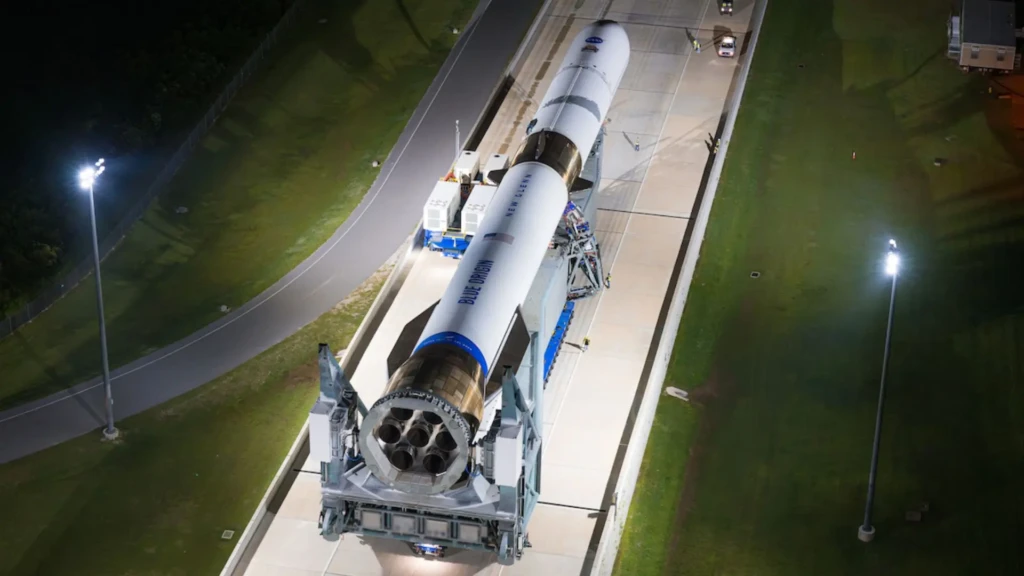
NASA’s next mission to Mars – ESCAPADE – could launch as soon as November 14. In a latest update, launch provider Blue Origin said it is targeting the New Glenn rocket’s liftoff between 1:27-2:55 am IST on November 14 (2:57-4:25 pm EST, Nov 13) as the solar storm is likely to die down soon.
The launch has been postponed twice – first on November 10 due to bad weather and again on November 13 due to solar storm. “NG-2 Update: We are scheduled to launch tomorrow, November 13, with a launch window from 2:57–4:25 PM EST / 19:57–21:25 UTC. The live webcast starts here at T-20 minutes,” Blue Origin said.
NG-2 Update: We are scheduled to launch tomorrow, November 13, with a launch window from 2:57–4:25 PM EST / 19:57–21:25 UTC. The live webcast starts here at T-20 minutes. pic.twitter.com/Dp9uqykdzA
— Blue Origin (@blueorigin) November 13, 2025
Just hours ago, it announced the launch scrub due to high solar activity which could have damaged the ESCAPADE spacecraft. Since November 9, scientists have recorded multiple intense solar flare and coronal mass ejection events that triggered radio blackouts across Africa and Europe, and brought auroras all over North America and even parts of Mexico.
⚡️Solar storm incoming! We are actively monitoring severe space weather events, occurring on 11-12 November. Severely disturbed geomagnetic conditions are expected to persist for at least 24 to 48 hours.
🔗https://t.co/cmizImQ0EF@esaoperations @MissionSoho pic.twitter.com/E8TKlWrUWj
— European Space Agency (@esa) November 12, 2025
Considering the high solar activity, the National Oceanic and Atmospheric Administration’s (NOAA) Space Weather Prediction Center has warned about a G4-level severe geomagnetic storm until November 14. “Final CME arrived & passing over Earth now. Conditions generally weakening, but variable. Strong solar wind speed and periods of favorable magnetic field orientation are driving up geomagnetic storms to G1-G3; with G4 still possible tonight,” the Weather Center posted on X.
Final CME arrived & passing over Earth now. Conditions generally weakening, but variable. Strong solar wind speed and periods of favorable magnetic field orientation are driving up geomagnetic storms to G1-G3; with G4 still possible tonight. Stay aware at https://t.co/TV7Yw6LXRw pic.twitter.com/CaX6O4FmzW
— NOAA Space Weather Prediction Center (@NWSSWPC) November 13, 2025
About NASA’s ESCAPADE mission
The ESCAPADE mission is the world’s first twin-satellite project to explore Mars and its atmospheric history. Built by Rocket Lab, the satellites Blue and Gold will examine how solar winds and charged particles interact with the Martian magnetosphere, in order to understand why the red planet lost its atmosphere.
The mission will begin after September 2027 when ESCAPADE will reach Mars and the observations will continue for 11 months. NASA says this mission could reveal how planets lose habitability over time and whether Earth might share the same fate.
ESCAPADE is the first mission to Mars NASA has built since the Perseverance rover which launched in 2020.
READ MORE: ‘Mars Is Not A Great Place’: Avi Loeb Derides Elon Musk’s Colonisation Dream
READ MORE: ESCAPADE: Why It May Be NASA’s Most Important Mars Mission In Years