ISRO announced Tuesday the successful completion of a test fire of the Small Satellite Launch Vehicle‘s (SSLV) third stage. With this test, the improved version of the rocket stage is validated and fully qualified for induction in flight. In a statement, the agency said that the stage features a Carbon-epoxy motor case, which has significantly reduced its mass and improved SSLV’s payload capacity by 90 kg.
“The stage also features an improved design for the igniter and nozzle system making the system more efficient and robust. The nozzle control is implemented through a fault-tolerant electro-mechanical actuation system with low power control electronics,” ISRO stated.
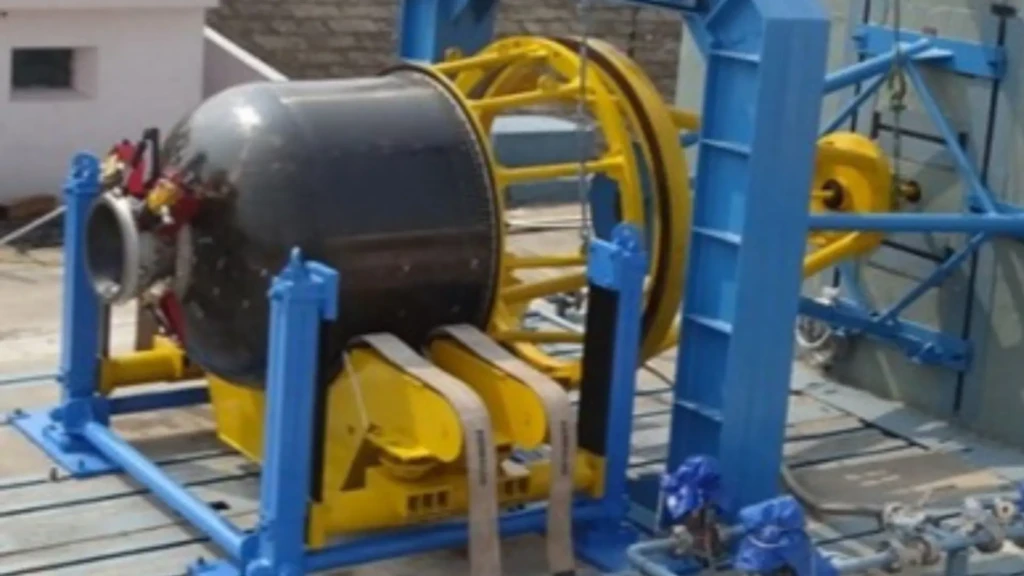
The rocket stage’s motor was fired for 108 seconds at the Solid Motor Static Test Facility of the Satish Dhawan Space Centre (SDSC), Sriharikota. Its performance on parameters such as pressure, thrust, temperature, vibration and control electronics and actuators matched the predictions – proving the motor’s robustness.
In 2025, multiple facilities have been commissioned to test solid motors for rocket stages.
According to ISRO, the solid motor production facilities were commissioned at Sriharikota in July, followed by a production line for ammonium perchlorate – required for the processing of solid motors – in September. India also has the world’s largest solid propellant mixing equipment at SDSC that was inaugurated earlier this year.
About ISRO’s SSLV rocket
The SSLV is a three-stage solid fuel rocket which made its debut in August 2022. Standing 34 metres tall, this rocket can be configured to launch single or multiple satellites ranging from 10 kg to up to 500 kg in a 500 km planar orbit.

Besides being cost effective, SSLV offers low turnaround time and requires minimal infrastructure for launch.
The SSLV rocket’s debut mission was partially successful. While it cleared the launch pad flawlessly, it failed to place the payloads – EOS-02 and AzaadiSAT satellites – into the intended orbit. Success came on the second attempt in February 2023, when it placed ISRO’s EOS-07 (156 kg), US-based ANTARIS’s Janus-1 (10.2 kg) and AzaadiSAT-2 (8.7 kg) satellite built by 750 female students into a 450 km circular orbit.
It flew on its third and final developmental mission in August 2024 with the EOS-08 satellite and successfully deployed it into orbit, proving its readiness for operational missions.
ALSO READ: Ax-4, NISAR And More: Reliving ISRO’s Biggest Spaceflight Milestones In 2025
ALSO READ: ISRO’s LVM3 Rocket Launches Heaviest Satellite Ever From Indian Soil; Watch