ISRO just got a step closer to launching Indians to space. The agency announced on December 20 the completion of a series of tests for Drogue parachutes of the Gaganyaan crew module’s deceleration system. The test was conducted over two days earlier this week at the Rail Track Rocket Sled (RTRS) facility of the Terminal Ballistics Research Laboratory (TBRL) in Chandigarh.
Union Minister of State for Science and Technology, Dr. Jitendra Singh, shared a video hailing the successful test. “Heartening to note that India has moved one more step closer to its first Human Space mission Gaganyaan,” he posted on X.
Heartening to note that India has moved one more step closer to its first Human Space mission #Gaganyaan.
ISRO successfully completed the Drogue Parachute Deployment Qualification Tests for the Gaganyaan Crew Module at the RTRS facility of TBRL, Chandigarh, during 18–19 December… pic.twitter.com/ci47TQDaoA
— Dr Jitendra Singh (@DrJitendraSingh) December 20, 2025
The system achieved all the test objectives, confirming their robustness even under significantly varying flight conditions, ISRO said.
Drogues are deployed before the deployment of main parachutes for a safe landing or splashdown of a spacecraft in the ocean. On Gaganyaan missions, the crew capsule will splashdown in the Bay of Bengal, slowing down from a speed of about 28,000 kilometres per hour during re-entry to just a few kilometres.
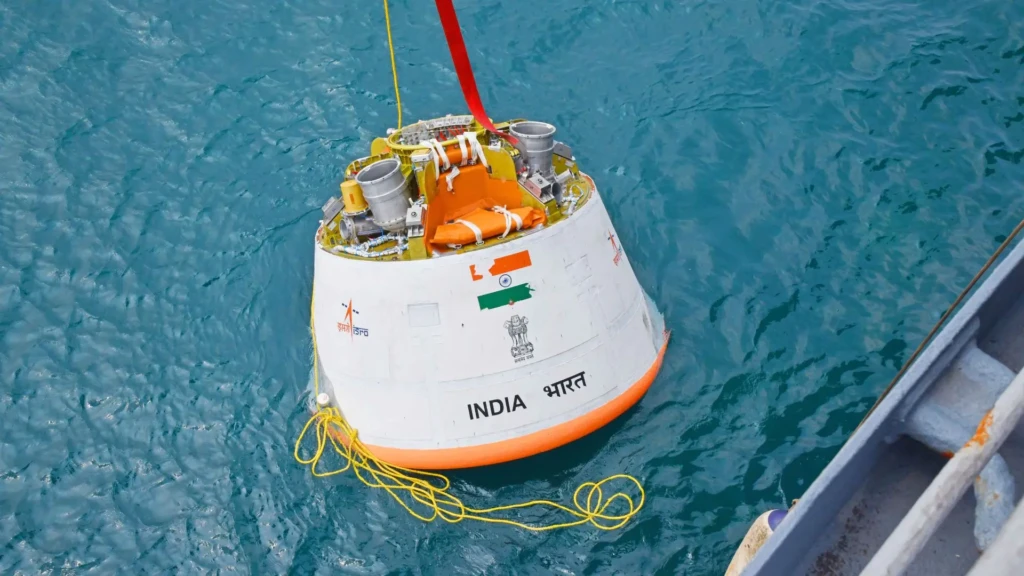
The Gaganyaan capsule has a total of 10 parachutes of four different types to achieve nominal deceleration.
“The descent sequence begins with two apex cover separation parachutes that remove the protective cover of the parachute compartment, followed by two drogue parachutes that stabilize and decelerate the module,” ISRO said in a statement. “Upon release of the drogues, three pilot parachutes are deployed to extract three main parachutes, which further slow down the Crew Module to ensure a safe touchdown.”
“A crucial component of this system is the deployment of drogue parachutes, which play a pivotal role in stabilizing the Crew Module and also reducing its velocity to a safe level during re-entry,” it added.
ISRO’s Gaganyaan progress
The recent tests follow parachute deployment demonstration completed in November. ISRO validated the crew capsule’s all 10 parachutes after dropping it from an altitude of 2.5 kilometres using the Indian Air Force’s IL-76 aircraft.
ISRO successfully conducted a key Integrated Main Parachute Airdrop Test (IMAT) for the Gaganyaan mission at Babina Field Firing Range, Jhansi, on Nov 3, 2025. The test validated the main parachutes under extreme conditions. #ISRO #Gaganyaan
For more information visit… pic.twitter.com/nqCgRmMkDn
— ISRO (@isro) November 11, 2025
Despite these progressive steps, the Gaganyaan program has suffered significant delays. The first uncrewed test launch which was planned for late 2025 will take place no earlier than January 2026. This test launch will be the first of three flights that need completion before sending astronauts on the Gaganyaan capsule in 2027. ISRO is currently conducting rigorous tests of the spacecraft to make it human rated and ensuring all systems are robust and reliable.
Earlier in November, ISRO Chairman Dr. V Narayanan revealed that more than 8,000 tests regarding the first test mission are complete. Hardware integration activities are also underway at the Satish Dhawan Space Centre to ensure a timely launch.
ALSO READ: How Gaganyaan Delays Are Setting India Back In Modern Space Race
ALSO READ: ISRO Targets Launch Of LVM3 Mission With US Broadband Satellite On December 24