Blue Origin is targeting November 13 to launch NASA’s ESCAPADE mission to Mars. The first attempt was scrubbed on November 10 due to unfavourable weather, specifically cumulus cloud rule, over the launch pad at Cape Canaveral Space Force Station in Florida.
In an X post shared on Monday, Blue Origin said it has selected a launch window from 1:20 AM to 2:47 AM IST (2:50 PM to 4:17 PM EST on November 12).
NG-2 Launch Update: Our next launch attempt is no earlier than Wednesday, November 12, due to forecasted weather and sea state conditions. We worked with the FAA and range to select a launch window from 2:50 PM – 4:17 PM EST / 19:50 – 21:17 UTC. The live webcast starts at T-20…
— Blue Origin (@blueorigin) November 10, 2025
“NG-2 Launch Update: Our next launch attempt is no earlier than Wednesday, November 12, due to forecasted weather and sea state conditions. We worked with the FAA and range to select a launch window from 2:50 PM – 4:17 PM EST / 19:50 – 21:17 UTC. The live webcast starts at T-20 minutes,” the company posted. It made the first attempt to launch the mission on November 10 during a 2.5-hour launch window. However, the weather turned unfavourable shortly after the launch window opened at 1:15 AM IST (3:45 PM EST), forcing several holds during the countdown. About 22 minutes left on the clock, Blue Origin stopped the countdown, confirming the launch scrub.
— Jeff Bezos (@JeffBezos) November 8, 2025
Blue Origin has sought an exception from the Federal Aviation Administration (FAA) which has limited commercial rocket launches to a window between 8:30 AM to 4:30 PM IST (10 PM EST to 6 AM EST) due to shortage of staff resulting from the government shutdown. The restriction came into effect on November 10 on the orders of Secretary of Transportation and acting NASA administrator, Sean Duffy, who cited safety concerns to justify the decision.
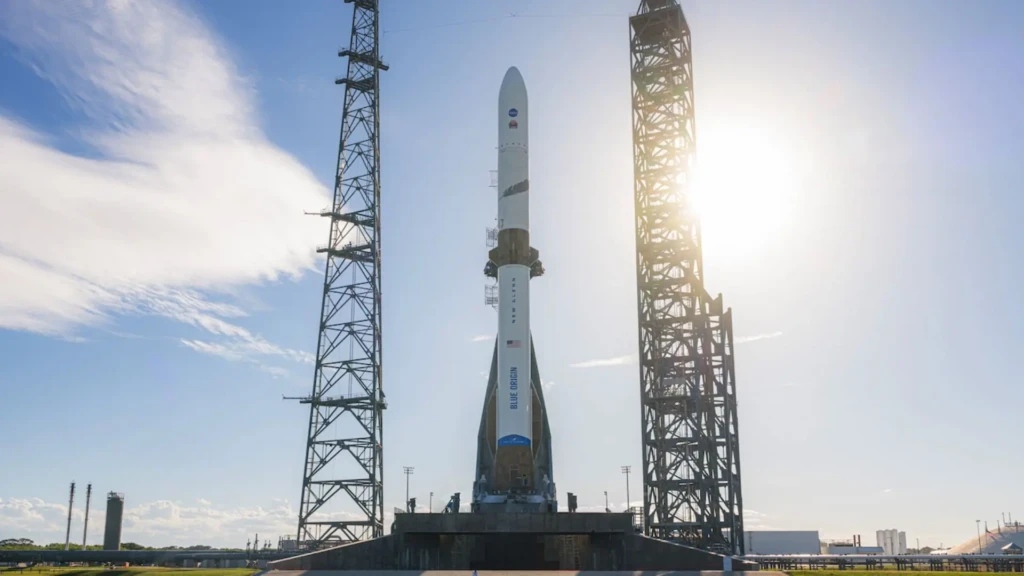
ESCAPADE, the world’s first twin-satellite mission to explore Mars, will be launched by Blue Origin’s mega-rocket New Glenn. The 321-feet-tall launch vehicle flew on its debut flight in January and will be launching its first mission to Mars. Interestingly, Blue Origin will also attempt to land the rocket’s first stage booster on a drone ship stationed in the Atlantic Ocean.
The ESCAPADE satellites, built by Rocket Lab, are designed to study the Martian magnetosphere and its interaction with the solar wind for 11 months from separate orbits. They will reach the red planet in September 2027 after spending a year at the second Lagrange Point or L2 located 1.5 million kilometres from Earth. This mission, which cost less than $80 million, was funded by NASA’s Small Innovative Missions for Planetary Exploration (SIMPLEx) program and the research will be led by the Space Sciences Laboratory at the University of California, Berkeley.
ALSO READ: ESCAPADE: Why It May Be NASA’s Most Important Mars Mission In Years
ALSO READ: Like SpaceX, Blue Origin Eyes Landing New Glenn Booster During ESCAPADE Launch