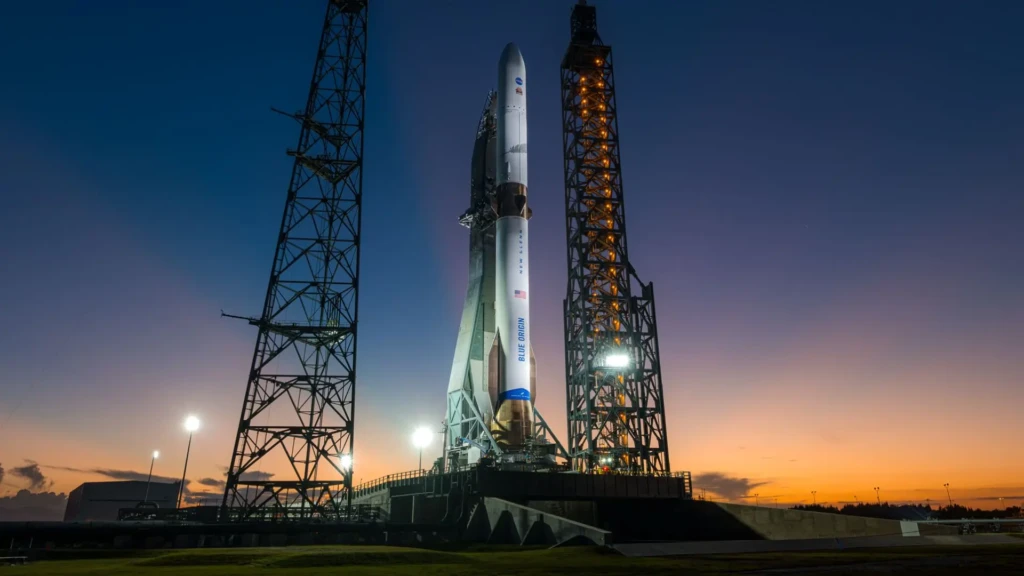
Blue Origin has delayed the launch of NASA’s ESCAPADE Mars mission again, this time due to the ongoing solar storm. In a statement on Wednesday, the company said the launch is being postponed until space weather improves and the new launch date will be announced soon. The liftoff was planned between a narrow window opening at 1:20 am IST on November 13 (2:50 pm EST on November 12).
“NG-2 Update: New Glenn is ready to launch. However, due to highly elevated solar activity and its potential effects on the ESCAPADE spacecraft, NASA is postponing launch until space weather conditions improve,” Blue Origin posted on X. “We are currently assessing opportunities to establish our next launch window based on forecasted space weather and range availability.”
NG-2 Update: New Glenn is ready to launch. However, due to highly elevated solar activity and its potential effects on the ESCAPADE spacecraft, NASA is postponing launch until space weather conditions improve. We are currently assessing opportunities to establish our next launch…
— Blue Origin (@blueorigin) November 12, 2025
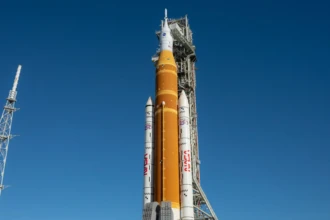
The twin-satellite ESCAPADE mission will launch atop the 321-feet-tall New Glenn rocket which is preparing for its second-ever flight. The launch was first scheduled for November 10 but got scrubbed due to unfavourable weather over the launch pad at Cape Canaveral Space Force Station in Florida.
Worsening space weather delays ESCAPADE launch
NASA and Blue Origin are exercising caution as the worsening space weather could affect both the rocket and the spacecraft.
In the last couple of days, scientists have recorded high solar activity, with the Sun releasing the strongest flares this year on November 12. Earth is also experience overwhelming streams of charged particles being expelled from the Sun during the recent coronal mass ejection event from the sunspot named AR4274. It has reportedly caused radio blackouts across Africa and Europe, and triggered auroras as far south as Mexico from the north pole.
Here is a view of today’s eruption from the Sun, currently en route to Earth. You can see a full ‘halo’ in the data, indicating the plasma is coming our way. You can also see the ‘fuzzy snow’ in the images, caused by particles from the solar flare hitting the camera! pic.twitter.com/CqbNG1kRH6
— Dr. Ryan French (@RyanJFrench) November 11, 2025
The National Oceanic and Atmospheric Administration’s (NOAA) Space Weather Prediction Center revealed on Wednesday that geomagnetic storm conditions are currently at G3 (strong), after peaking at G4 (severe) earlier. “G3 conditions are currently being observed. G4 conditions with a chance for higher levels remain possible throughout the day as another CME is expected to arrive midday (EST),” the agency posted on X.
G3 conditions are currently being observed. G4 conditions with a chance for higher levels remain possible throughout the day as another CME is expected to arrive midday (EST). pic.twitter.com/XcBmeNns4J
— NOAA Space Weather Prediction Center (@NWSSWPC) November 12, 2025
It is wise to forgo launch opportunities during heightened solar activity because charged solar particles and intense radiation can damage sensitive avionics, guidance systems of rockets and also affect the payloads. Since solar eruptions can disrupt radio signals, ground control may lose communication with the spacecraft after it is deployed in orbit and even damage its critical components. Both ESCAPADE satellites will rely on solar energy and prolonged exposure to space weather could cause total failure of their solar arrays.
The ESCAPADE mission was funded by NASA and the twin satellites were built by Rocket Lab. Their job is to study the Martian magnetosphere and how it interacts and gets affected by solar particles and radiation. Both the probes will reach Mars in 2027 and operate in separate orbits for 11 months. The objective to find out how Mars lost its atmosphere and eventually all its water.
ALSO READ: Strongest Solar Eruption Of 2025 Lights Up Skies With Auroras, Triggers Blackouts
ALSO READ: ESCAPADE: Why It May Be NASA’s Most Important Mars Mission In Years