Blue Terra Journal

  • Home
  • Spaceflight
    SpaceflightShow More
    Menstruation cups
    Menstruation Cups May Be The Giant Leap Needed For Women’s Health In Space
    December 7, 2025
    Blue Origin NS-37 mission
    Blue Origin Will Launch First Wheelchair User To Space On New Shepard Mission
    December 4, 2025
    Jared Isaacman SpaceX
    Jared Isaacman Defends Ties With Elon Musk And SpaceX: ‘No Different Than NASA’
    December 4, 2025
    China Zhuque-3
    China’s Private Rocket Fails To Land After Successful Liftoff; Crash Video Surfaces
    December 3, 2025
    NASA Roscosmos
    NASA Drops Russian Cosmonaut From Crew-12 Amid Reports of ‘Leaked’ SpaceX Secrets
    December 3, 2025
  • Astronomy
    AstronomyShow More
    Alaknanda galaxy gravitational lensing
    What is ‘Gravitational Lensing’ That Made Alaknanda Galaxy’s Discovery Possible?
    December 6, 2025
    NASA telescope
    NASA’s Incredible Nancy Grace Roman Telescope Is Assembled – Here’s What It Will Do
    December 6, 2025
    Bennu asteroid
    Asteroid Bennu Has More Than Just Ingredients Of Life – What NASA Found
    December 6, 2025
    ESA comet 3I/ATLAS
    ESA Drops Surprise Preview Of Comet 3I/ATLAS Images From JUICE Spacecraft
    December 5, 2025
    Alaknanda galaxy
    Alaknanda: Why This Ancient Spiral Galaxy’s Discovery By Indian Scientists Matters
    December 6, 2025
  • India
    IndiaShow More
    ISRO NISAR satellite
    ISRO Releases Image Of Godavari Delta Captured By $1.5 Billion NISAR Satellite
    December 2, 2025
    Skyroot Aerospace Vikram-I rocket.
    Skyroot Aerospace’s First Commercial Rocket Vikram-I Unveiled; Launch Soon
    November 27, 2025
    ISRO LVM3.
    ISRO Gears Up To Launch SpaceX Rival’s Broadband Satellite On Dec 15
    November 24, 2025
    ISRO
    ISRO’s Bahubali Milestone: Cryogenic Edge To Power Multiple Satellite Injections
    November 17, 2025
    ISRO Gaganyaan drop test.
    ISRO Completes Parachute Air Drop Test Of Gaganyaan Crew Module | Video
    November 21, 2025
  • Artemis
    ArtemisShow More
    NASA Artemis IV
    NASA Picks $50 Million Tools To Unlock The Moon’s Secrets On Artemis IV Mission
    December 7, 2025
    Jared Isaacman NASA
    NASA Chief Nominee Jared Isaacman Reiterates Pledge To Beat China In Moon Race
    December 3, 2025
    NASA Artemis 2 Orion spacecraft.
    Artemis 2: Unraveling NASA Orion Capsule – Humanity’s Ride To The Moon
    November 26, 2025
    NASA Artemis 2
    NASA Stacks Artemis 2 Spacecraft On Moon Rocket; Here’s What’s Next
    December 4, 2025
    Artemis vs apollo suit
    Artemis Vs Apollo: Why New Prada Spacesuits Are Better For NASA Astronauts
    November 27, 2025
  • More
    • About
    • Privacy Policy
    • Terms
    • Contact

Blue Terra Journal

  • Home
  • Spaceflight
  • Astronomy
  • India
  • Artemis
Search
  • Pages
    • About
    • Contact
    • Privacy Policy
    • Terms

Home - Astronomy - Alaknanda: Why This Ancient Spiral Galaxy’s Discovery By Indian Scientists Matters

Astronomy

Alaknanda: Why This Ancient Spiral Galaxy’s Discovery By Indian Scientists Matters

We're seeing this galaxy as it was 12 billion years ago.

Harsh Vardhan
Last updated: December 6, 2025 6:37 PM
Harsh Vardhan
Share
5 Min Read
Alaknanda galaxy
The Alaknanda spiral galaxy. Image: NASA/ESA/CSA/CASR- Rashi Jain, Yogesh Wadadekar
SHARE

Contents
  • About the Alaknanda galaxy
  • Significance of Alaknanda’s discovery 

A team of Indian scientists has discovered a spiral galaxy almost from the beginning of time, challenging our present understanding of the early universe. In a study published in Astronomy & Astrophysics, Rashi Jain and Yogesh Wadadekar, researchers from Pune’s National Centre for Radio Astrophysics, noted that they’ve named the galaxy ‘Alaknanda‘ after a Himalayan river. It is “one of the headstreams of the Ganga and sister river of the Mandakini, which, in turn, lends its name to the Milky Way galaxy,” the authors wrote.

Indian astronomers, using the powerful James Webb Space Telescope, have discovered “Alaknanda” — a beautifully formed spiral galaxy dating back to when the universe was just 1.5 billion years old.

A proud moment for India’s growing leadership in space science and cosmic… pic.twitter.com/vRDzcPm5ZD

— Dr Jitendra Singh (@DrJitendraSingh) December 4, 2025

About the Alaknanda galaxy

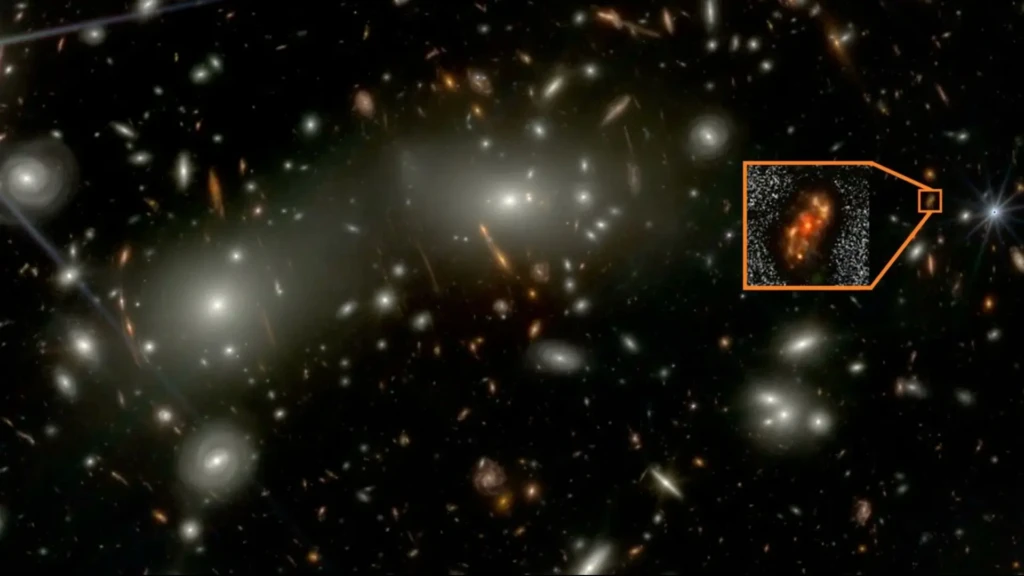
The Alaknanda galaxy was discovered when the duo was studying the UNCOVER survey data of the Abell 2744 galaxy cluster collected by James Webb Space Telescope‘s Near-Infrared Camera (NIRcam). They were able to spot Alaknanda due to a phenomenon called gravitational lensing caused by Abell 2744, that magnified the background galaxies up to dozens of times by bending the light emerging from them. Alaknanda was one of the galaxies in the background and its discovery wouldn’t have been possible without the lensing phenomenon.
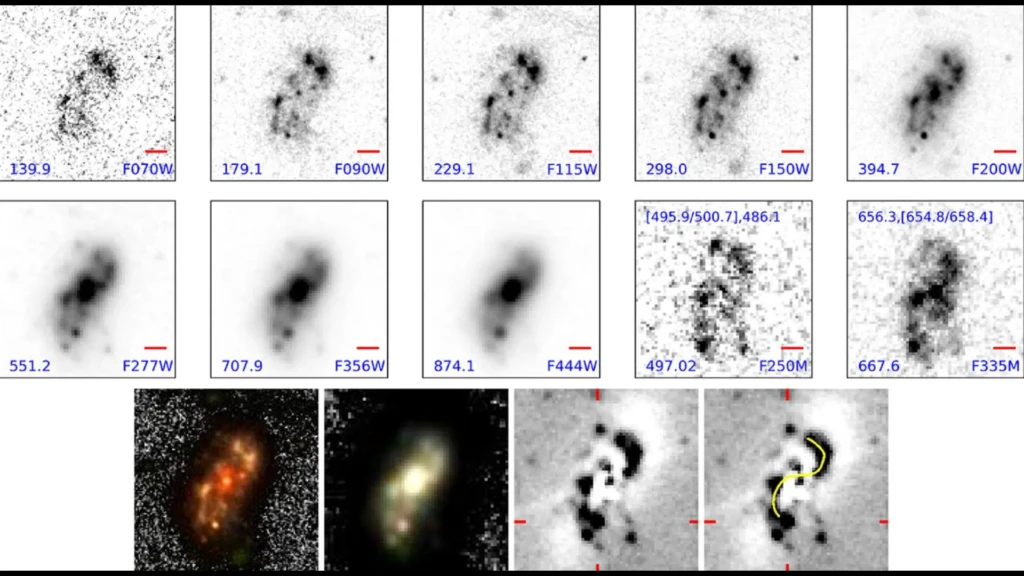
Alaknanda galaxy
The Alaknanda galaxy captured in Webb telescope’s images. Image: NASA/ESA/NCRA- Rashi Jain, Yogesh Wadadekar

Alaknanda has surprised scientists because it has two symmetrical spiral arms with star-forming regions appearing like “beads on a string.” This hasn’t been seen before in early galaxies. It is estimated to have been born just 1.5 billion years after the big bang (which birthed the universe around 13.8 billion years ago) and it spans about 33,000 light-years across.

According to the authors, Alaknanda has a mass 10 billion times greater than the Sun and it’s producing stars at a much higher rate than the Milky Way. The rate is estimated to be 63 Sun per year, which is strange for a galaxy so young. What’s even more surprising is that Alaknanda’s stars are only about 200 million years old, meaning this galaxy built itself rapidly in the early universe.
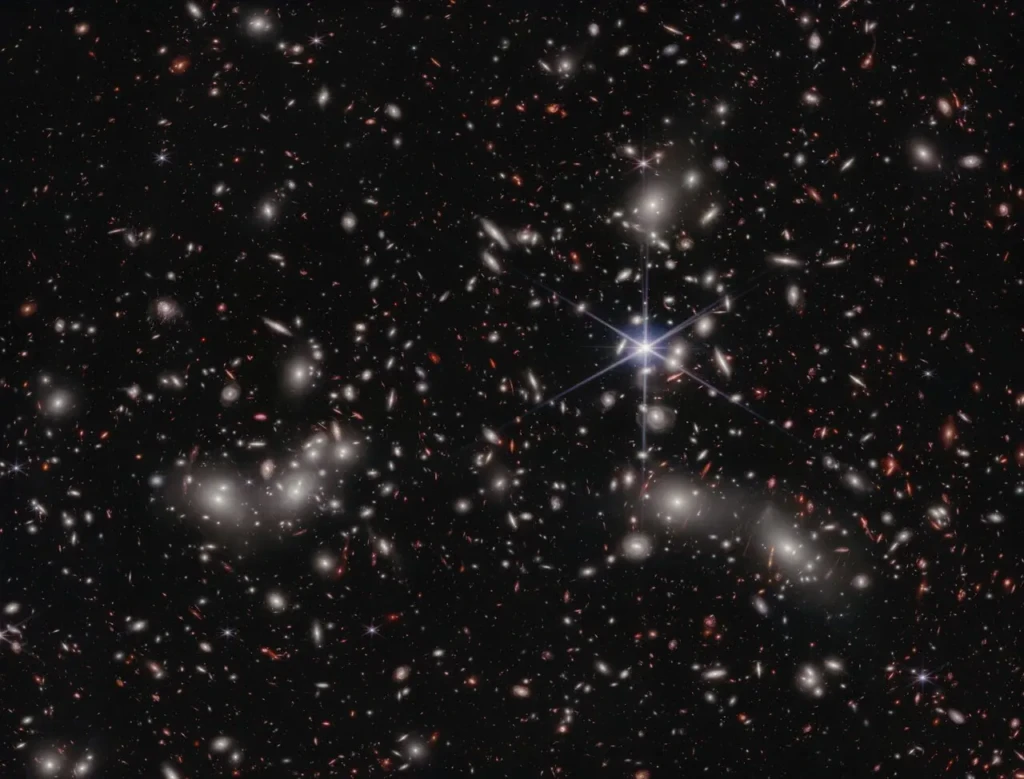
Alaknanda galaxy
Webb telescope’s view of the Abell 2744 galaxy cluster. Image: NASA/ESA/CSA

It is worth noting that we’re seeing Alaknanda as it was over 12 billion years ago – because that’s how long it took the light emerging from it to reach us. It’s possible that the galaxy has evolved to a great extent, grew much larger in size, merged with another galaxy or may not exist anymore. We don’t know its present state today because that would take another 12.5 billion years.

Significance of Alaknanda’s discovery 

This discovery is significant because it challenges earlier theories that spiral galaxies emerged at a much later stage after the big bang. Alaknanda has proved that stable, rotating disks may have formed much earlier than once believed. It has also posited new questions about the formation of spiral galaxies – do their arm form naturally from the galaxy’s own rotation or from the gravitational pull by a small companion galaxy? The assembly of such a large disk by itself soon after the birth of the universe is currently a mystery.

The study authors say that Alaknanda will be investigated further by the Webb telescope’s NIRSpec (Near-infrared Spectrograph) instrument and the ALMA observatory to answer key questions about the galaxy’s disk rotation and whether the disk is cold and stable like modern spirals or hot and turbulent.

ALSO READ: NASA’s PUNCH Mission Spies Newly Discovered Comet SWAN In Thrilling Footage

ALSO READ: What Webb Telescope’s Triple-Star System Discovery Reveals About The Universe

TAGGED:AlaknandaAlaknanda galaxyJames Webb Space TelescopeMilky Way
Share This Article
Facebook Pinterest Whatsapp Whatsapp LinkedIn Copy Link Print

Latest News

Menstruation cups
Menstruation Cups May Be The Giant Leap Needed For Women’s Health In Space
Spaceflight
NASA Artemis IV
NASA Picks $50 Million Tools To Unlock The Moon’s Secrets On Artemis IV Mission
Artemis
Alaknanda galaxy gravitational lensing
What is ‘Gravitational Lensing’ That Made Alaknanda Galaxy’s Discovery Possible?
Astronomy
NASA telescope
NASA’s Incredible Nancy Grace Roman Telescope Is Assembled – Here’s What It Will Do
Astronomy

You Might Also Like

NASA comet SWAN.
Astronomy

NASA’s PUNCH Mission Spies Newly Discovered Comet SWAN In Thrilling Footage

December 4, 2025
image 13 1
Astronomy

Comet 3I/ATLAS Vs Comet Lemmon: Why The Former Has No Tail Post Perihelion

November 20, 2025
image
Astronomy

Japan’s Akatsuki Orbiter Goes Silent Forever Ending Our Venus Presence

November 6, 2025
Solar Storm
Astronomy

Strongest Solar Eruption Of 2025 Lights Up Skies With Auroras, Triggers Blackouts

November 12, 2025
© 2025, Blue Terra Journal
  • About
  • Privacy Policy
  • Terms
  • Contact
Welcome Back!

Sign in to your account

Username or Email Address
Password

Lost your password?