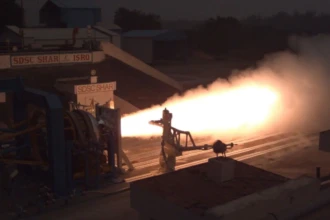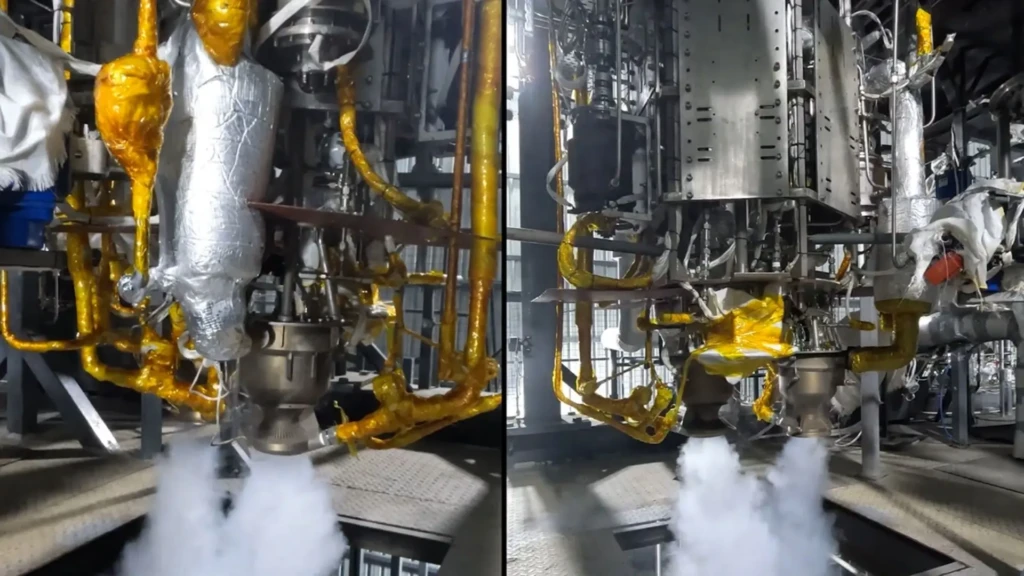
India’s Agnikul Cosmos has completed test firing of its dual 3D-printed rocket engines ahead of their much-awaited 2026 mission. Taking to X on Friday, Agnikul shared the demonstration video of the electric-motor driven, pump-fed engines which fired for over 49 seconds. “Deeply grateful to have had the opportunity to advance electric motor-driven, pump-fed 3D printed rocket engines in India through our homegrown technologies with ISRO & IN-SPACe support,” Agnikul stated.
This marks a giant leap toward the Chennai-based company’s goal of manufacturing 3D-printed engines and offering affordable launches.
Humbled to share this dual-engine firing video, where both of our in-house electric motor–driven, pump-fed, single-piece engines reached thermal steady state and demonstrated uniform system performance over 49 seconds. Deeply grateful to have had the opportunity to advance… pic.twitter.com/SlqK5kYPmd
— AgniKul Cosmos (@AgnikulCosmos) December 19, 2025
In a statement, Agnikul said that the indigenously built engines reached thermal steady state and demonstrated uniform system performance thanks to four pumps used for enabling combustion in this firing. These pumps are special because they’re driven by fully independent electric motors which allow better control and precision. Electric motors also enable multiple firings for upper stage missions and better reusability potential.
Agnikul said that majority of the 3D-printed pump components as well as drives and software controlling the pumps were fully developed in-house. The 3D-printed engines are enormously advantageous because such engines have fewer joints and welds and they can be rapidly manufactured with lower costs – making them ideal for smaller rockets.
Agnikul Cosmos’s plans for 2026
Established in 2017, the company fired its first single-piece 3D-printed engine Agnilet and achieved steady-state performance in 2021. This engine was put to test on May 30, 2024, when Agnikul attempted its first rocket launch with the Agnibaan SOrTeD (Single Orbit Transfer Demonstration) Mission-01 from Sriharikota to test indigenous technology and propulsion system.
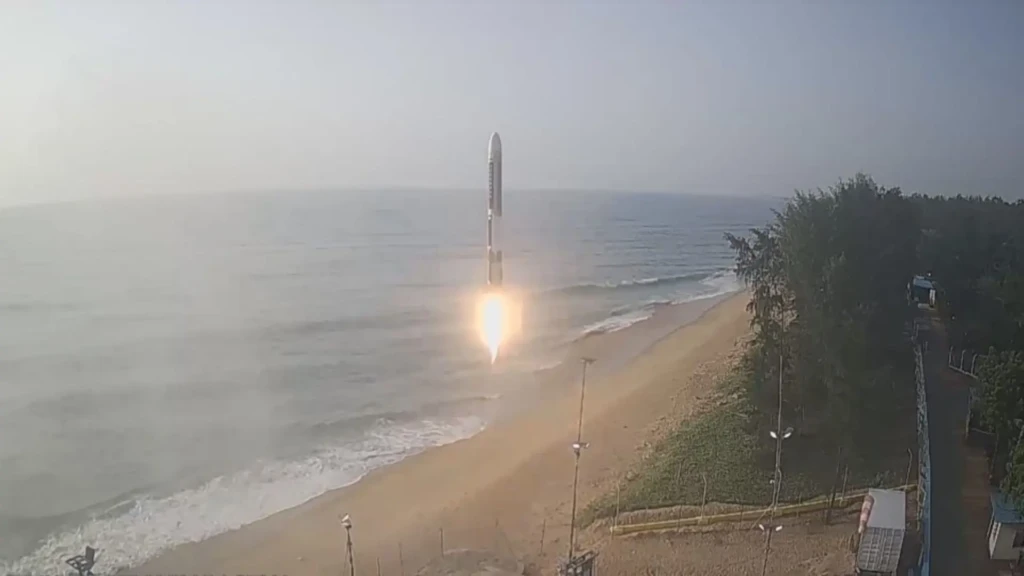
The test mission laid the foundation for future launches targeted for quarter one and four of 2026 from Agnikul’s launch pad in Sriharikota. The objective is to carry up to 100 kilograms and 300 kilograms to low-Earth orbit in the first and second mission, respectively.
ALSO READ: ISRO Targets Launch Of LVM3 Mission With US Broadband Satellite On December 24
ALSO READ: Interstellar Comet 3I/ATLAS Captured In Ghostly X-ray Image By ESA Telescope