Blue Terra Journal

  • Home
  • Spaceflight
    SpaceflightShow More
    NASA's SR-1 Freedom spacecraft.
    What Is NASA’s SR-1 Freedom Mission? The First Nuclear Reactor In Space Explained
    March 27, 2026
    Artist's impression of a NASA Moon base.
    NASA Moon Base: How The US Will Spend $20 Billion On This Ambitious Project
    March 25, 2026
    Russia's Soyuz rocket ascending to space.
    Russia’s Progress Spacecraft Suffers Mystery Glitch On Its Way To ISS; What Happened?
    March 23, 2026
    Robert Goddard
    Celebrating Robert Goddard – The Man Who Changed Rocketry 100 Years Ago
    March 17, 2026
    International Space Station gets extension to beat China
    Watch Out China! US Proposes Extending International Space Station Lifespan To 2032
    March 10, 2026
  • Astronomy
    AstronomyShow More
    Meteor spotted over Houston.
    Video Captures 1-Ton Meteor Exploding Over Houston Skies, NASA Releases Statement
    March 22, 2026
    NASA black hole simulation
    Fall Into A Black Hole With This Incredibly Scary Simulation Made By NASA
    March 18, 2026
    Comet C/2026 A1 MAPS
    Comet C/2026 A1 MAPS: What Are ‘Sun-Grazer’ Comets And Why Are They Special?
    March 12, 2026
    Moon is safe from asteroid 2024 YR4.
    The Moon Is Safe! James Webb Space Telescope Rules Out Asteroid 2024 YR4’s Collision
    March 6, 2026
    NASA Moon orbiter
    NASA Prepares To Save Its Orbiter During Total Solar Eclipse On The Moon
    March 3, 2026
  • India
    IndiaShow More
    Shubhanshu Shukla aboard the ISS.
    ISRO Astronaut Shubhanshu Shukla Awarded Ashoka Chakra For Heroic Ax-4 Mission
    February 9, 2026
    ISRO's PSLV lifts off to space.
    ISRO’s PSLV Rocket Suffers Third Stage Failure After Successful Liftoff; Payloads Lost
    January 23, 2026
    Dhruva Space team at ISRO facility.
    India’s Dhruva Space To Launch 10 Missions, Including 1st Northeastern Satellite, On ISRO’s PSLV
    January 12, 2026
    ISRO's PSLV rocket
    ISRO To Seek Redemption With PSLV-C62 Mission Launch On January 12
    January 12, 2026
    ISRO SSLV
    ISRO’s SSLV Rocket Just Got Better After Latest Third Stage Test Fire
    December 31, 2025
  • Artemis
    ArtemisShow More
    NASA Artemis II crew
    NASA’s Christina Koch Turns ‘Space Plumber’ To Fix $30 Million Toilet On Artemis II Mission
    April 3, 2026
    NASA Orion spacecraft
    NASA’s Artemis II Astronauts Are Moon-Bound After Successful Trans-Lunar Injection Burn
    April 3, 2026
    NASA Artemis II lifts off.
    Artemis II Lifts Off! NASA Launches 4 Astronauts To The Moon After Over 50 Years
    April 2, 2026
    NASA's Artemis II astronauts
    NASA Artemis II Launch Live: Watch Humanity Return To The Moon On April 2
    April 2, 2026
    NASA Apollo 8 image
    NASA Artemis II: Why This Moon Mission Is Our Generation’s Apollo 8
    March 30, 2026
  • More
    • About
    • Privacy Policy
    • Terms
    • Contact

Blue Terra Journal

  • Home
  • Spaceflight
  • Astronomy
  • India
  • Artemis
Search
  • Pages
    • About
    • Contact
    • Privacy Policy
    • Terms

Home - Astronomy - Fall Into A Black Hole With This Incredibly Scary Simulation Made By NASA

Astronomy

Fall Into A Black Hole With This Incredibly Scary Simulation Made By NASA

It is beautiful and terrifying at the same time.

Blue Terra Journal
Last updated: March 18, 2026 12:17 AM
Blue Terra Journal
Share
3 Min Read
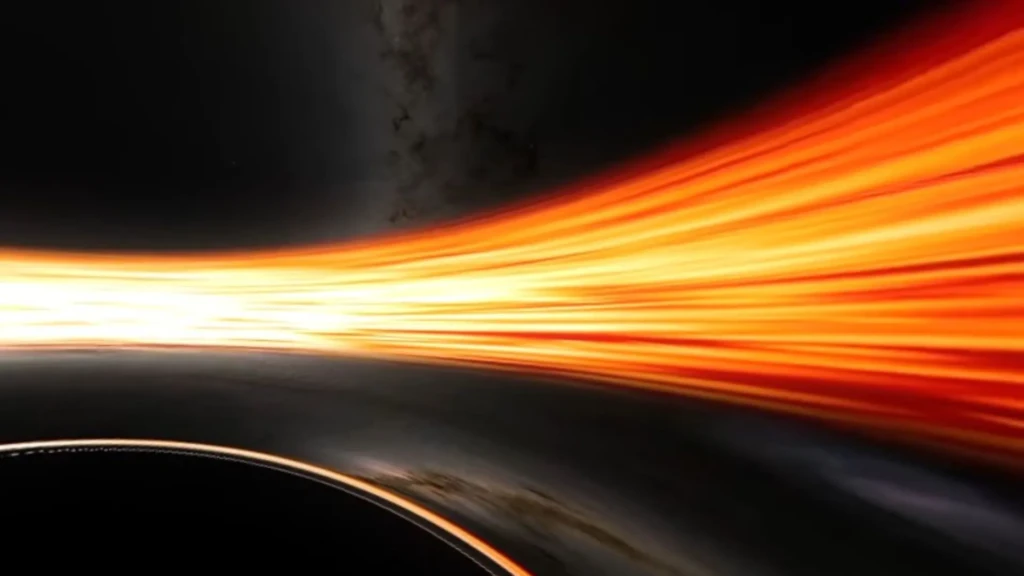
NASA black hole simulation
Screengrab from black hole simulation video. Image: NASA
SHARE

Black holes are arguably the most feared objects in astronomy, probably because of their unfathomable size and the fact that nobody knows what hides beyond the event horizon – the outer boundary and a point of no return. What scientists do know is that these objects are millions even billions of times more massive the Sun thus have enormous gravity and any person falling toward it would experience a phenomenon called ‘sphagettification‘ – get stretched like a sphagetti due to the intense gravitational pull. Extremely painful as you can imagine.

Sphagettification was predicted by Albert Einstein’s general relativity and popularised by Stephen Hawking. It happens because the tidal forces on an object nearer the black hole is much stronger than that on the other end.

But what would that unfortunate person experience while moving toward the event horizon. Let’s forget the painful sphagettification as well, what would it look like plunging into a black hole?

A simulation (above) created by a NASA supercomputer has the answer.
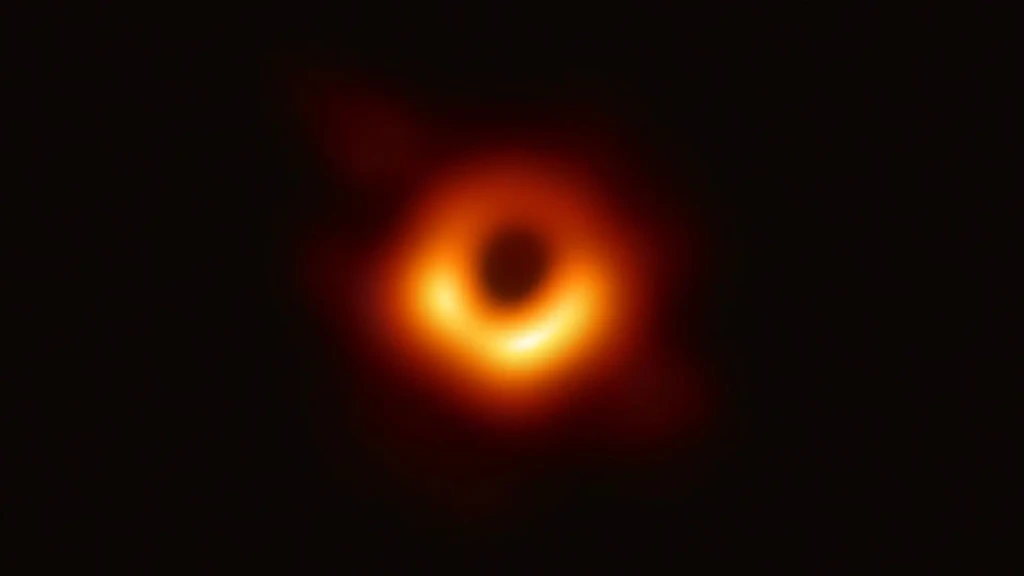
Black hole image.
A real image of a black hole. Image: NASA

Created by Jeremy Schnittman, an astrophysicist at NASA’s Goddard Space Flight Center, this simulation features a supermassive black hole with 4.3 million times the mass of our Sun, equivalent to the one located at the center of our Milky Way galaxy.

“Stellar-mass black holes, which contain up to about 30 solar masses, possess much smaller event horizons and stronger tidal forces, which can rip apart approaching objects before they get to the horizon,” Schnittman said.

In this simulation, the black hole’s event horizon spans about 25 million kilometers, or about 17% of the distance from Earth to the Sun. The swirling cloud of hot, glowing gas you see around the dark pit, called an accretion disk surrounds it.

Schnittman explains that the camera takes three hours to fall to the event horizon and then reaches a one-dimensional point called a singularity, where the laws of physics as we know them cease to operate.

ALSO READ: Comet C/2026 A1 MAPS: What Are ‘Sun-Grazer’ Comets And Why Are They Special?

ALSO READ: Universe In A Bottle: How Lab Made Space Dust Will Shape Our Understanding Of The Cosmos

TAGGED:astronomyblack holeevent horizonMilky WayNASA
Share This Article
Facebook Pinterest Whatsapp Whatsapp LinkedIn Copy Link Print

Latest News

NASA Artemis II crew
NASA’s Christina Koch Turns ‘Space Plumber’ To Fix $30 Million Toilet On Artemis II Mission
Artemis
NASA Orion spacecraft
NASA’s Artemis II Astronauts Are Moon-Bound After Successful Trans-Lunar Injection Burn
Artemis
NASA Artemis II lifts off.
Artemis II Lifts Off! NASA Launches 4 Astronauts To The Moon After Over 50 Years
Artemis
NASA's Artemis II astronauts
NASA Artemis II Launch Live: Watch Humanity Return To The Moon On April 2
Artemis

You Might Also Like

SpaceX launches NASA telescope.
Astronomy

SpaceX Launches NASA’s Exoplanet Exploring Telescope Pandora On Twilight Mission

January 19, 2026
Comet 3I/ATLAS
Astronomy

Interstellar Comet 3I/ATLAS Captured In Ghostly X-ray Image By ESA Telescope

January 5, 2026
NASA's SLS rocket at the Vehicle Assembly Building.
Artemis

Watch NASA’s SLS Rocket Roll Out To Launch Pad For Artemis II Moon Mission Today

January 19, 2026
Blue Origin SpaceX
Spaceflight

How Does Blue Origin’s Monstrous New Glenn Rocket Compare To Starship?

November 23, 2025
© 2026, Blue Terra Journal
  • About
  • Privacy Policy
  • Terms
  • Contact
Welcome Back!

Sign in to your account

Username or Email Address
Password

Lost your password?