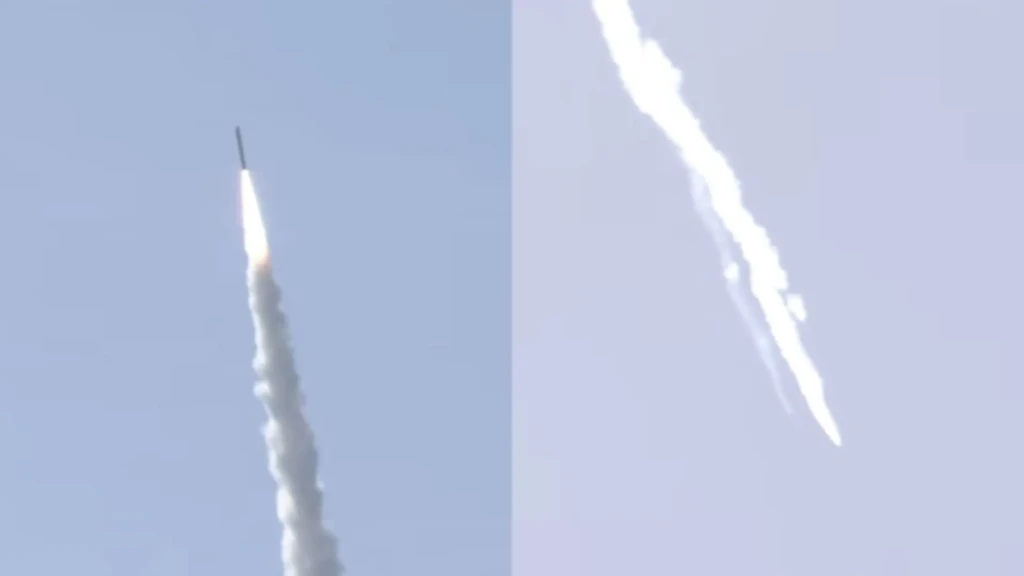
A private Japanese rocket failed on its test flight for the third time. Kairos no. 3, which was launched by Space One from its Spaceport Kii in Wakayama Prefecture on March 5, exploded about two minutes after a successful liftoff.
While the 18-metre-tall rocket travelled considerably farther than its debut mission, which lasted only five seconds, it nevertheless ended in an explosive failure.
🚨BREAKING! Japan’s SpaceOne KAIROS Rocket Launch Ends In Failure🚨
Space One’s KAIROS No. 3 rocket suffered an anomaly during first stage flight following liftoff on March 5, 2026 at 11:10 a.m. local time from the Kii Spaceport in Japan.According to the company, the vehicle… pic.twitter.com/UFrYMJ0rhg
— The Launch Pad (@TLPN_Official) March 5, 2026
According to reports, the mission team identified a major issue during ascent which prompted them to activate the flight termination system (FTS). The system is activated when it is clear that the mission success is no longer possible.
In a statement on X, Space One said – “We hereby inform you of the launch results for Kairos No. 3. Kairos No. 3 was launched on March 5, 2026, at 11:10:00 a.m., but we determined that mission success was difficult and implemented flight termination measures.”
“Currently, details are under investigation,” it further said.
ALSO READ: NASA Lends Support To Japan After H3 Rocket Failure; Here’s What Went Wrong
Videos on social media show the Kairos rocket lifting off nominally leaving a thick trail of smoke behind and disintegrating after the FTS was activated.
Space One debuted Kairos in March 2024 but it was terminated just five seconds after liftoff due to lower-than-expected velocity and thrust. The second mission in December 2024 was also a disappointment as it had to be terminated about three minutes post liftoff at an altitude of roughly 100 kilometres.
The third mission included five small satellites that were lost after the failure. According to Japanese media NHK World, Kairos no. 3 was supposed to deploy them at an altitude of 500 kilometres. This failure marks a major hurdle in Space One’s plans to launch 30 rockets in a year by the 2030s.
ALSO READ: Pakistan And China Finalise Timeline To Launch Former’s Astronaut To Tiangong Space Station