Blue Origin has decided to halt New Shepard missions, both cargo and crew, for at least two years to focus on bigger goals – landing humans on the Moon. In an official statement released Friday, it shared plans to shift the necessary resources to “accelerate development of the company’s human lunar capabilities.”
“The decision reflects Blue Origin’s commitment to the nation’s goal of returning to the Moon and establishing a permanent, sustained lunar presence,” it further said.
Six different stories. One unforgettable journey to space. pic.twitter.com/qH2nlwCvLp
— Blue Origin (@blueorigin) January 23, 2026
The announcement comes just a week after Blue Origin launched six tourists on a sub-orbital mission. The NS-38 mission, as it was called, marked the company’s 17th crewed and 38th overall mission – taking the total number of humans launched to space to 98.
Blue Origin’s lunar ambitions
The Jeff Bezos-owned company is one of NASA‘s preferred options to land humans on the Moon – the other being Elon Musk’s SpaceX. To support the Artemis Program, NASA has invested over $3 billion in Blue Origin for a lander that would take astronauts to the lunar surface.
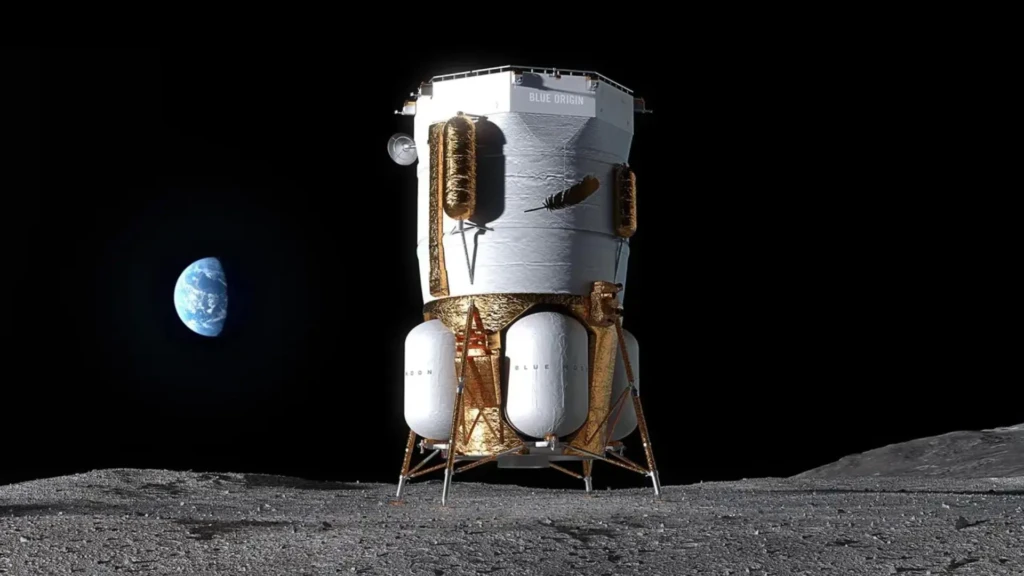
Blue Origin is currently building the Blue Moon Mark 1 lander for NASA that could launch in Q1 of 2026. Under the Pathfinder Mission, Blue Moon will attempt to land in the lunar south pole and validate key technologies before attempting a crewed landing.

According to Blue Origin, this 26.5-feet-tall lander can deliver up to three metric tons anywhere on the lunar surface. Mark 1 is being funded under NASA’s Commercial Lunar Payload Services (CLPS) initiative which enables the agency to send its experimental payloads on private landers. Interestingly, NASA has revived its VIPER rover that will be delivered to the lunar suface by Mark 1.
Mark 1 will be followed by a bigger version Human Landing System (HLS) Blue Moon Mark 2, which NASA has contracted to land astronauts on the Moon under Artemis V in 2029.
The landing missions prior to Artemis V are a responsibility of SpaceX which is developing Starships for the job.
We are currently inching closer to the launch of Artemis II, which is targeted for liftoff no earlier than February 8. It is the first crewed lunar mission since 1972 and involves four astronauts taking a 10-day trip around the Moon.
In 2028, NASA is likely to launch Artemis III which will see humans walk on the Moon for the first time in over five decades. Artemis III has slipped few years beyond scheduled due to slow development of Starship, which had just one fully successful test flight out of five missions in 2025. The mega-rocket is now scheduled to launch in mid-March on its 12th integrated test flight, per Musk, and would see the debut of its bigger version.
ALSO READ: NASA’s Artemis II To Carry Relic Of Humanity’s First Flight And More To The Moon
ALSO READ: Inside Artemis II: How NASA Will Study Astronaut Health And Deep Space Radiation