Blue Terra Journal

  • Home
  • Spaceflight
    SpaceflightShow More
    SpaceX Dragon spacecraft for NASA's Crew-12 mission.
    SpaceX Rolls Out Dragon Spacecraft For NASA’s Crew-12 Mission While Falcon 9 Remains Grounded
    February 4, 2026
    NASA partners with Axiom Space
    NASA And Axiom Space Announce 5th Private Crew Mission To International Space Station In 2027
    February 1, 2026
    Blue Origin Mark 1 lander.
    Blue Origin Halts New Shepard Missions For At Least 2 Years To Land Humans On The Moon
    February 1, 2026
    SpaceX Starship on flight 11.
    SpaceX CEO Elon Musk Reveals When Starship Will Launch On Next Test Flight
    January 29, 2026
    NOAA's SOLAR-1 observatory.
    NOAA’s Sun Spying SOLAR-1 Observatory Reaches Its Destination 1.5 Million Km From Earth
    January 31, 2026
  • Astronomy
    AstronomyShow More
    Voyager 1 illustration
    NASA’s Voyager 1 Will Be One Light-Day Away From Earth In 2026 – What This Means
    January 26, 2026
    Auroras triggered by CMEs.
    Auroras Flood The Night Skies After Largest Solar Radiation Storm In Over 20 Years | Photos
    January 20, 2026
    Hubble discovers Cloud-9.
    Hubble Telescope Uncovers New Object ‘Cloud-9’ – A ‘Failed Galaxy’ With No Stars
    January 13, 2026
    SpaceX launches NASA telescope.
    SpaceX Launches NASA’s Exoplanet Exploring Telescope Pandora On Twilight Mission
    January 19, 2026
    Comet 3I/ATLAS by Hubble telescope
    Comet 3I/ATLAS Is Not An Alien Spacecraft – This Research Likely Confirms It
    January 10, 2026
  • India
    IndiaShow More
    Shubhanshu Shukla aboard the ISS.
    ISRO Astronaut Shubhanshu Shukla Awarded Ashoka Chakra For Heroic Ax-4 Mission
    January 25, 2026
    ISRO's PSLV lifts off to space.
    ISRO’s PSLV Rocket Suffers Third Stage Failure After Successful Liftoff; Payloads Lost
    January 23, 2026
    Dhruva Space team at ISRO facility.
    India’s Dhruva Space To Launch 10 Missions, Including 1st Northeastern Satellite, On ISRO’s PSLV
    January 12, 2026
    ISRO's PSLV rocket
    ISRO To Seek Redemption With PSLV-C62 Mission Launch On January 12
    January 12, 2026
    ISRO SSLV
    ISRO’s SSLV Rocket Just Got Better After Latest Third Stage Test Fire
    December 31, 2025
  • Artemis
    ArtemisShow More
    NASA's Artemis II SLS Rocket
    NASA Delays Artemis II Moon Mission Launch To March – Here’s Why
    February 3, 2026
    NASA's SLS rocket.
    Astronauts In Quarantine, Rocket Powered On – How NASA Is Preparing For Artemis II
    February 3, 2026
    NASA's Artemis II crew
    Inside Artemis II: How NASA Will Study Astronaut Health And Deep Space Radiation
    January 30, 2026
    NASA's SLS rocket at launch pad.
    NASA’s Artemis II To Carry Relic Of Humanity’s First Flight And More To The Moon
    January 27, 2026
    NASA's SLS rocket
    NASA’s SLS Rocket Rolls Out To The Launch Pad For Artemis II – Here’s What’s Next
    January 27, 2026
  • More
    • About
    • Privacy Policy
    • Terms
    • Contact

Blue Terra Journal

  • Home
  • Spaceflight
  • Astronomy
  • India
  • Artemis
Search
  • Pages
    • About
    • Contact
    • Privacy Policy
    • Terms

Home - Spaceflight - NOAA’s Sun Spying SOLAR-1 Observatory Reaches Its Destination 1.5 Million Km From Earth

Spaceflight

NOAA’s Sun Spying SOLAR-1 Observatory Reaches Its Destination 1.5 Million Km From Earth

It's the first NOAA satellite designed for space weather observations.

Harsh Vardhan
Last updated: January 31, 2026 8:07 PM
Harsh Vardhan
Share
4 Min Read
NOAA's SOLAR-1 observatory.
Artist's concept of NOAA's SOLAR-1 observatory. Image: NOAA
SHARE

The Space Weather Follow On – Lagrange 1 or SWFO-L1, built by the US National Oceanic and Atmospheric Administration (NOAA), has arrived at Lagrange Point 1 to keep a watchful eye on the Sun. Launched on September 24, 2025 aboard a SpaceX Falcon 9 rocket, the observatory executed its final engine burn to enter its orbital position at L1 on January 23. Now that it’s at its desired location, SWFO-L1 has been renamed to Space weather Observations at L1 to Advance Readiness-1 (SOLAR-1), the NOAA said in an update.

NOAA’s SWFO-L1 observatory executed its final engine burn, successfully entering its final orbital position at Lagrange point 1 and is now renamed SOLAR-1. Full story at https://t.co/5iSlVTpntd pic.twitter.com/TYB7T9ZOyX

— NOAA Space Weather Prediction Center (@NWSSWPC) January 27, 2026

The Lagrange Point is located 1.5 million kilometres (one million miles) from Earth and it provides a unique vantage point for an uninterrupted view of the Sun. ISRO’s Aditya-L1 solar observatory is also parked at the same spot.

“SOLAR-1, America’s first satellite designed exclusively for continuous, operational space weather observations, represents a major advancement in our defense against solar storms,” stated Greg Marlow, NOAA’s director.

The purpose of NOAA’s SOLAR-1 observatory

SOLAR-1 is designed to serve as an early warning system by continuously monitoring the sun and space weather before it impacts our planet. Using a suite of four instruments, the observatory will make real-time measurements of the solar activity, allowing scientists to take precautionary measures in order to protect critical infrastructure on Earth and in space.
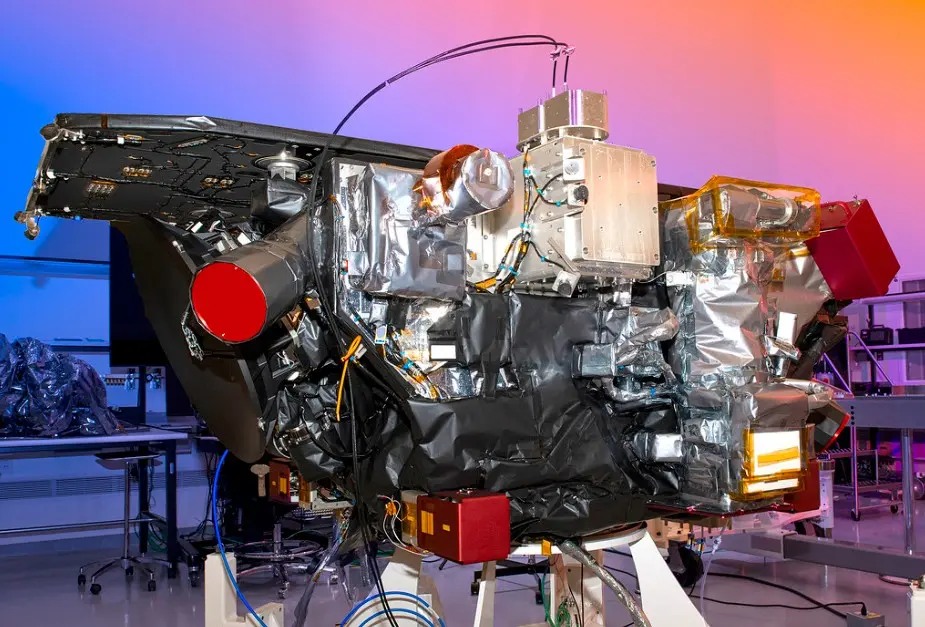
NOAA's SOLAR-1 observatory.
NOAA’s SOLAR-1 observatory. Image: NOAA

The observatory is equipped with a coronagraph to image coronal mass ejection (CME) – expulsion of charged particles from the Sun – along with a Solar Wind Plasma Sensor (SWiPS), SupraThermal Ion Sensor (STIS), and a magnetometer (MAG). According to NOAA, SOLAR-1 will send data to Earth without interruption allowing infrastructure operators adequate time to act. The coronagraph will be able to send CME imagery within 30 minutes of acquisition as opposed to the NASA Solar and Heliospheric Observatory (SOHO) which takes up to eight hours.

SOLAR-1 is the first of a series of advanced observatories that are being built for space weathering monitoring. It has a designed mission life of five years but the fuel efficient operation at L1, which is also gravitationally stable, might extend its lifespan by several more years.

“The SOLAR-1 spacecraft is going to be an impressive new tool in our arsenal for space weather monitoring and prediction — not only for our nation, but the entire world — because space weather is a global concern,” said Shawn Dahl, Service Coordinator at NOAA’s Space Weather Prediction Center (SWPC).

ALSO READ: How Do Auroras Form? Science Behind This Colourful Cosmic Phenomenon

ALSO READ: Auroras Flood The Night Skies After Largest Solar Radiation Storm In Over 20 Years | Photos

TAGGED:Lagrange PointNOAASOLAR-1Sun
Share This Article
Facebook Pinterest Whatsapp Whatsapp LinkedIn Copy Link Print

Latest News

SpaceX Dragon spacecraft for NASA's Crew-12 mission.
SpaceX Rolls Out Dragon Spacecraft For NASA’s Crew-12 Mission While Falcon 9 Remains Grounded
Spaceflight
NASA's Artemis II SLS Rocket
NASA Delays Artemis II Moon Mission Launch To March – Here’s Why
Artemis
NASA's SLS rocket.
Astronauts In Quarantine, Rocket Powered On – How NASA Is Preparing For Artemis II
Artemis
NASA partners with Axiom Space
NASA And Axiom Space Announce 5th Private Crew Mission To International Space Station In 2027
Spaceflight

You Might Also Like

Mars NASA ISRO
Spaceflight

From Moon & Mars Missions To Starship Flights, A Recap Of 2025’s Biggest Spaceflight Moments

January 8, 2026
Auroras triggered by CMEs.
Astronomy

Auroras Flood The Night Skies After Largest Solar Radiation Storm In Over 20 Years | Photos

January 20, 2026
Elon Musk SpaceX
Spaceflight

Elon Musk Says Tesla’s Optimus Will Be A Von Neumann Probe. What Does It Mean?

November 30, 2025
Blue Origin NS-37 mission
Spaceflight

Blue Origin Scrubs NS-37 Crew Mission A Minute Before Launch Due To Anomaly

December 19, 2025
© 2026, Blue Terra Journal
  • About
  • Privacy Policy
  • Terms
  • Contact
Welcome Back!

Sign in to your account

Username or Email Address
Password

Lost your password?