Blue Terra Journal

  • Home
  • Spaceflight
    SpaceflightShow More
    SpaceX Dragon spacecraft for NASA's Crew-12 mission.
    SpaceX Rolls Out Dragon Spacecraft For NASA’s Crew-12 Mission While Falcon 9 Remains Grounded
    February 4, 2026
    NASA partners with Axiom Space
    NASA And Axiom Space Announce 5th Private Crew Mission To International Space Station In 2027
    February 1, 2026
    Blue Origin Mark 1 lander.
    Blue Origin Halts New Shepard Missions For At Least 2 Years To Land Humans On The Moon
    February 1, 2026
    SpaceX Starship on flight 11.
    SpaceX CEO Elon Musk Reveals When Starship Will Launch On Next Test Flight
    January 29, 2026
    NOAA's SOLAR-1 observatory.
    NOAA’s Sun Spying SOLAR-1 Observatory Reaches Its Destination 1.5 Million Km From Earth
    January 31, 2026
  • Astronomy
    AstronomyShow More
    Voyager 1 illustration
    NASA’s Voyager 1 Will Be One Light-Day Away From Earth In 2026 – What This Means
    January 26, 2026
    Auroras triggered by CMEs.
    Auroras Flood The Night Skies After Largest Solar Radiation Storm In Over 20 Years | Photos
    January 20, 2026
    Hubble discovers Cloud-9.
    Hubble Telescope Uncovers New Object ‘Cloud-9’ – A ‘Failed Galaxy’ With No Stars
    January 13, 2026
    SpaceX launches NASA telescope.
    SpaceX Launches NASA’s Exoplanet Exploring Telescope Pandora On Twilight Mission
    January 19, 2026
    Comet 3I/ATLAS by Hubble telescope
    Comet 3I/ATLAS Is Not An Alien Spacecraft – This Research Likely Confirms It
    January 10, 2026
  • India
    IndiaShow More
    Shubhanshu Shukla aboard the ISS.
    ISRO Astronaut Shubhanshu Shukla Awarded Ashoka Chakra For Heroic Ax-4 Mission
    January 25, 2026
    ISRO's PSLV lifts off to space.
    ISRO’s PSLV Rocket Suffers Third Stage Failure After Successful Liftoff; Payloads Lost
    January 23, 2026
    Dhruva Space team at ISRO facility.
    India’s Dhruva Space To Launch 10 Missions, Including 1st Northeastern Satellite, On ISRO’s PSLV
    January 12, 2026
    ISRO's PSLV rocket
    ISRO To Seek Redemption With PSLV-C62 Mission Launch On January 12
    January 12, 2026
    ISRO SSLV
    ISRO’s SSLV Rocket Just Got Better After Latest Third Stage Test Fire
    December 31, 2025
  • Artemis
    ArtemisShow More
    NASA's Artemis II SLS Rocket
    NASA Delays Artemis II Moon Mission Launch To March – Here’s Why
    February 3, 2026
    NASA's SLS rocket.
    Astronauts In Quarantine, Rocket Powered On – How NASA Is Preparing For Artemis II
    February 3, 2026
    NASA's Artemis II crew
    Inside Artemis II: How NASA Will Study Astronaut Health And Deep Space Radiation
    January 30, 2026
    NASA's SLS rocket at launch pad.
    NASA’s Artemis II To Carry Relic Of Humanity’s First Flight And More To The Moon
    January 27, 2026
    NASA's SLS rocket
    NASA’s SLS Rocket Rolls Out To The Launch Pad For Artemis II – Here’s What’s Next
    January 27, 2026
  • More
    • About
    • Privacy Policy
    • Terms
    • Contact

Blue Terra Journal

  • Home
  • Spaceflight
  • Astronomy
  • India
  • Artemis
Search
  • Pages
    • About
    • Contact
    • Privacy Policy
    • Terms

Home - Astronomy - Hubble Telescope Uncovers New Object ‘Cloud-9’ – A ‘Failed Galaxy’ With No Stars

Astronomy

Hubble Telescope Uncovers New Object ‘Cloud-9’ – A ‘Failed Galaxy’ With No Stars

"This is a tale of a failed galaxy."

Harsh Vardhan
Last updated: January 13, 2026 10:22 PM
Harsh Vardhan
Share
4 Min Read
Hubble discovers Cloud-9.
Hubble has confirmed that this object lacks stars. Image: NASA/ESA
SHARE

The Hubble telescope has revealed what a “failed galaxy” looks like. According to the European Space Agency (ESA), it has confirmed the existence of an object – a starless cloud of gas dominated by dark-matter. Nicknamed ‘Cloud-9’ it’s being considered a remnant of early galaxy formation and this makes it the first confirmed detection of such an object. The findings were reported by a team of scientists in The Astrophysical Journal Letters last week.

🆕 New astronomical object just dropped!

This starless, dark-matter-dominated cloud, nicknamed ‘Cloud-9’, is the first such object seen in the Universe. 1/3 pic.twitter.com/BV0gr1H0Ae

— HUBBLE (@HUBBLE_space) January 5, 2026

“This is a tale of a failed galaxy,” Alejandro Benitez-Llambay of the Milano-Bicocca University in Milan, said in a statement. “It tells us that we have found in the local Universe a primordial building block of a galaxy that hasn’t formed.”

This cloud, located 14 million-light years away, has been officially named Reionization-Limited H I Cloud or ‘RELHIC’ which was thought to be a faint dwarf galaxy. Its core is composed of neutral hydrogen with a mass equivalent to one million Suns and it’s about 4,900 light-years in diameter. Scientists think Cloud-9 is dominated by dark matter equivalent to about five billion solar masses.

Hubble telescope substantiates Cloud-9 findings

According to ESA, the starless relic was discovered three years ago by the Five-hundred-meter Aperture Spherical Telescope (FAST) in Guizhou, China, and follow-up observations by the US-based Green Bank Telescope and the Very Large Array facilities revealed more about it. However, the lack of stars wasn’t confirmed until scientists turned Hubble’s Advanced Camera for Surveys (ACS) towards it.

Hubble telescope confirmed lack of stars in Cloud-9.
The colour magenta represents radio data collected by Very Large Array and dashed circle represents peak radio emission from the cloud. Image: NASA, ESA. G. Anand (STScI), and A. Benitez-Llambay (Univ. of Milan-Bicocca)

Objects like REHLIC are dark matter clouds that failed to accumulate enough gas to form stars. Since there are no stars, there are no elements that would give birth to other objects like planets and asteroids.
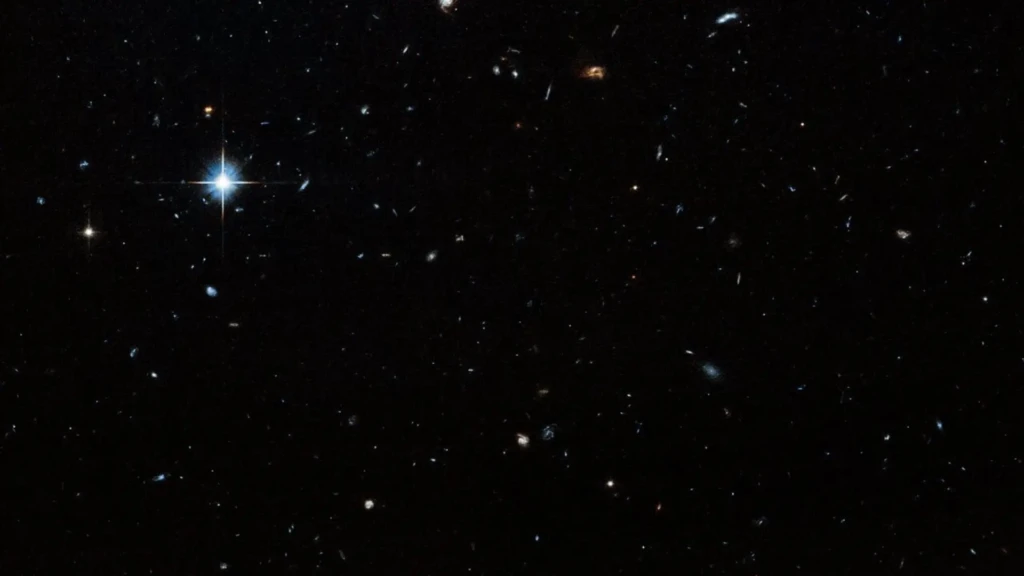
Hubble's view of Cloud-9.
Cloud-9 captured in visible light by Hubble’s ACS. Image: NASA, ESA. G. Anand (STScI), and A. Benitez-Llambay (Univ. of Milan-Bicocca)

“We know from theory that most of the mass in the Universe is expected to be dark matter, but it’s difficult to detect this dark material because it doesn’t emit light. Cloud-9 gives us a rare look at a dark-matter-dominated cloud,” researcher Andrew Fox of AURA/STScI for the ESA explained.

Cloud-9 was discovered on the outskirts of a nearby spiral galaxy, Messier 94 (M94) and gas distortions suggest that the two are bound gravitationally. Astronomers have found several hydrogen clouds near the Milky Way galaxy and they seem to be bigger and more irregular. Cloud-9, on the other hand, is smaller, more compact and highly spherical.

Researchers believe there’s still a chance that Cloud-9 could evolve into a full fledged galaxy. It seems to be at a ‘sweet spot’ because if the mass had grown over five billion solar masses, the gases would have collapsed, forming stars and eventually taking the form of galaxies and if it was smaller, the gases could have dispersed and ionised before eventually fading away.

ALSO READ: Comet 3I/ATLAS Is Not An Alien Spacecraft – This Research Likely Confirms It

ALSO READ: NASA Releases Insane Cosmic Map Made By Its Brand New SPHEREx Telescope
TAGGED:Cloud-9Dark matterESAHubble telescopeNASA
Share This Article
Facebook Pinterest Whatsapp Whatsapp LinkedIn Copy Link Print

Latest News

SpaceX Dragon spacecraft for NASA's Crew-12 mission.
SpaceX Rolls Out Dragon Spacecraft For NASA’s Crew-12 Mission While Falcon 9 Remains Grounded
Spaceflight
NASA's Artemis II SLS Rocket
NASA Delays Artemis II Moon Mission Launch To March – Here’s Why
Artemis
NASA's SLS rocket.
Astronauts In Quarantine, Rocket Powered On – How NASA Is Preparing For Artemis II
Artemis
NASA partners with Axiom Space
NASA And Axiom Space Announce 5th Private Crew Mission To International Space Station In 2027
Spaceflight

You Might Also Like

image 14 1
Astronomy

ESA’s Euclid Telescope Spies Nebula Birthing Stars 1,300 Light-Years Away

November 7, 2025
NASA's Crew-11 astronauts.
Spaceflight

NASA Crew-11 Evacuation LIVE: Watch Four Astronauts Depart From The ISS On Jan. 15

January 17, 2026
Auroras triggered by CMEs.
Astronomy

Auroras Flood The Night Skies After Largest Solar Radiation Storm In Over 20 Years | Photos

January 20, 2026
NASA Artemis 2
Artemis

NASA Stacks Artemis 2 Spacecraft On Moon Rocket; Here’s What’s Next

December 4, 2025
© 2026, Blue Terra Journal
  • About
  • Privacy Policy
  • Terms
  • Contact
Welcome Back!

Sign in to your account

Username or Email Address
Password

Lost your password?