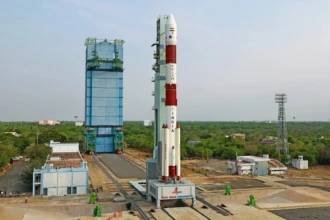
Indian startup Dhruva Space is gearing up for its biggest space mission to date. The Hyderabad-based firm will launch 10 missions from six Indian states and two countries on ISRO‘s PSLV rocket which is scheduled to liftoff at 10:17 am IST on January 12. Also called the PSLV-C62 mission, the rocket will carry the Earth observation satellite EOS-N1 as the primary payload.
10 missions. 6 Indian States. 2 Nations.
Polar Access-1. 10:17am IST. 12.01.2026.To orbit we go, aboard #ISRO PSLV-C62.
👉🏽 Read more: https://t.co/rhHdpLXbEk pic.twitter.com/rxl8Pg7Tds
— Dhruva Space (@DhruvaSpace) January 9, 2026
Named Polar Access-1 (PA-1) mission, it includes four satellites, five separation systems to release the satellites in orbit and multiple operational ground stations that will collectively support disaster communication, environmental monitoring, education, and commercial Earth Observation from a Sun-Synchronous Orbit.
Among the 15 passenger payloads in total is the first satellite from the northeast region built by the Assam Don Bosco University.
Payloads of Dhruva Space’s PA-1 mission
Among the four satellites is CGUSAT-1 – Odisha’s first satellite mission developed by CV Raman Global University to support disaster response. Bengaluru’s Dayananda Sagar University has contributed the DSAT-1 satellite which focuses on two-way amateur-band communications and telemetry. Also part of the mission is the LACHIT-1 satellite, the first to represent India’s northeast region. It was delivered under Dhruva Space’s Accelerated Space Technology Readiness & Access or ASTRA programme focusing on “building long-term state-level space tech capabilities.”

The fourth and final satellite is THYBOLT-3 – Dhruva Space’s own mission demonstrating a satellite-enabled disaster communication network using amateur radio architecture. “CGUSAT-1, DSAT-1, LACHIT-1, and THYBOLT-3 will be accessible to the global amateur radio community, enabling licensed amateur operators across the globe to participate in satellite communications and experimentation,” the company said in a statement.
Other than the satellites, PA-1 is supporting other spacecraft missions like the Chennai-based OrbitAID Aerospace’s patented Standard Interface for Docking and Refuelling Port (SIDRP) for on-orbit refuelling operations. Dhruva Space will provide tracking, telemetry, and data downlink via their Ground-Station-as-a-Service (GSaaS).
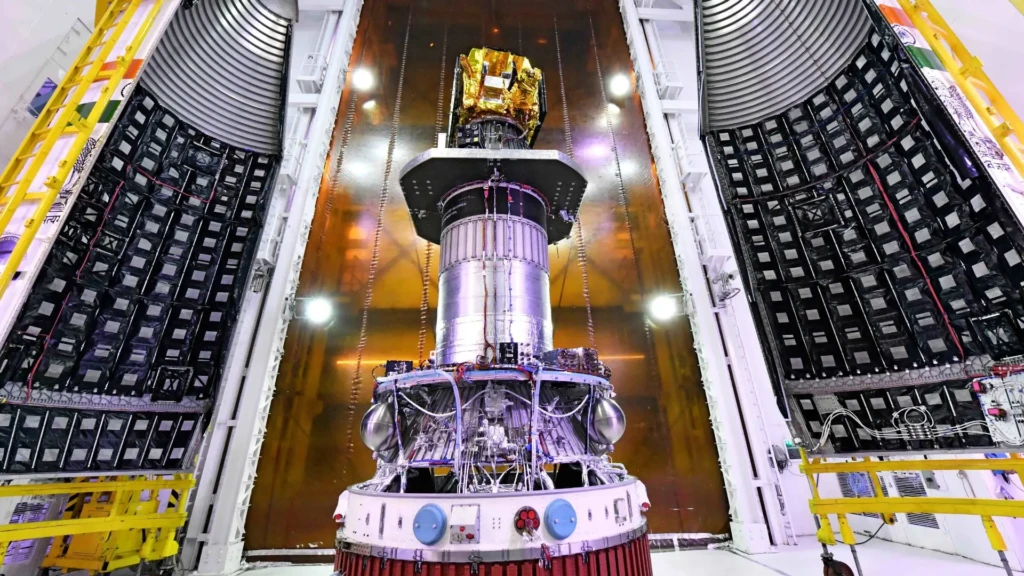

Also aboard is a technology-demonstration satellite developed for the Laxman Gyanpith School by Ahmedabad-based firm CubeSat Aerospace. This tiny satellite features an LED payload that will simulate an ‘artificial star’ visible from Ahmedabad.
The PSLV rocket will also carry KID or Kestrel Initial Technology Demonstrator – a small-scale prototype of a re-entry vehicle built by Spain’s Orbital Paradigm. “The KID will be the last co-passenger to be injected, after which it is slated to re-enter the earth’s atmosphere towards splashdown in the South Pacific Ocean,” ISRO said. The one foreign payload is a satellite developed by the Nepal Academy of Science and Technology and Antarikchya Pratishan Nepal focusing on vegetation density mapping for environmental monitoring.
Another satellite not associated with PA-1 is the MOI-1, an AI-powered satellite built by Hyderabad -based startups TakeMe2Space and EON Space Labs to demonstrate Earth-imaging capabilities.
The upcoming mission will mark the PSLV rocket’s 64th flight on the ninth commercial mission undertaken by ISRO’s commercial arm NewSpace India Limited (NSIL). PSLV has previously supported missions like Chandrayaan-1, Mangalyaan (Mars Orbiter Mission), Aditya-L1 and the Astrosat. In 2017, it launched a record-setting 104 satellites on a single mission.
ALSO READ: ISRO To Seek Redemption With PSLV-C62 Mission Launch On January 12
ALSO READ: ISRO’s LVM3 Rocket Launches Heaviest Satellite Ever From Indian Soil; Watch