Blue Terra Journal

  • Home
  • Spaceflight
    SpaceflightShow More
    SpaceX Starship
    SpaceX Starship’s 12th Test Flight Targeted On May 20; No Booster Catch This Time
    May 13, 2026
    SpaceX's Starship during launch rehearsal.
    SpaceX Completes Starship’s Launch Rehearsal For Flight 12 This Week; What To Expect?
    May 13, 2026
    China US rivalry reach new heights.
    ‘Rival’ China Is Unintentionally The Biggest Motivator For NASA’s Moon Ambitions
    April 28, 2026
    NASA Voyager 1 illustration
    NASA Shuts Down Another Voyager 1 Instrument; How Long Can This Spacecraft Last?
    April 22, 2026
    NASA's SR-1 Freedom spacecraft.
    What Is NASA’s SR-1 Freedom Mission? The First Nuclear Reactor In Space Explained
    March 27, 2026
  • Astronomy
    AstronomyShow More
    Artist's impression of NASA's Psyche spacecraft.
    NASA’s Psyche Spacecraft Will Zoom Past Mars Today On Its Way To Metal-Rich Asteroid
    May 15, 2026
    Comet MAPS image
    Video: Comet MAPS destroyed after plunging into the Sun; event caught by NASA missions
    April 18, 2026
    Apophis asteroid flyby
    ‘God Of Chaos’: Apophis Asteroid Will Fly Dangerously Close To Earth Exactly 5 Years From Now
    April 14, 2026
    Meteor spotted over Houston.
    Video Captures 1-Ton Meteor Exploding Over Houston Skies, NASA Releases Statement
    March 22, 2026
    NASA black hole simulation
    Fall Into A Black Hole With This Incredibly Scary Simulation Made By NASA
    March 18, 2026
  • India
    IndiaShow More
    Shubhanshu Shukla aboard the ISS.
    ISRO Astronaut Shubhanshu Shukla Awarded Ashoka Chakra For Heroic Ax-4 Mission
    February 9, 2026
    ISRO's PSLV lifts off to space.
    ISRO’s PSLV Rocket Suffers Third Stage Failure After Successful Liftoff; Payloads Lost
    January 23, 2026
    Dhruva Space team at ISRO facility.
    India’s Dhruva Space To Launch 10 Missions, Including 1st Northeastern Satellite, On ISRO’s PSLV
    January 12, 2026
    ISRO's PSLV rocket
    ISRO To Seek Redemption With PSLV-C62 Mission Launch On January 12
    January 12, 2026
    ISRO SSLV
    ISRO’s SSLV Rocket Just Got Better After Latest Third Stage Test Fire
    December 31, 2025
  • Artemis
    ArtemisShow More
    NASA Artemis II mission
    Welcome Home! NASA’s Artemis II Astronauts Are Back After Historic Moon Voyage
    April 22, 2026
    NASA Artemis II iPhone image
    iPhones Reigned Supreme On NASA’s Artemis II Moon Mission
    April 10, 2026
    Artemis II NASA
    All Eyes On Scary Artemis II Reentry As NASA Moon Mission Nears Completion
    April 9, 2026
    NASA Artemis II
    NASA Artemis II Crew Names Moon Crater ‘Carroll’ After Commander Reid Wiseman’s Late Wife
    April 7, 2026
    NASA Artemis II
    Watch: NASA Artemis II Astronauts Begin Flyby Of Moon’s Far Side For The First Time Ever
    April 9, 2026
  • More
    • About
    • Privacy Policy
    • Terms
    • Contact

Blue Terra Journal

  • Home
  • Spaceflight
  • Astronomy
  • India
  • Artemis
Search
  • Pages
    • About
    • Contact
    • Privacy Policy
    • Terms

Home - Astronomy - Comet 3I/ATLAS Will Get Closest To Earth On Dec 19 – Here’s What You Must Know

Astronomy

Comet 3I/ATLAS Will Get Closest To Earth On Dec 19 – Here’s What You Must Know

The comet will be 270 million km from Earth at its closest distance.

Harsh Vardhan
Last updated: December 20, 2025 8:32 PM
Harsh Vardhan
Share
5 Min Read
Comet 3I/ATLAS NASA Avi Loeb
Comet 3I/ATLAS captured post perihelion. Image: GeminiObs/NOIRLab/NSF/AURA/B. Bolin
SHARE

Contents
  • Comet 3I/ATLAS and its mysteries
  • Why study comet 3I/ATLAS?

The interstellar comet 3I/ATLAS is heading out of the inner solar system and is set to make its closest approach to Earth this week. According to the European Space Agency (ESA), the comet will be at around 270 million kilometres from Earth on December 19, offering scientists a closer look at its puzzling characteristics. 3I/ATLAS was discovered by the NASA-funded ATLAS (Asteroid Terrestrial-impact Last Alert System) survey telescope in Rio Hurtado, Chile on July 1.

Comet 3I/ATLAS
Comet 3I/ATLAS captured by Hubble telescope. Image: NASA

It soon became the third confirmed interstellar object to visit our solar system when astronomers calculated its extreme hyperbolic trajectory. Here’s all you need to know about this strange visitor.

Comet 3I/ATLAS and its mysteries

While NASA confirmed last month that 3I/ATLAS is indeed a comet and not a potential alien spacecraft (as suggested by Harvard scientist Avi Loeb), its characteristics are unusual. For one, it lacks a visible, millions of kilometres long tail in several pictures, which has led many to suspect that the comet may have an extraterrestrial origin. Besides, spectroscopic observations initially revealed that 3I/ATLAS had a higher nickel content than iron, unlike other comets, and a high nickel-to-cyanide ratio.

Dr. Cyrielle Opitom, astronomer at Scotland’s University of Edinburgh, who has published many papers on 3I/ATLAS based on observations of the European Southern Observatory’s (ESO) Very Large Telescope, explains in the video below that high nickel emission from the comet was “very surprising.”

Scientists determine the chemical makeup of a comet through spectroscopic data. Spectroscopy is the method of studying light that materials emit, absorb, transmit, or reflect. Light beams carry information (like a barcode) about the regions they’ve emerged from and areas they’ve travelled through. By analysing the ‘spectra’ or different wavelengths of light, spectroscopes can reveal what things are made of, how hot they are, how dense they are, and how fast they are moving in space.

Comet 3I/ATLAS
Comet 3I/ATLAS captured in X-ray by ESA’s XMM-Newton telescope. Image: ESA

Comet 3I/ATLAS has an icy nucleus few metres to a few kilometres wide, like all comets do, and has a cloud of gas and dust around the nucleus called the coma. Interestingly, spectroscopic measurements revealed that the comet’s composition changed as expected after it reached closest point to the Sun (perihelion) on October 29. Astrophysicist Suzanna Randall from the ESO says that its iron to nickel ratio is now similar to solar system comets.
Comet 3I/ATLAS
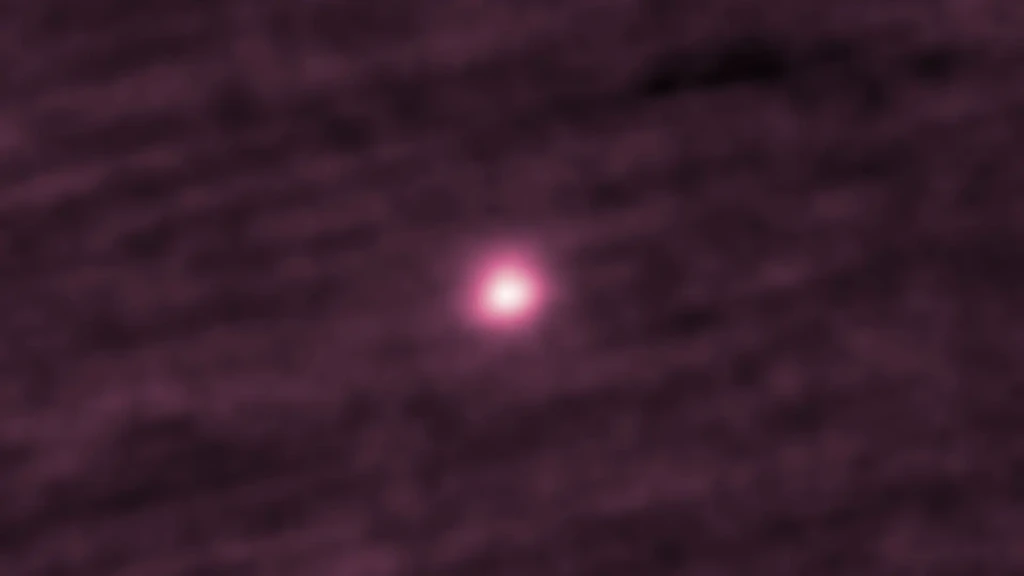
Comet 3I/ATLAS photographed by STEREO-A telescope. Image: NASA

Another ‘anomaly’ highlighted by Loeb, was the comet’s unusual brightness after perihelion. This bolstered the theory of 3I/ATLAS being an alien spaceship. Opitom said that this is usual for comets that either undergo an explosion in the nucleus or fragmentation.

An ‘anti-tail’ was also cited as an anomaly, as a result of material spewing in the direction of the Sun. Loeb published a blog on the anti-tail today, saying it has grown longer than the distance between Earth and the Moon. According to Opitom, anti-tail forms because the radiation pressure from the Sun may not be strong enough to push large materials behind the comet.

ALSO READ: ESA Drops Surprise Preview Of Comet 3I/ATLAS Images From JUICE Spacecraft

Why study comet 3I/ATLAS?

Comets like 3I/ATLAS, especially the interstellar ones, carry information about other star systems. ESA says that 3I/ATLAS might be billions of years old, possibly older than our solar system, and its analysis could reveal what environments it was formed in.

There are two other comets – 1I/Oumuamua and 2I/Borisov – that visited our solar system in 2017 and 2019, respectively but none are being studied as extensively as 3I/ATLAS. Notably, Loeb had posited that Oumuamua may also be an alien spacecraft, but it wasn’t.

Meanwhile, NASA and ESA along with other institutions are preparing to point there telescopes to get a better look at 3I/ATLAS. The former recently released pictures taken by numerous spacecraft and space telescopes.

ALSO READ: Interstellar Comet 3I/ATLAS Captured In Ghostly X-ray Image By ESA Telescope

TAGGED:Comet 3I/ATLASESANASASpace
Share This Article
Facebook Pinterest Whatsapp Whatsapp LinkedIn Copy Link Print

Latest News

Artist's impression of NASA's Psyche spacecraft.
NASA’s Psyche Spacecraft Will Zoom Past Mars Today On Its Way To Metal-Rich Asteroid
Astronomy
SpaceX Starship
SpaceX Starship’s 12th Test Flight Targeted On May 20; No Booster Catch This Time
Spaceflight
SpaceX's Starship during launch rehearsal.
SpaceX Completes Starship’s Launch Rehearsal For Flight 12 This Week; What To Expect?
Spaceflight
China US rivalry reach new heights.
‘Rival’ China Is Unintentionally The Biggest Motivator For NASA’s Moon Ambitions
Spaceflight

You Might Also Like

SpaceX Dragon spacecraft.
Spaceflight

SpaceX Dragon Spacecraft Splashes Down With NASA’s Crew-11 Astronauts

January 17, 2026
Blue Origin NS-37 mission
Spaceflight

Blue Origin’s New Shepard Director Replaces NS-38 Mission Crew Member After He Falls Sick

January 21, 2026
Hubble discovers Cloud-9.
Astronomy

Hubble Telescope Uncovers New Object ‘Cloud-9’ – A ‘Failed Galaxy’ With No Stars

January 13, 2026
Comet 3I/ATLAS
Astronomy

Comet 3I/ATLAS May Have Broken Into 16 Or More Pieces, Says Scientist

November 17, 2025
© 2026, Blue Terra Journal
  • About
  • Privacy Policy
  • Terms
  • Contact
Welcome Back!

Sign in to your account

Username or Email Address
Password

Lost your password?