NASA’s James Webb Space Telescope has broken its own record of discovering the oldest supernova ever. The world’s most powerful observatory has confirmed that a bright flash of light detected in March indeed came from a massive exploding star.
When a star at least five times more massive than the Sun reach the end of its life, it runs out of fuel and collapses under its own weight within seconds. This collapse creates enormous shock waves, causing the outer part of the star to explode, creating a supernova.
🆕 Webb has spotted the earliest supernova yet! 💥
After a bright flash of light (a gamma-ray burst) was detected by the SVOM mission in March, Webb was brought onto the case to investigate. It quickly confirmed that it came from the explosive death of a massive star ⭐☠️ This… pic.twitter.com/uu1Z3UXKhT
— ESA Webb Telescope (@ESA_Webb) December 9, 2025
In the study published in the journal Astronomy & Astrophysics, scientists said that the supernova confirmed by Webb occurred nearly 13 billion years ago, when the universe was just 730 million years old. The last earliest known supernova occurred 1.8 billion years after the big bang. They also noted that this supernova was accompanied by a gamma-ray burst (GRB) – the rare, energetic jet of gamma radiation – that signalled the explosion.
Webb telescope’s rare discovery
“There are only a handful of gamma-ray bursts in the last 50 years that have been detected in the first billion years of the Universe,” Andrew Levan, lead author and professor at Netherlands’ Radboud University, said in a statement. “This particular event is very rare and very exciting.”
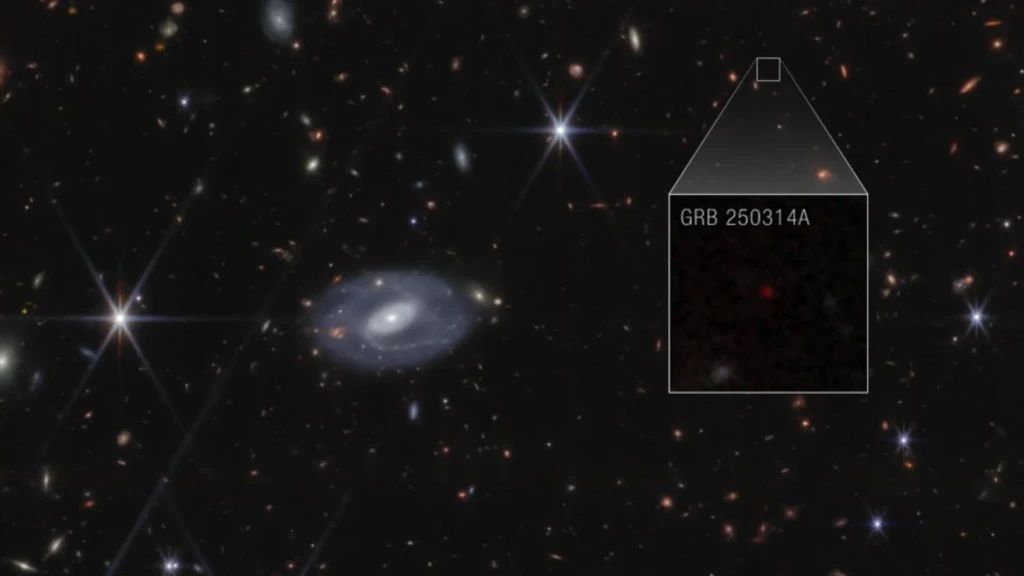
Gamma ray-bursts are hard to detect because they last only a few seconds. The recent one designated GRB 250314A was a burst that lasted 10 seconds, scientists said. Longer bursts are frequently linked to explosion of massive stars.
According to the European Space Agency (ESA), which built the Webb telescope alongside NASA, the supernova discovery resulted from a confluence of multiple observatories. The GRB was first noticed on March 14 by Space-based multi-band astronomical Variable Objects Monitor (SVOM) mission. Using NASA’s Neil Gehrels Swift Observatory, astronomers then pinpointed its location in the sky. Few hours later, the Nordin Optical Telescope in Spain revealed an infrared-light GRB afterglow, which associated it with a distant object, allowing the European Southern Observatory’s Very Large Telescope to estimate that the star (that went supernova) existed 730 million years after the universe was born.
ALSO READ: ESA’s Euclid Telescope Spies Nebula Birthing Stars 1,300 Light-Years Away
“Only Webb could directly show that this light is from a supernova – a collapsing massive star,” said Levan who later led the research team using Webb. “This observation also demonstrates that we can use Webb to find individual stars when the Universe was only 5% of its current age.“
Discovery suprises scientists
The supernova discovery was surprising because it was very similar to a modern, nearby supernovae they compared it to. Since very little is known about the first billion years of the universe, scientists can only speculate what it must have been like. “We went in with open minds,” said co-author Nial Tanvir. “And lo and behold, Webb showed that this supernova looks exactly like modern supernovae.” What’s even more interesting, is that Webb was able to locate the supernova’s host galaxy as well. This distant galaxy is also similar to other galaxies that existed at the same time, the telescope revealed.
Levan and team have received approval to observe more GRBs emitted by early universe objects using the Webb telescope. Their observation is likely to reveal a lot about the star which may have exploded when the universe lacked heavy elements.
ALSO READ: Alaknanda: Why This Ancient Spiral Galaxy’s Discovery By Indian Scientists Matters