Blue Terra Journal

  • Home
  • Spaceflight
    SpaceflightShow More
    NASA's SR-1 Freedom spacecraft.
    What Is NASA’s SR-1 Freedom Mission? The First Nuclear Reactor In Space Explained
    March 27, 2026
    Artist's impression of a NASA Moon base.
    NASA Moon Base: How The US Will Spend $20 Billion On This Ambitious Project
    March 25, 2026
    Russia's Soyuz rocket ascending to space.
    Russia’s Progress Spacecraft Suffers Mystery Glitch On Its Way To ISS; What Happened?
    March 23, 2026
    Robert Goddard
    Celebrating Robert Goddard – The Man Who Changed Rocketry 100 Years Ago
    March 17, 2026
    International Space Station gets extension to beat China
    Watch Out China! US Proposes Extending International Space Station Lifespan To 2032
    March 10, 2026
  • Astronomy
    AstronomyShow More
    Meteor spotted over Houston.
    Video Captures 1-Ton Meteor Exploding Over Houston Skies, NASA Releases Statement
    March 22, 2026
    NASA black hole simulation
    Fall Into A Black Hole With This Incredibly Scary Simulation Made By NASA
    March 18, 2026
    Comet C/2026 A1 MAPS
    Comet C/2026 A1 MAPS: What Are ‘Sun-Grazer’ Comets And Why Are They Special?
    March 12, 2026
    Moon is safe from asteroid 2024 YR4.
    The Moon Is Safe! James Webb Space Telescope Rules Out Asteroid 2024 YR4’s Collision
    March 6, 2026
    NASA Moon orbiter
    NASA Prepares To Save Its Orbiter During Total Solar Eclipse On The Moon
    March 3, 2026
  • India
    IndiaShow More
    Shubhanshu Shukla aboard the ISS.
    ISRO Astronaut Shubhanshu Shukla Awarded Ashoka Chakra For Heroic Ax-4 Mission
    February 9, 2026
    ISRO's PSLV lifts off to space.
    ISRO’s PSLV Rocket Suffers Third Stage Failure After Successful Liftoff; Payloads Lost
    January 23, 2026
    Dhruva Space team at ISRO facility.
    India’s Dhruva Space To Launch 10 Missions, Including 1st Northeastern Satellite, On ISRO’s PSLV
    January 12, 2026
    ISRO's PSLV rocket
    ISRO To Seek Redemption With PSLV-C62 Mission Launch On January 12
    January 12, 2026
    ISRO SSLV
    ISRO’s SSLV Rocket Just Got Better After Latest Third Stage Test Fire
    December 31, 2025
  • Artemis
    ArtemisShow More
    NASA Artemis II crew
    NASA’s Christina Koch Turns ‘Space Plumber’ To Fix $30 Million Toilet On Artemis II Mission
    April 3, 2026
    NASA Orion spacecraft
    NASA’s Artemis II Astronauts Are Moon-Bound After Successful Trans-Lunar Injection Burn
    April 3, 2026
    NASA Artemis II lifts off.
    Artemis II Lifts Off! NASA Launches 4 Astronauts To The Moon After Over 50 Years
    April 2, 2026
    NASA's Artemis II astronauts
    NASA Artemis II Launch Live: Watch Humanity Return To The Moon On April 2
    April 2, 2026
    NASA Apollo 8 image
    NASA Artemis II: Why This Moon Mission Is Our Generation’s Apollo 8
    March 30, 2026
  • More
    • About
    • Privacy Policy
    • Terms
    • Contact

Blue Terra Journal

  • Home
  • Spaceflight
  • Astronomy
  • India
  • Artemis
Search
  • Pages
    • About
    • Contact
    • Privacy Policy
    • Terms

Home - Astronomy - What is ‘Gravitational Lensing’ That Made Alaknanda Galaxy’s Discovery Possible?

Astronomy

What is ‘Gravitational Lensing’ That Made Alaknanda Galaxy’s Discovery Possible?

This galaxy was born over 12 billion years ago.

Harsh Vardhan
Last updated: December 18, 2025 10:51 PM
Harsh Vardhan
Share
5 Min Read
Alaknanda galaxy gravitational lensing
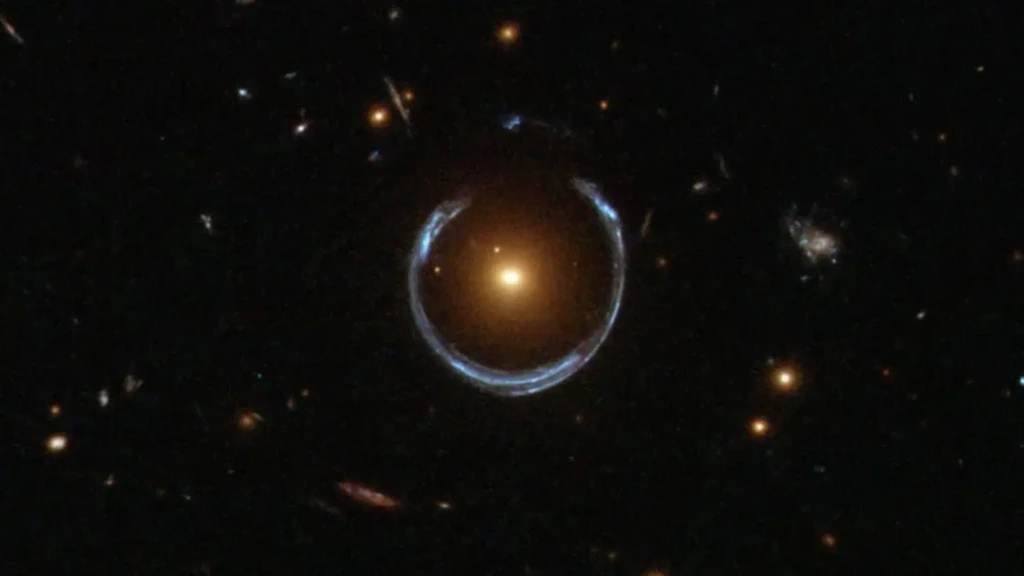
The blue horseshoe galaxy magnified and distorted due to gravitational lensing. Image: NASA
SHARE

Contents
  • What is gravitational lensing?
  • The Alaknanda galaxy

Two researchers at Pune’s National Centre for Radio Astrophysics (NCRA) in India have discovered a “galaxy deemed impossible by the current understanding of galaxy formation.” Named Alaknanda after a Himalayan river, this galaxy was born when the universe was just 1.5 billion years old, making it one of the oldest spiral galaxies ever found.

JWST has discovered a remarkably mature spiral galaxy named Alaknanda in the early Universe The James Webb Space Telescope has spotted a grand-design spiral galaxy (officially A2744-QSO1, nicknamed Alaknanda) with two clearly defined arms — observed when the Universe was only… pic.twitter.com/3qbRlTeXhw

— Black Hole (@konstructivizm) December 5, 2025

Researchers Rashi Jain and Yogesh Wadadekar spotted it while studying a data set by the James Webb Space Telescope of a galaxy cluster named Abell 2744. In the paper published in the journal Astronomy & Astrophysics, the researchers revealed that Alaknanda was detected through gravitational lensing, a phenomenon in which gravity warps spacetime and bends light emerging from background objects.

What is gravitational lensing?

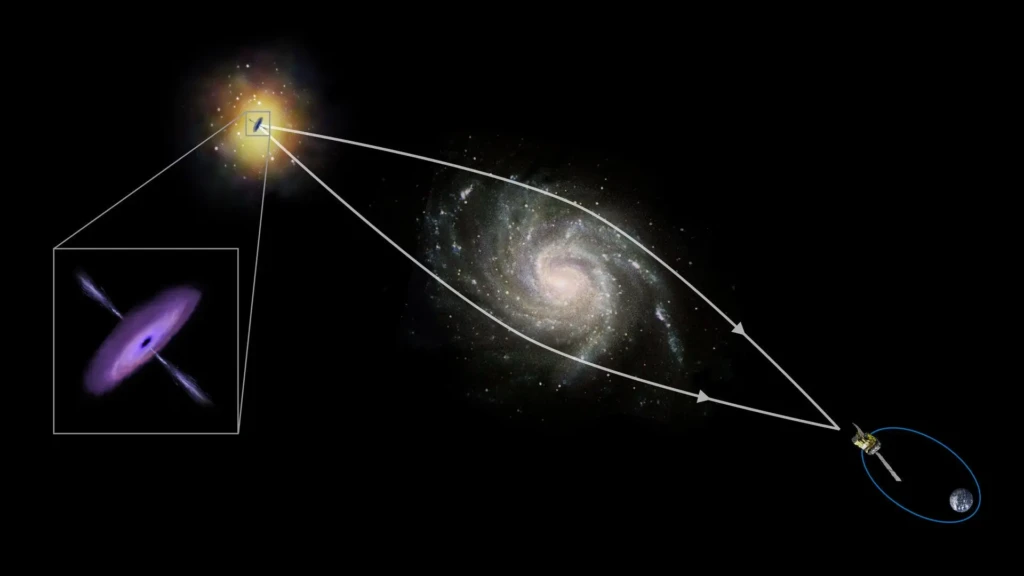
Gravitational lensing occurs when a massive celestial body warps spacetime, which causes the light moving around it to bend, like a lens does. Einstein’s general theory of relativity, which fuses time and space, states that gravity is simply the curvature of spacetime, not a pulling force.
Alaknanda galaxy
Visual representation of gravitational lensing. Image: ESA

The most popular analogy of this theory is imagining a heavy metal ball placed on a stretched rubber sheet. The ball causes a dip in the sheet creating a curved surface. If you roll a few marbles on this rubber sheet, they would follow the curved path created by the ball. This is exactly how the planets in our solar system orbit the Sun. The Sun is the ball, space is the rubber sheet and planets are the marbles. 

According to the relativity theory, planets orbit stars because the fabric of space around the star is curved, and even light travelling through this path bends along the way.

Alaknanda galaxy gravitational lensing
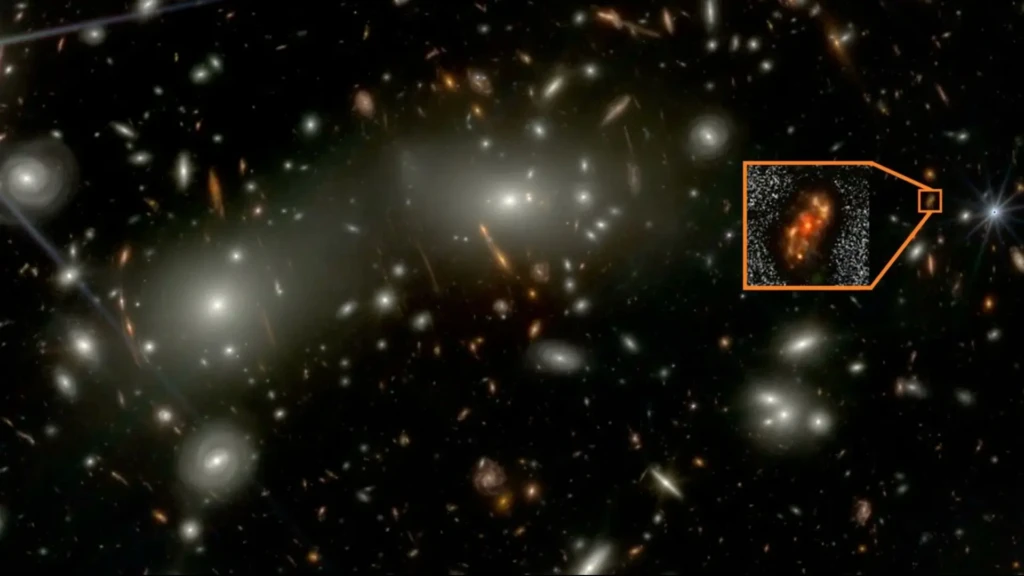
Due to gravitational lensing, background galaxies appear elongated, curved and magnified. Image: ESA

 Gravitational lensing is theory of relativity in action. Galaxy clusters like Abell 2744, whose gravitation is unimaginably strong, significantly warp spacetime. In the process, they act as gravitational lenses and path of light from objects behind them gets curved, producing a stretched or distorted image of the distant objects. But the most valuable consequence of this lensing is magnification.

The distortion of light by a massive foreground object causes the object in the background, which otherwise would be too far and too faint to be seen, appear larger and nearer than they actually are. In Alaknanda’s case, the Abell cluster acted as a cosmic magnifying glass that unveiled the obscure galaxy.

The Alaknanda galaxy

The study authors noted in their paper that the Alaknanda galaxy spans 33,000 light-years across and has two spiral arms, which is surprising for a galaxy born just 1.5 billion years after the big bang.
Alaknanda galaxy
The Alaknanda spiral galaxy. Image: NASA/ESA/CSA/CASR- Rashi Jain, Yogesh Wadadekar

Its star forming regions have a “beads on a string” pattern and the galaxy weighs 10 billion solar masses, again, unusual for a young galaxy. Scientists also found that Alaknanda is forming stars at a rate of around 60 suns per year, far greater than the Milky Way’s current rate.

The finding challenges the established understanding of how quickly large, well-formed galaxies can emerge. Alaknanda appears to have developed into a mature spiral galaxy far sooner than expected for galaxies of its kind.

ALSO READ: Alaknanda: Why This Ancient Spiral Galaxy’s Discovery By Indian Scientists Matters

ALSO READ: ESA Drops Surprise Preview Of Comet 3I/ATLAS Images From JUICE Spacecraft
TAGGED:Alaknanda galaxygravitational lensingJames Webb Space TelescopeNational Centre for Radio Astrophysics
Share This Article
Facebook Pinterest Whatsapp Whatsapp LinkedIn Copy Link Print

Latest News

NASA Artemis II crew
NASA’s Christina Koch Turns ‘Space Plumber’ To Fix $30 Million Toilet On Artemis II Mission
Artemis
NASA Orion spacecraft
NASA’s Artemis II Astronauts Are Moon-Bound After Successful Trans-Lunar Injection Burn
Artemis
NASA Artemis II lifts off.
Artemis II Lifts Off! NASA Launches 4 Astronauts To The Moon After Over 50 Years
Artemis
NASA's Artemis II astronauts
NASA Artemis II Launch Live: Watch Humanity Return To The Moon On April 2
Artemis

You Might Also Like

Comet 3I/ATLAS captured by NASA SPHEREx telescope
Astronomy

NASA Releases New Comet 3I/ATLAS Pictures As It Glows Up On An Outbound Journey

February 8, 2026
Donald Trump UFO files
Astronomy

Donald Trump Has Ordered Release Of Files On Aliens And UFOs; What Should We Expect?

April 3, 2026
Hubble discovers Cloud-9.
Astronomy

Hubble Telescope Uncovers New Object ‘Cloud-9’ – A ‘Failed Galaxy’ With No Stars

January 13, 2026
Moon is safe from asteroid 2024 YR4.
Astronomy

The Moon Is Safe! James Webb Space Telescope Rules Out Asteroid 2024 YR4’s Collision

March 6, 2026
© 2026, Blue Terra Journal
  • About
  • Privacy Policy
  • Terms
  • Contact
Welcome Back!

Sign in to your account

Username or Email Address
Password

Lost your password?