Blue Terra Journal

  • Home
  • Spaceflight
    SpaceflightShow More
    SpaceX Dragon spacecraft for NASA's Crew-12 mission.
    SpaceX Rolls Out Dragon Spacecraft For NASA’s Crew-12 Mission While Falcon 9 Remains Grounded
    February 4, 2026
    NASA partners with Axiom Space
    NASA And Axiom Space Announce 5th Private Crew Mission To International Space Station In 2027
    February 1, 2026
    Blue Origin Mark 1 lander.
    Blue Origin Halts New Shepard Missions For At Least 2 Years To Land Humans On The Moon
    February 1, 2026
    SpaceX Starship on flight 11.
    SpaceX CEO Elon Musk Reveals When Starship Will Launch On Next Test Flight
    January 29, 2026
    NOAA's SOLAR-1 observatory.
    NOAA’s Sun Spying SOLAR-1 Observatory Reaches Its Destination 1.5 Million Km From Earth
    January 31, 2026
  • Astronomy
    AstronomyShow More
    Voyager 1 illustration
    NASA’s Voyager 1 Will Be One Light-Day Away From Earth In 2026 – What This Means
    January 26, 2026
    Auroras triggered by CMEs.
    Auroras Flood The Night Skies After Largest Solar Radiation Storm In Over 20 Years | Photos
    January 20, 2026
    Hubble discovers Cloud-9.
    Hubble Telescope Uncovers New Object ‘Cloud-9’ – A ‘Failed Galaxy’ With No Stars
    January 13, 2026
    SpaceX launches NASA telescope.
    SpaceX Launches NASA’s Exoplanet Exploring Telescope Pandora On Twilight Mission
    January 19, 2026
    Comet 3I/ATLAS by Hubble telescope
    Comet 3I/ATLAS Is Not An Alien Spacecraft – This Research Likely Confirms It
    January 10, 2026
  • India
    IndiaShow More
    Shubhanshu Shukla aboard the ISS.
    ISRO Astronaut Shubhanshu Shukla Awarded Ashoka Chakra For Heroic Ax-4 Mission
    January 25, 2026
    ISRO's PSLV lifts off to space.
    ISRO’s PSLV Rocket Suffers Third Stage Failure After Successful Liftoff; Payloads Lost
    January 23, 2026
    Dhruva Space team at ISRO facility.
    India’s Dhruva Space To Launch 10 Missions, Including 1st Northeastern Satellite, On ISRO’s PSLV
    January 12, 2026
    ISRO's PSLV rocket
    ISRO To Seek Redemption With PSLV-C62 Mission Launch On January 12
    January 12, 2026
    ISRO SSLV
    ISRO’s SSLV Rocket Just Got Better After Latest Third Stage Test Fire
    December 31, 2025
  • Artemis
    ArtemisShow More
    NASA's SLS rocket.
    NASA’s Artemis II Rocket Plagued By Leaks Again; Administrator Jared Isaacman Reacts
    February 5, 2026
    NASA's Artemis II SLS Rocket
    NASA Delays Artemis II Moon Mission Launch To March – Here’s Why
    February 3, 2026
    NASA's SLS rocket.
    Astronauts In Quarantine, Rocket Powered On – How NASA Is Preparing For Artemis II
    February 3, 2026
    NASA's Artemis II crew
    Inside Artemis II: How NASA Will Study Astronaut Health And Deep Space Radiation
    January 30, 2026
    NASA's SLS rocket at launch pad.
    NASA’s Artemis II To Carry Relic Of Humanity’s First Flight And More To The Moon
    January 27, 2026
  • More
    • About
    • Privacy Policy
    • Terms
    • Contact

Blue Terra Journal

  • Home
  • Spaceflight
  • Astronomy
  • India
  • Artemis
Search
  • Pages
    • About
    • Contact
    • Privacy Policy
    • Terms

Home - Spaceflight - Russia’s Baikonur Pad Collapses After Soyuz Launch To International Space Station

Spaceflight

Russia’s Baikonur Pad Collapses After Soyuz Launch To International Space Station

It was Russia's only active launch pad.

Harsh Vardhan
Last updated: November 28, 2025 12:50 PM
Harsh Vardhan
Share
5 Min Read
Russia Soyuz
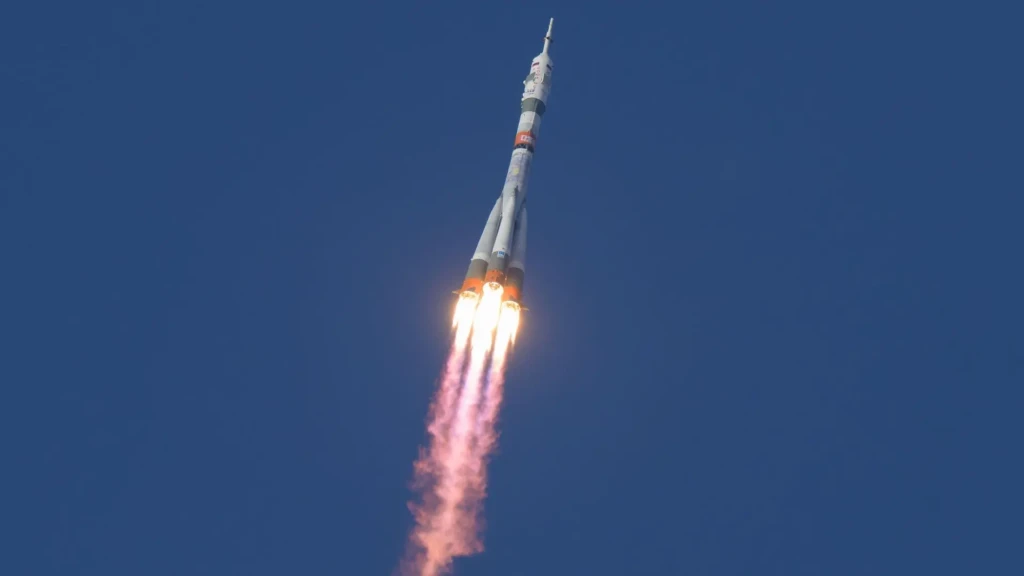
Russia's Soyuz 2.1a rocket launching to the ISS. Image: NASA
SHARE

Russia’s Baikonur Cosmodrome launch pad in Kazakhstan has reportedly suffered significant damage after yesterday’s launch. Reports say that the service tower at Pad 31 collapsed after the Soyuz 2.1a rocket lifted off on November 27 with three astronauts. The astronauts were part of the MS-28 mission which launched to the International Space Station (ISS).

Baikonur was used by the Soviet Union for a secretive space program during the cold-war era and has been leased by Russia after Kazakhstan gained independence in 1991. 

Off they go! @Astro_ChrisW is embarking on his first-ever flight to space. The crew aboard the spacecraft will spend eight months conducting research on the @Space_Station. pic.twitter.com/MLzOnKL7DL

— NASA (@NASA) November 27, 2025

The damage was reportedly caused by the rocket’s exhaust plume, affecting the mobile service tower which provides access to technicians for pre-launch servicing of the launch vehicle’s aft section.

Taking note of the pad’s condition, Russian space agency Roscosmos said per TASS News – “The launch site was inspected, as is done every time after a rocket launch. Damage to a number of launch pad elements was detected. Such damage may appear after launch, so an inspection like this is mandatory in international practice. The condition of the launch complex is currently being assessed.”

⚡️BREAKING: Russia has suddenly lost access to space

An accident at Baikonur has effectively deprived Russia of the ability to launch humans into space for the first time in 60 years.

During the launch of the Soyuz MS-28, the service tower collapsed at launch pad 31.

This is… pic.twitter.com/mGQv2c3xoh

— NEXTA (@nexta_tv) November 27, 2025

Pad 31 is more than 60 years old and it’s currently the only active site available for Russia’s rocket launches. The second site Gagarin’s Start was decommissioned in 2019 and Kazakhstan has plans to build a museum at the site. The incident has crippled Russia’s ability for rocket launches for now and the forthcoming crew and cargo missions will be delayed indefinitely.

“All the necessary spare parts are available for restoration, and the damage will be repaired in the near future,” Roscosmos has said per TASS, however, the restoration is likely to take at least a few months.

According to NEXTA, space expert Vitaly Yegorov said that Russia “has lost its ability to send humans into space” and that the repair work could take up to two years.
Russia's Soyuz Ms-28 spacecraft.
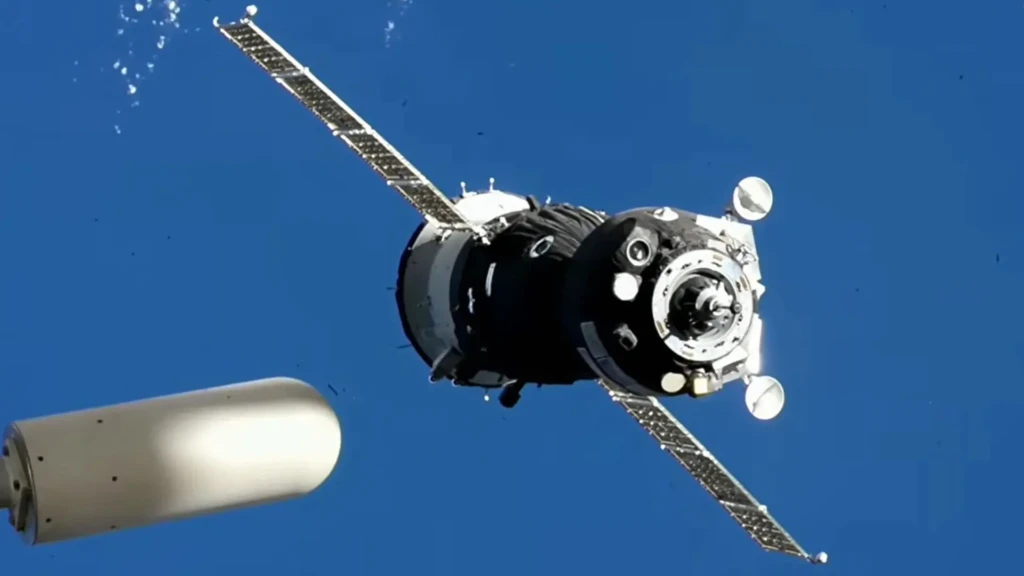
Russia’s Soyuz MS-28 spacecraft approaching the ISS. Image: NASA

Roscosmos occasionally launches a three-member crew to the ISS along with cargo on its Progress spacecraft. As part of a seat-swap agreement between Russia and the US, astronauts of both countries hitch a ride to the ISS on each other’s spacecraft.

With Russia no longer capable, SpaceX’s Crew Dragon remains the only option for both American and Russian travellers. For cargo missions, that send equipment and essential supplies for space station astronauts, NASA has SpaceX Cargo Dragon and Northrop Grumman’s Cygnus spacecraft as the available alternatives.

ALSO READ: Russia Launches Three Humans, Including NASA Astronaut, To ISS On Thanksgiving

MS-28 crew safe at the ISS

Meanwhile, the riders of the MS-28 spacecraft – Chris Williams of NASA, and Russia’s Sergey Kud-Sverchkov and Sergei Mikaev – are safe aboard the space station. Their journey was smooth as the launch had no effect on them. The trio reached their destination a couple of hours after liftoff at 3:57 pm IST and were welcomed by the seven-member Expedition 73 team.

They will spend eight-months on the orbital lab conducting microgravity experiments and research.

ALSO READ: China’s Shenzhou-22 ‘Rescue’ Spacecraft Docks At Tiangong Space Station

TAGGED:BaikonurInternational Space StationRussiaSoyuz
Share This Article
Facebook Pinterest Whatsapp Whatsapp LinkedIn Copy Link Print

Latest News

NASA's SLS rocket.
NASA’s Artemis II Rocket Plagued By Leaks Again; Administrator Jared Isaacman Reacts
Artemis
SpaceX Dragon spacecraft for NASA's Crew-12 mission.
SpaceX Rolls Out Dragon Spacecraft For NASA’s Crew-12 Mission While Falcon 9 Remains Grounded
Spaceflight
NASA's Artemis II SLS Rocket
NASA Delays Artemis II Moon Mission Launch To March – Here’s Why
Artemis
NASA's SLS rocket.
Astronauts In Quarantine, Rocket Powered On – How NASA Is Preparing For Artemis II
Artemis

You Might Also Like

NASA Jared Isaacman
Spaceflight

Billionaire Jared Isaacman Takes Oath As NASA’s Youngest And 15th Administrator

December 23, 2025
NASA MS-27
Spaceflight

NASA Astronaut Returns With Russian Cosmonauts After Spending 245 Days In Space | Photos

December 13, 2025
China Zhuque-3
Spaceflight

China’s Private Rocket Fails To Land After Successful Liftoff; Crash Video Surfaces

December 3, 2025
Neil deGrasse Tyson's thoughts on Mars.
Spaceflight

Neil deGrasse Tyson Shares The Only Reasons Humans May Reach Mars

November 14, 2025
© 2026, Blue Terra Journal
  • About
  • Privacy Policy
  • Terms
  • Contact
Welcome Back!

Sign in to your account

Username or Email Address
Password

Lost your password?