Blue Terra Journal

  • Home
  • Spaceflight
    SpaceflightShow More
    NASA's MAVEN orbiter
    NASA’s MAVEN Orbiter Confirmed Dead On Mars; What Did It Achieve In 11 Years?
    June 5, 2026
    Blue Origin's New Glenn rocket.
    What Blue Origin’s New Glenn Explosion Means For NASA And Its Moon Ambitions
    June 10, 2026
    Elon Musk SpaceX Starship
    Elon Musk’s SpaceX launches new Starship V3 on 12th mission, but it wasn’t flawless
    June 5, 2026
    SpaceX Starship
    SpaceX Starship’s 12th Test Flight Targeted On May 20; No Booster Catch This Time
    May 31, 2026
    SpaceX's Starship during launch rehearsal.
    SpaceX Completes Starship’s Launch Rehearsal For Flight 12 This Week; What To Expect?
    May 13, 2026
  • Astronomy
    AstronomyShow More
    The galactic bulge by Euclid telescope. Credit: European Space Agency
    This Euclid Telescope Image Of Milky Way’s Centre With 60 Million Stars May Break Your Brain
    June 27, 2026
    UFO videos shared by US government
    UFO Alert! US Government Releases New Videos Of Glowing Orbs Floating In The Sky
    June 13, 2026
    Meteor over Mayon volcano
    Watch: Flashy Green Meteor Streaks Over Erupting Volcano In The Philippines
    May 27, 2026
    Artist's impression of NASA's Psyche spacecraft.
    NASA’s Psyche Spacecraft Will Zoom Past Mars Today On Its Way To Metal-Rich Asteroid
    May 15, 2026
    Comet MAPS image
    Video: Comet MAPS destroyed after plunging into the Sun; event caught by NASA missions
    April 18, 2026
  • India
    IndiaShow More
    Shubhanshu Shukla aboard the ISS.
    ISRO Astronaut Shubhanshu Shukla Awarded Ashoka Chakra For Heroic Ax-4 Mission
    February 9, 2026
    ISRO's PSLV lifts off to space.
    ISRO’s PSLV Rocket Suffers Third Stage Failure After Successful Liftoff; Payloads Lost
    January 23, 2026
    Dhruva Space team at ISRO facility.
    India’s Dhruva Space To Launch 10 Missions, Including 1st Northeastern Satellite, On ISRO’s PSLV
    January 12, 2026
    ISRO's PSLV rocket
    ISRO To Seek Redemption With PSLV-C62 Mission Launch On January 12
    January 12, 2026
    ISRO SSLV
    ISRO’s SSLV Rocket Just Got Better After Latest Third Stage Test Fire
    December 31, 2025
  • Artemis
    ArtemisShow More
    NASA Artemis III crew
    NASA Artemis III: Meet The Astronauts Who Will Set The Stage For 2028 Moon Landing
    June 10, 2026
    Blue Origin's New Glenn rocket.
    What Blue Origin’s New Glenn Explosion Means For NASA And Its Moon Ambitions
    June 10, 2026
    NASA Artemis II mission
    Welcome Home! NASA’s Artemis II Astronauts Are Back After Historic Moon Voyage
    April 22, 2026
    NASA Artemis II iPhone image
    iPhones Reigned Supreme On NASA’s Artemis II Moon Mission
    April 10, 2026
    Artemis II NASA
    All Eyes On Scary Artemis II Reentry As NASA Moon Mission Nears Completion
    April 9, 2026
  • More
    • About
    • Privacy Policy
    • Terms
    • Contact

Blue Terra Journal

  • Home
  • Spaceflight
  • Astronomy
  • India
  • Artemis
Search
  • Pages
    • About
    • Contact
    • Privacy Policy
    • Terms

Home - Artemis - Artemis 2: Unraveling NASA Orion Capsule – Humanity’s Ride To The Moon

Artemis

Artemis 2: Unraveling NASA Orion Capsule – Humanity’s Ride To The Moon

Artemis 2 is likely to launch next February.

Harsh Vardhan
Last updated: November 26, 2025 10:44 PM
Harsh Vardhan
Share
6 Min Read
NASA Artemis 2 Orion spacecraft.
NASA's Orion spacecraft in space during Artemis 1. Image: NASA
SHARE

Contents
  • Orion inside out 
  • Concerns regarding Orion
  • When is Artemis 2 launching?

NASA has stacked the Orion spacecraft atop the Space Launch System (SLS) rocket ahead of crucial pre-flight tests in the coming weeks. The capsule being prepared for Artemis 2 mission will take four astronauts on a journey to the lunar orbit, marking humanity’s return to deep space after 54 years. Notably, the astronauts will return in 10 days without landing on the lunar surface.

Orion has been tested once before during Artemis 1 in 2022, but the stakes are higher this time because there will be humans aboard the spacecraft.

Artemis II is stacked, communication systems have been tested, and now we are gearing up for a launch day dress rehearsal.

Learn more about our next steps as we prepare to launch and fly our first crewed mission under the Artemis campaign >> https://t.co/IsqU3fRi5Y pic.twitter.com/jyF576uG66

— NASA Artemis (@NASAArtemis) November 20, 2025

American Astronauts Reid Wiseman, Christina Koch, Victor Glover and Canada’s Jeremy Hansen have been tasked with testing Orion’s critical components in a deep space environment and proving its life support systems are capable of supporting long-duration missions.
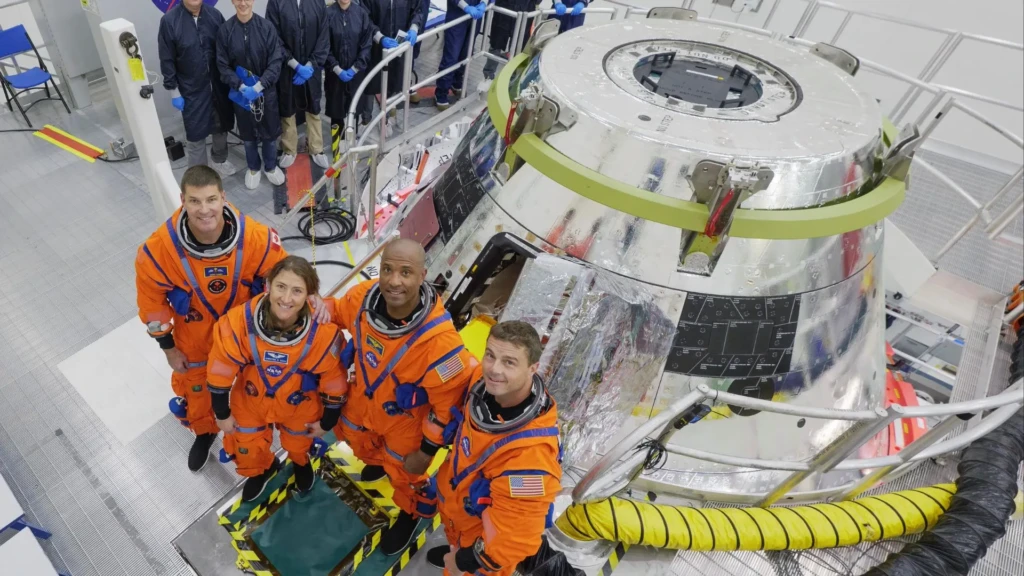
NASA Artemis 2 astronauts.
NASA’s Artemis 2 astronauts Jeremy Hansen, Christina Koch, Victor Glover and Reid Wiseman (left to right) during their training with Orion. Image: NASA

According to NASA, Orion, named Integrity for Artemis 2, is capable of supporting a crew of four for 21 days without docking with another spacecraft, and Artemis 2 will prove its readiness for a manned mission.

Orion inside out 

The Orion spacecraft is composed of a Crew Module, built by Lockheed Martin, and the European Service Module or ESM, built by the European Space Agency (ESA). When integrated, Orion stands 26.5 feet (8.1 metres) tall and has a mass of 26,000 kg with fuel.

NASA Orion
NASA’s Orion spacecraft components. Image: NASA

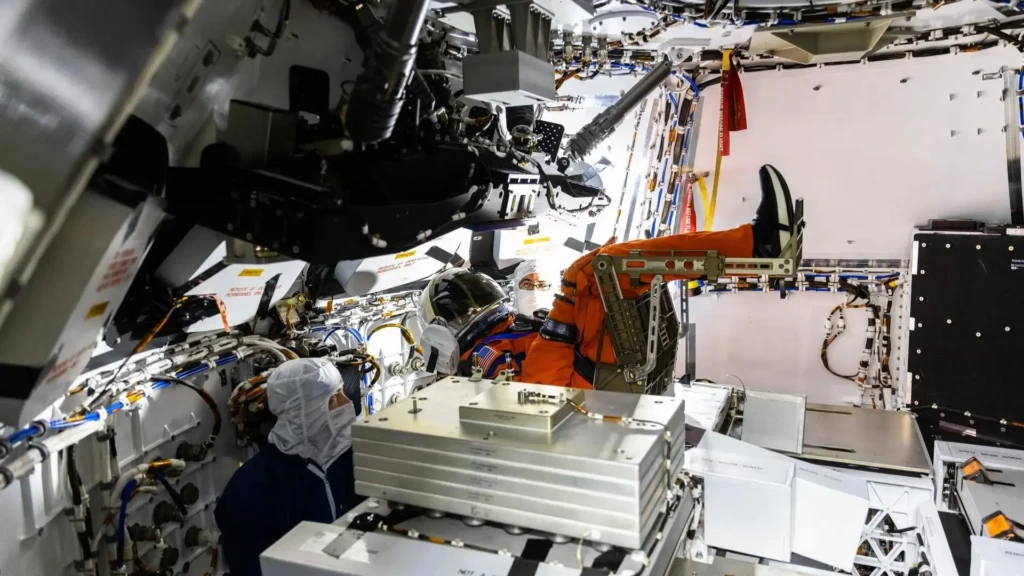
The Crew Module stands 16.5 feet (5 metres) tall and this is where the four astronauts will stay during the course of their mission. It is equipped with three 13-inch touchscreen displays, manual flight control panels, four panoramic windows, thermal control, systems for removing carbon dioxide and moisture, storage system for breathable air and water, and stowage lockers on the floor in case the crew needs to shield itself from a radiation event.

Orion is also fitted with an advanced compact toilet, with improved design that makes its use in space easier for both men and women. The crew will also have access to built-in exercise device for both aerobic and strength training.
NASA Orion
Inside view of the Orion spacecraft. Image: NASA

The spacecraft’s lifeline is the ESM that will supply it with electricity, propulsion, thermal control, oxygen, nitrogen and water. It has 33 engines, including one main and 24 reaction control thrusters that are used to steer and control Orion while in orbit. There are also eight auxiliary engines to execute translational maneuvers, essentially acting as a backup to the main engine. The ESM also has massive solar arrays, with 15,000 solar cells, spanning approximately 19 metres which can generate up to 11 kW of electricity.

At its base, Orion is covered with the world’s largest heat shield measuring 16.5 feet in diameter. NASA says it is designed to survive atmospheric re-entry at 40,233 km per hour and endure temperatures up to 2,760°C.
NASA Orion
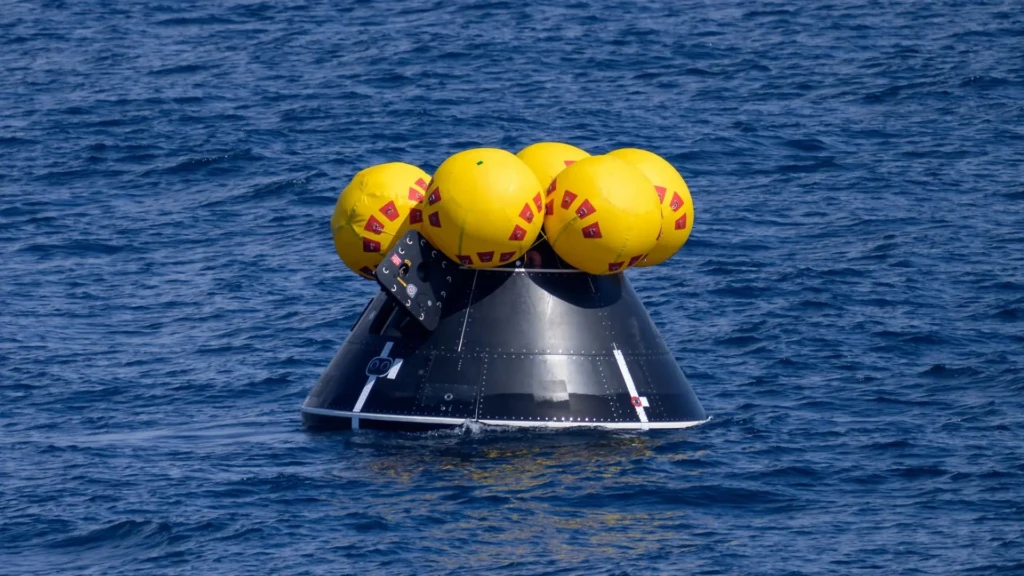
The Orion crew module during recovery trials. Image: NASA

Shortly before re-entry, the Crew Module will separate from the Service Module for a splashdown using a system of 11 parachutes that will deploy sequentially.

Concerns regarding Orion

Artemis 1 exposed a few flaws in Orion’s design. The spacecraft went offline multiple times while in space, causing communication outages. NASA has reportedly made software and antenna upgrades to fix the problem. Besides, the heatshield also got eroded more than expected, prompting NASA to redesign it and make it more durable.

When is Artemis 2 launching?

NASA has said that Artemis 2 will launch no later than April 2026 and the agency is currently targeting a launch window in February next year. The Orion spacecraft has been stacked atop the SLS rocket and both components will undergo several rounds of key tests in the following weeks with the astronauts’ participation. The rocket will then be rolled out to the launch pad at NASA’s Kennedy Space Center for a wet dress rehearsal, wherein it will be loaded with propellant and mission teams will conduct a full launch countdown as an exercise.

ALSO READ: NASA Stacks Artemis 2 Spacecraft On Moon Rocket; Here’s What’s Next

ALSO READ: Artemis 3 Delayed To 2028? Report Says SpaceX’s Starship May Hurt NASA Again

TAGGED:Artemis 1Artemis 2NASAOrionSLS Rocket
Share This Article
Facebook Pinterest Whatsapp Whatsapp LinkedIn Copy Link Print

Latest News

The galactic bulge by Euclid telescope. Credit: European Space Agency
This Euclid Telescope Image Of Milky Way’s Centre With 60 Million Stars May Break Your Brain
Astronomy
UFO videos shared by US government
UFO Alert! US Government Releases New Videos Of Glowing Orbs Floating In The Sky
Astronomy
NASA Artemis III crew
NASA Artemis III: Meet The Astronauts Who Will Set The Stage For 2028 Moon Landing
Artemis
NASA's MAVEN orbiter
NASA’s MAVEN Orbiter Confirmed Dead On Mars; What Did It Achieve In 11 Years?
Spaceflight

You Might Also Like

Ramses nasa
Astronomy

Asteroid Bennu Has More Than Just Ingredients Of Life – What NASA Found

December 6, 2025
NASA OSIRIX-APEX
Spaceflight

NASA’s Deep Space Probes Send Stunning Images Of Earth, Moon And Uranus

November 29, 2025
ISRO Aditya-L1
Astronomy

ISRO’s Aditya-L1 And NASA Missions Uncover Reason Behind 2024 Solar Storm Fury

December 13, 2025
Comet 3I/ATLAS by Hubble telescope
Astronomy

Comet 3I/ATLAS Is Not An Alien Spacecraft – This Research Likely Confirms It

January 10, 2026
© 2026, Blue Terra Journal
  • About
  • Privacy Policy
  • Terms
  • Contact
Welcome Back!

Sign in to your account

Username or Email Address
Password

Lost your password?