Blue Terra Journal

  • Home
  • Spaceflight
    SpaceflightShow More
    NASA's SR-1 Freedom spacecraft.
    What Is NASA’s SR-1 Freedom Mission? The First Nuclear Reactor In Space Explained
    March 27, 2026
    Artist's impression of a NASA Moon base.
    NASA Moon Base: How The US Will Spend $20 Billion On This Ambitious Project
    March 25, 2026
    Russia's Soyuz rocket ascending to space.
    Russia’s Progress Spacecraft Suffers Mystery Glitch On Its Way To ISS; What Happened?
    March 23, 2026
    Robert Goddard
    Celebrating Robert Goddard – The Man Who Changed Rocketry 100 Years Ago
    March 17, 2026
    International Space Station gets extension to beat China
    Watch Out China! US Proposes Extending International Space Station Lifespan To 2032
    March 10, 2026
  • Astronomy
    AstronomyShow More
    Meteor spotted over Houston.
    Video Captures 1-Ton Meteor Exploding Over Houston Skies, NASA Releases Statement
    March 22, 2026
    NASA black hole simulation
    Fall Into A Black Hole With This Incredibly Scary Simulation Made By NASA
    March 18, 2026
    Comet C/2026 A1 MAPS
    Comet C/2026 A1 MAPS: What Are ‘Sun-Grazer’ Comets And Why Are They Special?
    March 12, 2026
    Moon is safe from asteroid 2024 YR4.
    The Moon Is Safe! James Webb Space Telescope Rules Out Asteroid 2024 YR4’s Collision
    March 6, 2026
    NASA Moon orbiter
    NASA Prepares To Save Its Orbiter During Total Solar Eclipse On The Moon
    March 3, 2026
  • India
    IndiaShow More
    Shubhanshu Shukla aboard the ISS.
    ISRO Astronaut Shubhanshu Shukla Awarded Ashoka Chakra For Heroic Ax-4 Mission
    February 9, 2026
    ISRO's PSLV lifts off to space.
    ISRO’s PSLV Rocket Suffers Third Stage Failure After Successful Liftoff; Payloads Lost
    January 23, 2026
    Dhruva Space team at ISRO facility.
    India’s Dhruva Space To Launch 10 Missions, Including 1st Northeastern Satellite, On ISRO’s PSLV
    January 12, 2026
    ISRO's PSLV rocket
    ISRO To Seek Redemption With PSLV-C62 Mission Launch On January 12
    January 12, 2026
    ISRO SSLV
    ISRO’s SSLV Rocket Just Got Better After Latest Third Stage Test Fire
    December 31, 2025
  • Artemis
    ArtemisShow More
    NASA Artemis II crew
    NASA’s Christina Koch Turns ‘Space Plumber’ To Fix $30 Million Toilet On Artemis II Mission
    April 3, 2026
    NASA Orion spacecraft
    NASA’s Artemis II Astronauts Are Moon-Bound After Successful Trans-Lunar Injection Burn
    April 3, 2026
    NASA Artemis II lifts off.
    Artemis II Lifts Off! NASA Launches 4 Astronauts To The Moon After Over 50 Years
    April 2, 2026
    NASA's Artemis II astronauts
    NASA Artemis II Launch Live: Watch Humanity Return To The Moon On April 2
    April 2, 2026
    NASA Apollo 8 image
    NASA Artemis II: Why This Moon Mission Is Our Generation’s Apollo 8
    March 30, 2026
  • More
    • About
    • Privacy Policy
    • Terms
    • Contact

Blue Terra Journal

  • Home
  • Spaceflight
  • Astronomy
  • India
  • Artemis
Search
  • Pages
    • About
    • Contact
    • Privacy Policy
    • Terms

Home - Astronomy - What Are Interstellar Comets And What Makes Them Special?

Astronomy

What Are Interstellar Comets And What Makes Them Special?

They show up out of nowhere and never return.

Harsh Vardhan
Last updated: November 15, 2025 8:54 PM
Harsh Vardhan
Share
4 Min Read
Comet 3I/ATLAS by Hubble telescope
Hubble telescope's view of Comet 3I/ATLAS on July 21. Image: NASA
SHARE

Contents
  • What is an interstellar comet?
  • How do we know 3I/ATLAS is an interstellar comet?
  • Why is 3I/ATLAS special?

Scientists are busy studying comet 3I/ATLAS, which has hogged the headlines because of its unusual characteristics. What’s even more fascinating is its interstellar origin and astronomers want to use this opportunity to learn about the environment outside our solar system. But what does ‘interstellar’ even mean and why is 3I/ATLAS more special than comets that we usually see?

What is an interstellar comet?

First things first. 3I/ATLAS is the third known interstellar comet [thus 3I] and it’s named after the NASA-funded Asteroid Terrestrial-impact Last Alert System (ATLAS) telescope which discovered it. Now, the word ‘interstellar’ means space between the stars, and it’s associated with an object which formed outside our solar system. So naturally, an interstellar comet is a comet that originated elsewhere in the universe and is just passing through. 
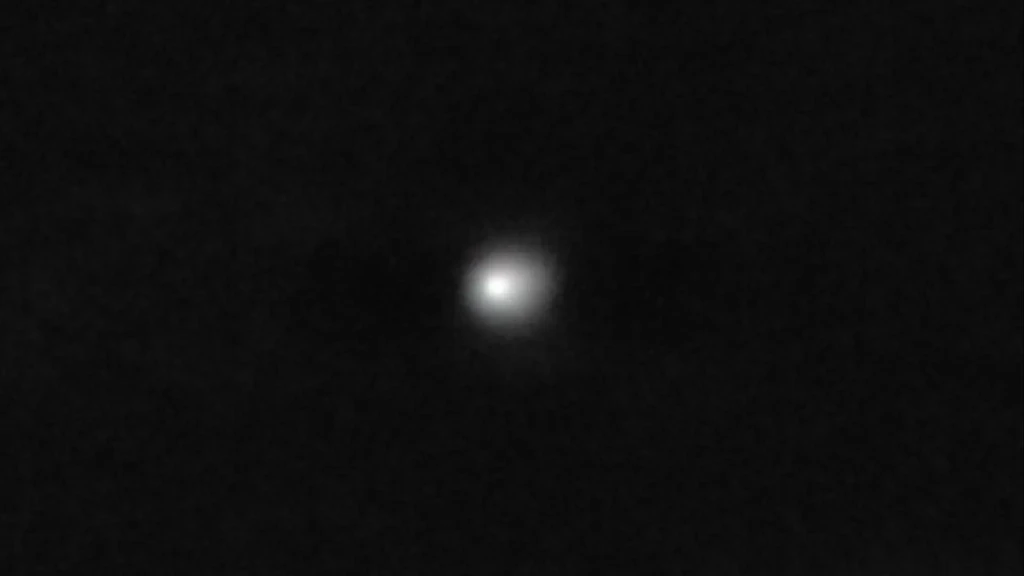
Comet 3I/ATLAS.
Comet 3I/ATLAS photographed in July, 2025. Image: European Southern Observatory

The solar system’s boundary is marked where the heliosphere ends. Heliosphere is a giant bubble around everything in our solar system – the planets, asteroids, comets – and it’s created by the solar wind flowing away from the Sun. NASA explains it as the region of space under the influence of our Sun. Anything outside this region is considered a part of interstellar space.
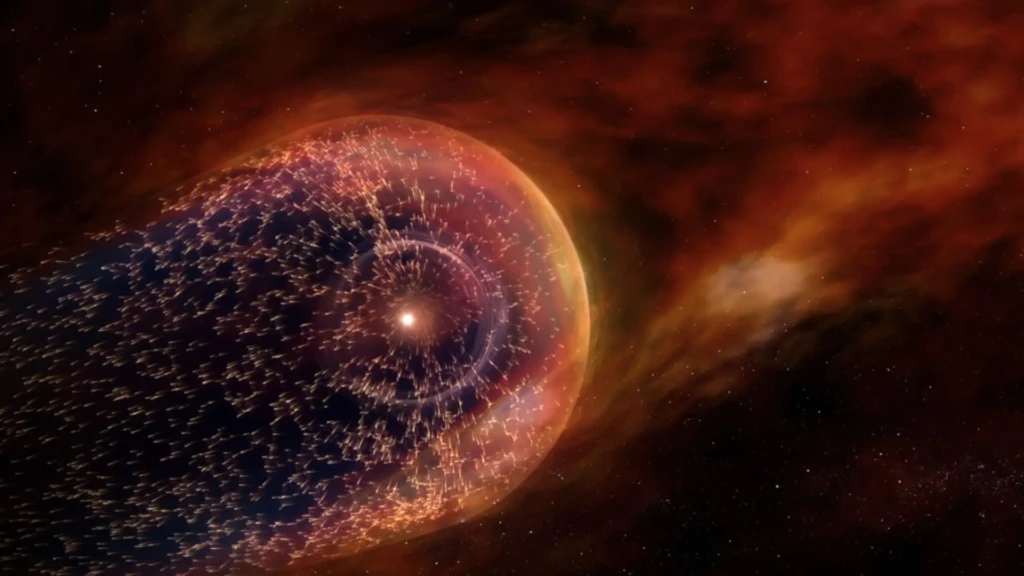
NASA's heliosphere animation.
Visualisation of the heliosphere. Image: NASA

The Voyager 1 and 2 probes, which launched in 1977, became the first man-made objects to enter interstellar space when they escaped the heliosphere in 2012 and 2018, respectively.

How do we know 3I/ATLAS is an interstellar comet?

Astronomers determine whether an object is interstellar by studying its trajectory. Normal comets follow elliptical orbits that are tied to the Sun whereas interstellar comets travel on hyperbolic paths, meaning our solar system is just a landmark in their journey and they will never return.

The Comet 3I/ATLAS
Comet 3I/ATLAS photographed on August 27. Image: NOIRLab

Their hyperbolic trajectories are identified by calculating the comet’s eccentricity and excess speed. Interstellar comets move too fast to be gravitationally bound to the Sun and this is a key indicator of their origin. These characteristics have helped scientists discover three interstellar comets so far- 1I/Oumuamua, 2I/Borisov and the latest 3I/ATLAS.

Why is 3I/ATLAS special?

Interstellar comets such as 3I/ATLAS are special because they act like time capsules, carrying material from the earliest stages of their star systems. Besides, their chemistry is totally different from native comets such as Comet Lemmon and hint at chemical environments very different from ours.

For instance, 2I/Borisov reportedly had unusually high levels of carbon monoxide compared to typical solar system comets whereas 3I/ATLAS is dominated by carbon dioxide and has a very high concentration of nickel. The latter’s age is also estimated at around seven billion years, making it significantly older than the Sun. It is also said to have many anomalies including a lack of cometary tail despite reaching perihelion (closest distance to the Sun) on October 30.

These outsiders are natural probes of other planetary systems and they offer limited time to study how organic chemistry vary across the universe.

ALSO READ: Comet 3I/ATLAS Vs Comet Lemmon: Why The Former Has No Tail Post Perihelion

ALSO READ: Comet 3I/ATLAS May Have Broken Into 16 Or More Pieces, Says Scientist

TAGGED:cometComet 3I/ATLASinterstellar cometNASASpace
Share This Article
Facebook Pinterest Whatsapp Whatsapp LinkedIn Copy Link Print

Latest News

NASA Artemis II crew
NASA’s Christina Koch Turns ‘Space Plumber’ To Fix $30 Million Toilet On Artemis II Mission
Artemis
NASA Orion spacecraft
NASA’s Artemis II Astronauts Are Moon-Bound After Successful Trans-Lunar Injection Burn
Artemis
NASA Artemis II lifts off.
Artemis II Lifts Off! NASA Launches 4 Astronauts To The Moon After Over 50 Years
Artemis
NASA's Artemis II astronauts
NASA Artemis II Launch Live: Watch Humanity Return To The Moon On April 2
Artemis

You Might Also Like

NASA ESCAPADE mission
Spaceflight

NASA’s Mars-Bound ESCAPADE Spacecraft Prepare For First Engine Burns

December 2, 2025
Comet 3I/ATLAS pre-perihelion.
Astronomy

Comet 3I/ATLAS Is NOT Changing Colours, But Sudden Brightness Remains A Mystery

November 19, 2025
NASA Crew-12 astronauts
Spaceflight

Welcome Aboard! Watch Astronauts Welcome NASA’s Crew-12 On International Space Station

February 21, 2026
Blue Origin will attempt booster landing on November 10.
Spaceflight

Like SpaceX, Blue Origin Eyes Landing New Glenn Booster During ESCAPADE Launch

November 8, 2025
© 2026, Blue Terra Journal
  • About
  • Privacy Policy
  • Terms
  • Contact
Welcome Back!

Sign in to your account

Username or Email Address
Password

Lost your password?