“NASA Operating Status: NASA is currently CLOSED due to a lapse in Government funding,” reads the homepage of the American space agency. Over 15,000 NASA employees – about 80 percent of the space agency’s workforce has been furloughed (on temporary leave without pay) following the USA entering into the country’s longest shutdown ever (41 days and ongoing).
The agency has faced similar shutdowns in 2013, 2018 and 2019 but this time, it could have major repercussions for the country’s space program, specifically the Artemis missions. The Government Accountability Office (GAO) in its 2024 assessment reported, “the first crewed lunar landing [Artemis III] is unlikely to occur in 2025” and could further get postponed to early 2027,” which is exactly what happened.
The US’s recent space history is now increasingly dotted with shutdowns, funding issues – putting at risk the schedule of the country’s upcoming lunar missions. This is happening when its competitor China is racing ahead unabated in its planned lunar explorations. Notably, China recently conducted two successful tests associated with landing astronauts on the Moon by 2030. In a matter of concern for the US lunar programme, during this time period – SpaceX’s lunar lander faced major litigation issues; The funding related uncertainties kicked-in with the US government shutdown looming. So will a US shutdown offer advantage to China in the race to the Moon?
‘Excepted Services’ Now Includes Artemis Lunar Programme
Looking back into history, citing the GAO report, signs are worrying. According to the GAO’s 2024 ‘Assessments of Major Projects’ report, among 53 major NASA projects, almost half of the lifecycle baseline project overruns were connected to the three Artemis missions – amounting to over $7 billion. Moreover adding to the woes, the timelines NASA has set for the Artemis mission are more aggressive compared to conventional human spaceflight missions, according to GAO.
The GAO analysed two major areas where the Artemis programme had vulnerabilities. The GAO reported in 2022, NASA hasn’t done ‘schedule risk analysis’ for the country’s next crewed mission to the Moon – Artemis II (target 2026), on which parts of the programme, if faced with technical challenges or issues, can potentially result in overall delays. Thereby the space agency inadvertently kept itself in the dark about whether the lunar mission will face any delays.
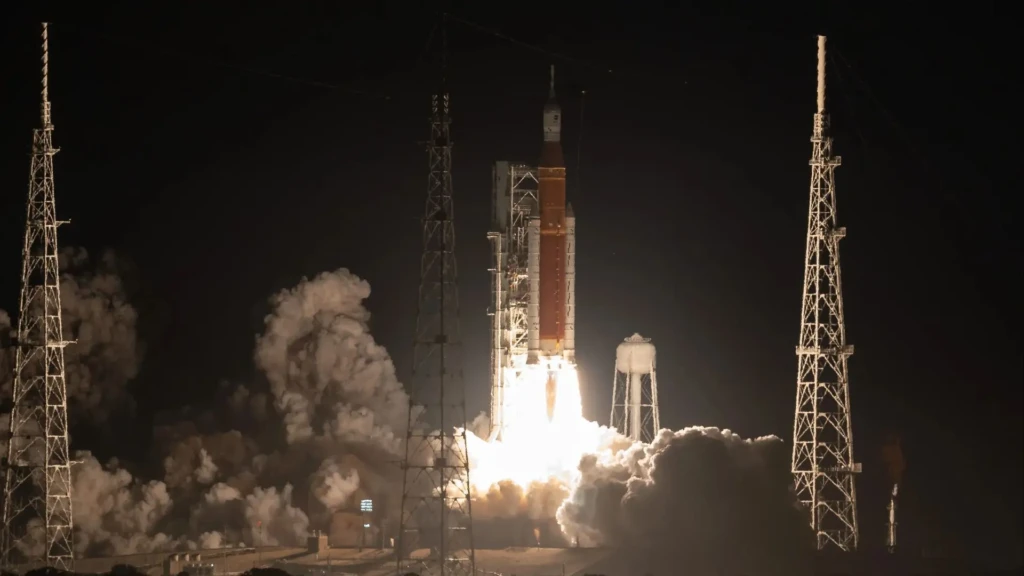
Secondly, according to the GAO’s 2024 Ground Systems report, the agency warned that the Artemis’ Exploration Ground Systems (EGS) programme, critical for launches, lacked “schedule margin remaining” for key launch support systems. This may put the schedule of all the future Artemis missions – Artemis II or III and beyond in jeopardy.
ALSO READ: China’s Tiangong Space Station Will Host Pakistani Astronaut In 2026
However there is a ray of hope – albeit temporary for NASA’s plans for the Artemis. As per the latest shutdown plan announced by NASA, the Artemis programme has been included in the ‘Excepted Services’ i.e while the funding for all other NASA activities is ceased, the Artemis programme will continue to get funds and the activities on the programme will remain normal. Additionally the associated employees will also continue to work on the mission.
The shutdown-related NASA Continuity of Appropriations Plan, September 2025 says, “NASA would continue to support Artemis operations during any funding lapse. At this time, activities that should continue in order to protect production of elements of Artemis II and III and related activities (e.g., development, manufacturing, assembly, processing, troubleshooting, integration, testing, oversight, etc.) and activities necessary to maintain processing and supply chain safety for Artemis IV+. Those employees who contribute directly to Artemis activities would be excepted from furlough. Contractor activities will also continue supporting necessary excepted activities.”
Former NASA Head Demands ‘Appropriations’
However, is it enough? Not quite, feel experts, who warn that such ‘excepted’ operations can only have a limited impact without supporting programs still under the cloud of funding uncertainty. Former NASA Administrator Jim Bridenstine felt unconvinced of continuing resolutions (CR) and budgets of temporary nature. “We need to be advocating for appropriations because, ultimately, technology is changing, capabilities are changing, and we need to be able to change programs commensurate with the times,” Bridenstine reportedly said. “If we rely on continuing resolutions, we buy obsolete things and we don’t buy the right things.”
Bridenstine warned, lack of budgets and political partisanship could delay the Artemis timeline. It means ‘Advantage China’, handing the country a potential geopolitical advantage. Other experts have also warned of lagging behind China in the aftermath of the repeated political gridlocks and the resultant shutdowns.
During a Senate Commerce Committee hearing in September, Bridenstine said it is “highly unlikely” US would land astronauts on China unless the agency adopts radical changes in its plan.
ALSO READ: Jared Isaacman Is Back As Trump Renominates Him For NASA Head Post
Senator Ted Cruz reportedly said, “Space is a strategic frontier with direct consequences for national security, economic growth and technological leadership. … Delays or disruptions only serve our competitors’ interests,” He further added, “any drastic changes in NASA’s architecture at this stage threaten United States leadership in space.”
Showing strong resentment on CR, Senator Jerry Moran said, “As long as it’s easier to do a CR than it is to do appropriation bills, we apparently are not going to do them. … It is a mistake for this Congress to get in the habit of continuing resolutions,” connecting CRs directly to giving an advantage to China.
China’s Moon Strategy
All of this matters because Beijing has publicly stated goals to land astronauts on the Moon by 2030 and to build a lunar research base by 2035.
Notably, China has recently taken two major steps toward its goal of landing astronauts on the moon by 2030. The country successfully completed a zero-altitude escape test of its next-generation Mengzhou crewed spacecraft at the Jiuquan Satellite Launch Centre in June. This was to prove the system can safely eject astronauts in case of launch failure.
Alongside this, China also conducted a rocket stage hot-fire test in September, another key milestone in its lunar program. The planned mission will see the Mengzhou spacecraft dock in lunar orbit with the Lanyue lunar lander, from which two astronauts will descend to the moon’s surface for a short stay. These tests are part of China’s broader plan to build a permanent lunar base, the International Lunar Research Station (ILRS), marking a long-term strategy for sustained human and robotic presence on the moon.
ALSO READ: ‘Mars Is Not A Great Place’: Avi Loeb Derides Elon Musk’s Colonisation Dream
Reported by: Abhishek Raval