China has released pictures of interstellar Comet 3I/ATLAS captured from Mars. According to the China National Space Administration (CNSA), the pictures were taken by the Tianwen-1 orbiter’s High-Resolution Imaging Camera (HiRIC) when the comet was at its closest distance from Mars (30 million kilometres) on October 3.
This comes a few weeks after the European Space Agency (ESA) shared images captured by its ExoMars TGO and Mars Express orbiters between October 1 and 7.
Tianwen-1 Mars orbiter captured video of interstellar comet 3I/ATLAS from 30 million km away, a rare close-up view of the dark visitor with its high-res camera. Full HD:https://t.co/IFQWE7pCRl pic.twitter.com/IykcUo5mgo
— CNSA Watcher (@CNSAWatcher) November 6, 2025
The comet was discovered on July 1 by the NASA-funded Asteroid Terrestrial-impact Last Alert System (ATLAS) survey telescope in Rio Hurtado, Chile, and scientists soon confirmed it was the third object to visit from outside our solar system after 1I/Oumuamua (2017) and 2I/Borisov (2019). Scientists estimate that its nucleus measures at least 5 kilometres wide and it will be closest to Earth on December 19 at around 270 million kilometres.
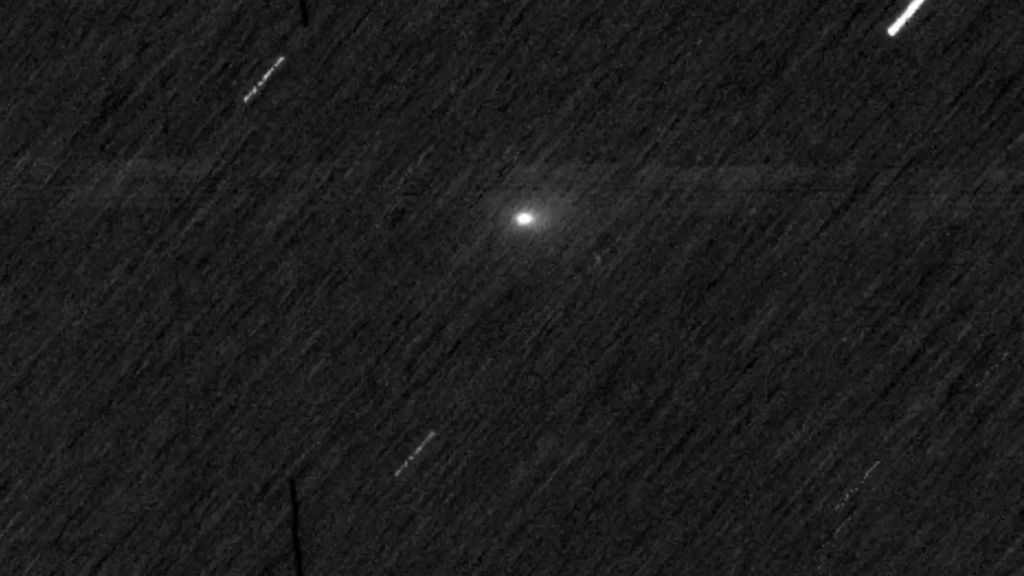
Tianwen-1’s view of Comet 3I/ATLAS
The visuals collected by Tianwen-1 show the comet as a fuzzy bright dot moving across a star-filled background. Similar to views from ESA’s orbiters, the comet lacks a tail which many, including Harvard physicist Avi Loeb, find odd. Interestingly, this comet is getting more attention than usual because Loeb believes it could have an extraterrestrial origin due to its anomalies.
In the video from Tianwen-1, one can see the nucleus surrounded by a coma (cloud of gas and dust) which measures several thousand kilometres wide.

3I/ATLAS reached perihelion (closest point to the Sun) on October 30, more than three weeks after zooming past Mars. Currently, the comet is reportedly behind the Sun from Earth’s vantage point, and should be visible again by early December.
NASA’s HiRISE camera aboard the Mars Reconnaissance Orbiter also captured pictures of the comet which are reportedly clearer than the Hubble telescope’s. However, the images remain unreleased due to the US government’s shutdown and are unlikely to be released until operations resume.
In a blog published on November 5, Loeb shared the comet’s new images captured by Spain-based observatories, and it doesn’t seem to have a tail despite reaching perihelion. Loeb and Congresswoman Anna Paulina Luna have been pushing NASA to release HiRISE pictures as soon as possible although we’ll have to wait until the shutdown ends.
ALSO READ: Comet 3I/ATLAS: Should We Take Avi Loeb’s Alien Theory Seriously?
ALSO READ: Meteor Explodes In The Sky Over Portugal, ESA Releases Fiery Video