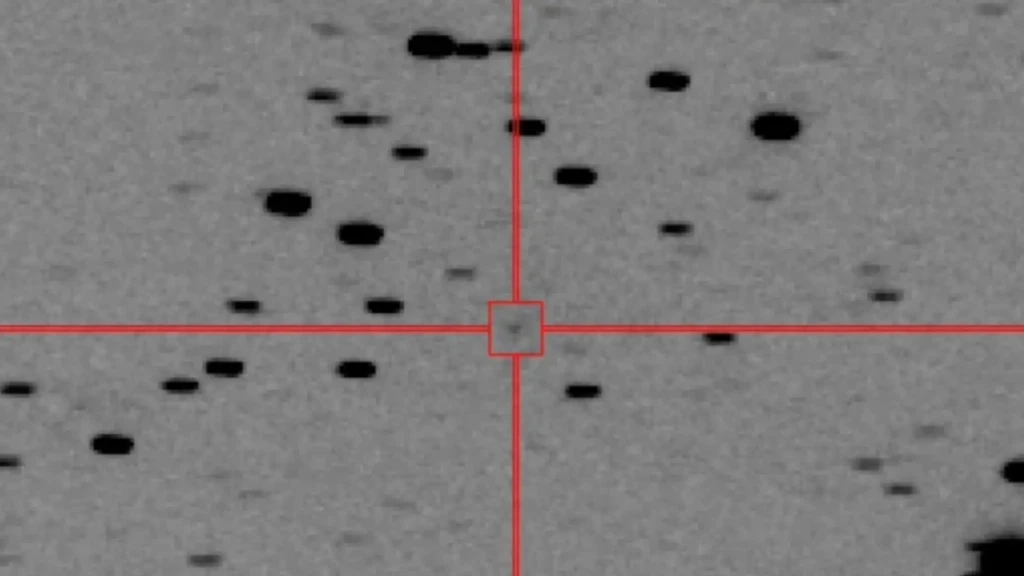
A new comet is creating a lot of buzz among astronomers. Dubbed C/2026 A1 MAPS, it’s the first comet discovered in 2026 and the space rock is heading for an insanely close pass to the Sun. The comet was discovered on January 13 and its name is an acronym of the four discoverer’s last names – Alain Maury, Georges Attard, Daniel Parrott and Florian Signoret. These astronomers run remote telescopes in Chile’s Atacama desert, per Universe Today.
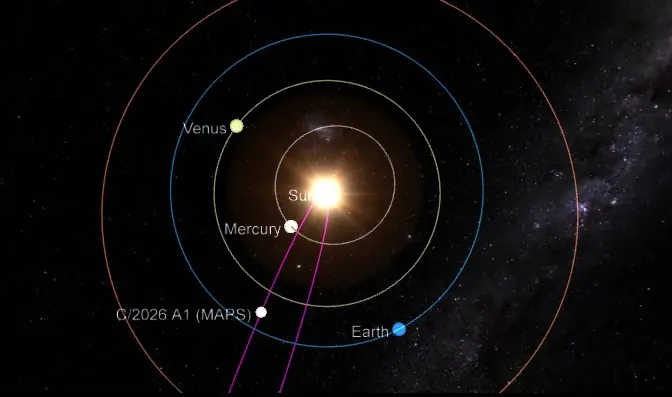
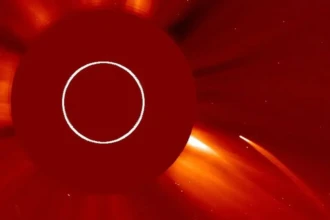
A1 MAPS, approximately 2.4 km across, is a ‘sungrazer’ comet belonging to the Kreutz group and scientists predict it will reach perihelion (closest point to the Sun) in April. On April 4, it will pass about 1,60,000 kilometers (99,000 miles) above the photosphere – lowest layer of the Sun’s atmosphere. This distance is less than half the distance between the Earth and the Moon.
Sungrazer comets dive deep into the Sun’s corona (outermost layer of the solar atmosphere) so it’s highly likely that the comet will not survive the encounter. If the comet somehow doesn’t disintegrate post perihelion, it could be brighter for a brief amount of time and achieve Venus-level illumination – enough to be visible to the naked eye.
Visibility of comet C/2026 A1 MAPS
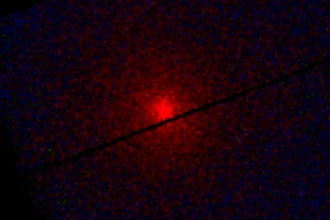
Until early April, A1 MAPS’s visibility will be faint. Residents in the southern hemisphere currently have a better view of the comet and will soon reveal itself in the norther hemisphere although it won’t be as prominent. According to The Sky Live, the comet is currently in the Eridanus constellation of the southern celestial hemisphere and around 192 million km from Earth. At its closest on April 6, comet C/2026 will be nearly 144 million km from our planet.
It remains to be seen whether its brightness will increase or remain dim since that depends on whether or not the comet will survive perihelion.
We are just moving on from the flyby of another comet named C/2024 E1 or Comet Wierzchoś, which reached perihelion on January 20. It was at its closest distance to Earth (around 151 million km) on February 17 and its visibility will increase in the northern hemisphere over the next few weeks.
Astronomers suggest looking above the southwestern horizon after dusk near the constellation Sculptor. While the southern hemisphere currently has a better view, it will climb higher in the northern skies in the coming weeks.
ALSO READ: A Hefty Green Comet Just Flew By Earth. Here’s How You Can Still Spot It
ALSO READ: What Does The CIA Know About Comet 3I/ATLAS? Avi Loeb Seeks Answers