Update January, 6, 2026 – New findings on comet 3I/ATLAS suggest this interstellar visitor is a natural object and not an alien spacecraft. Scientist Avi Loeb is still suspicious about its origin. Article originally published on Jan 3, 2026.
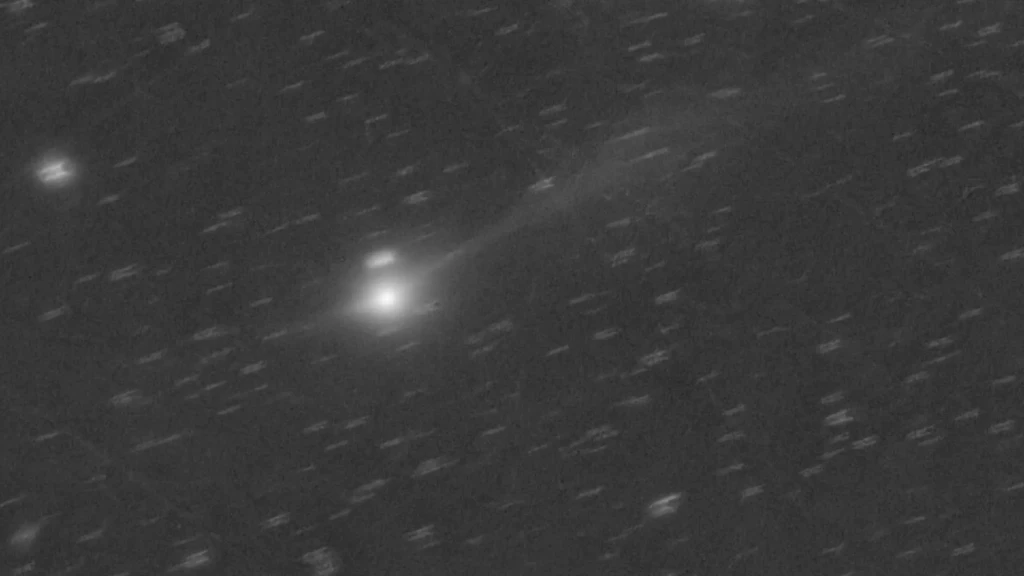
The interstellar comet 3I/ATLAS‘s strange anti-tail may hold clues to its true nature, says Harvard physicist Avi Loeb who suspects it of being an alien spacecraft. In his recent blog, Loeb suggested that ground-based telescopes must collect data on the release of gases along the comet’s anti-tail jet which extends hundreds of thousands of kilometres long.

3I/ATLAS has a massive Sun-facing jet which is unusual because materials ejected from comets are normally pushed away from the Sun.
Comet 3I/ATLAS and its anti-tail
The anti-tail jet consists of dust and gas which are being released as the comet moves on its hyperbolic trajectory. When a comet travels through space, sunlight heats its surface and triggers sublimation (conversion of frozen ice directly into gas) which causes it to shed mass and creates a tail.
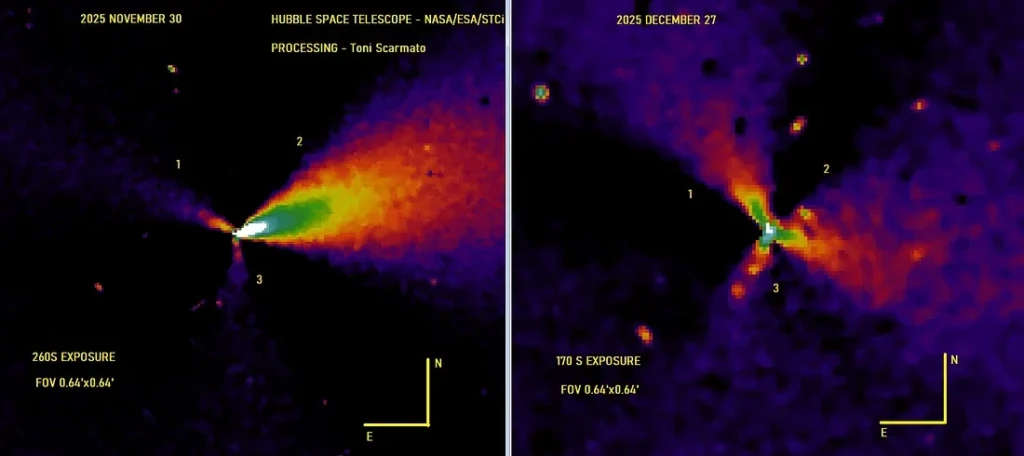
Observations from several major telescopes, including NASA’s Hubble telescope, have revealed that one of 3I/ATLAS’s narrow sunward anti-tail jet is 10 times longer than it is wide. These jets of varying lengths are one of the comet’s many anomalies Loeb has highlighted.
The scientist has explained that dust grains about 10 microns in size are being ejected from the comet and the gases being released are pushing the dust particles despite solar radiation pressure. Loeb, however, argues that if 3I/ATLAS is a natural comet the gases should not be streaming as far as the dust does along the anti-tail – it should stop within 5,000 km of the comet’s nucleus.

Loeb even brought up propulsion systems saying chemical thrusters, like on rockets, could send gases up to 25,000 km beyond the nucleus whereas ion thrusters could reach 1,00,000 km from the nucleus.
“If it is a natural comet, then the anti-tail jet should not include streaming gas beyond a distance of 5,000 kilometers from the nucleus. At distances much larger than 5,000 kilometers from 3I/ATLAS as a comet, the anti-tail should be composed primarily of a stream of 10-micron dust particles with no streaming gas,” Loeb wrote.
According to him, the anti-tail jet presently must be gas-free and the reach of volatiles like frozen carbon dioxide or carbon monoxide 5,000 km beyond the nucleus could reveal a lot about the comet’s nature.
3I/ATLAS was discovered on July 1, 2025 by the NASA-funded Asteroid Terrestrial-impact Last Alert System (ATLAS) and it’s the third confirmed interstellar object after comets Oumuamua and Borisov. It reached perihelion (closest point to the Sun) on October 29 and made its closest approach to Earth on December 19, 2025. NASA has rejected all claims of 3I/ATLAS being an alien spacecraft, saying that its strange characteristics are just a result of the comet originating in a different environment than our solar system.
Is Comet 3I/ATLAS just a comet?
The scientific concensus leans heavily toward natural comet despite its many anomalies Loeb has flagged. One solid argument against the alien theory is the lack of technosignatures – signs of technology from advanced civilisation – from 3I/ATLAS which the Breakthrough Listen Initiative was looking for.
“We all would have been thrilled to find technosignatures coming from 3I/ATLAS, but they’re just not there. Finding no signals was the result we expected, due to the significant evidence for 3I/ATLAS being a comet with only natural features,” Benjamin Jacobson-Bell from the University of California, Berkeley, who led the research told Space.com. Loeb, however, is still not convinced as he argued in his latest blog that 3I/ATLAS may not have emitted any signal at the time of the 5-hour research – a short window. He has also questioned the Central Intelligence Agency (CIA) on its “neither confirm nor deny” answer to a query under the Freedom of Information Act.
ALSO READ: Comet 3I/ATLAS: Should We Take Avi Loeb’s Alien Theory Seriously?
ALSO READ: So What Happened To Comet 3I/ATLAS After Its Closest Approach To Earth?