Blue Terra Journal

  • Home
  • Spaceflight
    SpaceflightShow More
    SpaceX Dragon spacecraft for NASA's Crew-12 mission.
    SpaceX Rolls Out Dragon Spacecraft For NASA’s Crew-12 Mission While Falcon 9 Remains Grounded
    February 4, 2026
    NASA partners with Axiom Space
    NASA And Axiom Space Announce 5th Private Crew Mission To International Space Station In 2027
    February 1, 2026
    Blue Origin Mark 1 lander.
    Blue Origin Halts New Shepard Missions For At Least 2 Years To Land Humans On The Moon
    February 1, 2026
    SpaceX Starship on flight 11.
    SpaceX CEO Elon Musk Reveals When Starship Will Launch On Next Test Flight
    January 29, 2026
    NOAA's SOLAR-1 observatory.
    NOAA’s Sun Spying SOLAR-1 Observatory Reaches Its Destination 1.5 Million Km From Earth
    January 31, 2026
  • Astronomy
    AstronomyShow More
    Voyager 1 illustration
    NASA’s Voyager 1 Will Be One Light-Day Away From Earth In 2026 – What This Means
    January 26, 2026
    Auroras triggered by CMEs.
    Auroras Flood The Night Skies After Largest Solar Radiation Storm In Over 20 Years | Photos
    January 20, 2026
    Hubble discovers Cloud-9.
    Hubble Telescope Uncovers New Object ‘Cloud-9’ – A ‘Failed Galaxy’ With No Stars
    January 13, 2026
    SpaceX launches NASA telescope.
    SpaceX Launches NASA’s Exoplanet Exploring Telescope Pandora On Twilight Mission
    January 19, 2026
    Comet 3I/ATLAS by Hubble telescope
    Comet 3I/ATLAS Is Not An Alien Spacecraft – This Research Likely Confirms It
    January 10, 2026
  • India
    IndiaShow More
    Shubhanshu Shukla aboard the ISS.
    ISRO Astronaut Shubhanshu Shukla Awarded Ashoka Chakra For Heroic Ax-4 Mission
    January 25, 2026
    ISRO's PSLV lifts off to space.
    ISRO’s PSLV Rocket Suffers Third Stage Failure After Successful Liftoff; Payloads Lost
    January 23, 2026
    Dhruva Space team at ISRO facility.
    India’s Dhruva Space To Launch 10 Missions, Including 1st Northeastern Satellite, On ISRO’s PSLV
    January 12, 2026
    ISRO's PSLV rocket
    ISRO To Seek Redemption With PSLV-C62 Mission Launch On January 12
    January 12, 2026
    ISRO SSLV
    ISRO’s SSLV Rocket Just Got Better After Latest Third Stage Test Fire
    December 31, 2025
  • Artemis
    ArtemisShow More
    NASA's SLS rocket.
    NASA’s Artemis II Rocket Plagued By Leaks Again; Administrator Jared Isaacman Reacts
    February 5, 2026
    NASA's Artemis II SLS Rocket
    NASA Delays Artemis II Moon Mission Launch To March – Here’s Why
    February 3, 2026
    NASA's SLS rocket.
    Astronauts In Quarantine, Rocket Powered On – How NASA Is Preparing For Artemis II
    February 3, 2026
    NASA's Artemis II crew
    Inside Artemis II: How NASA Will Study Astronaut Health And Deep Space Radiation
    January 30, 2026
    NASA's SLS rocket at launch pad.
    NASA’s Artemis II To Carry Relic Of Humanity’s First Flight And More To The Moon
    January 27, 2026
  • More
    • About
    • Privacy Policy
    • Terms
    • Contact

Blue Terra Journal

  • Home
  • Spaceflight
  • Astronomy
  • India
  • Artemis
Search
  • Pages
    • About
    • Contact
    • Privacy Policy
    • Terms

Home - Astronomy - NASA Releases Insane Cosmic Map Made By Its Brand New SPHEREx Telescope

Astronomy

NASA Releases Insane Cosmic Map Made By Its Brand New SPHEREx Telescope

SPHEREx demonstrates its prowess.

Harsh Vardhan
Last updated: January 5, 2026 10:32 PM
Harsh Vardhan
Share
4 Min Read
NASA spherex
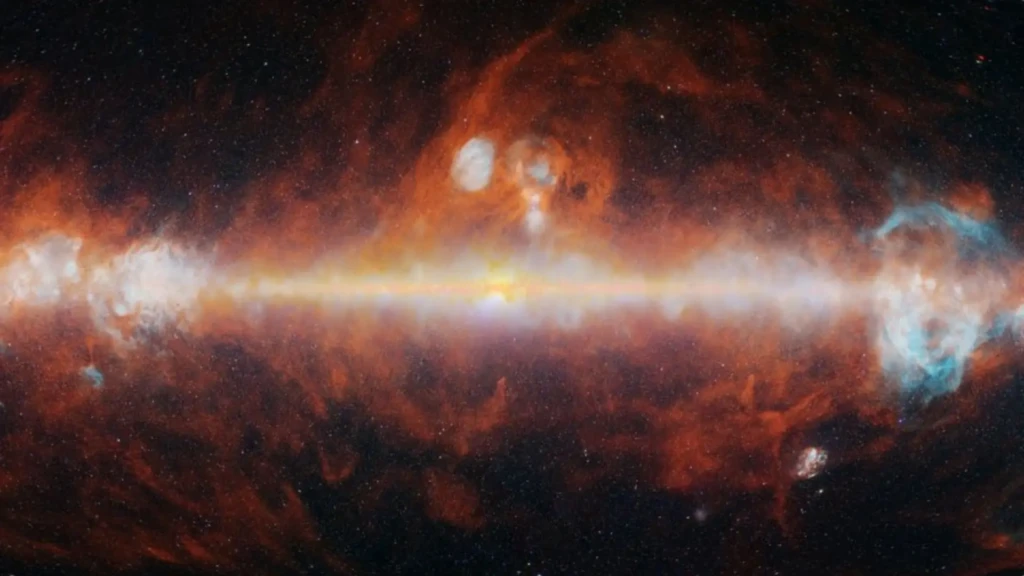
Cosmic map made by SPHEREx telescope. Image: NASA
SHARE

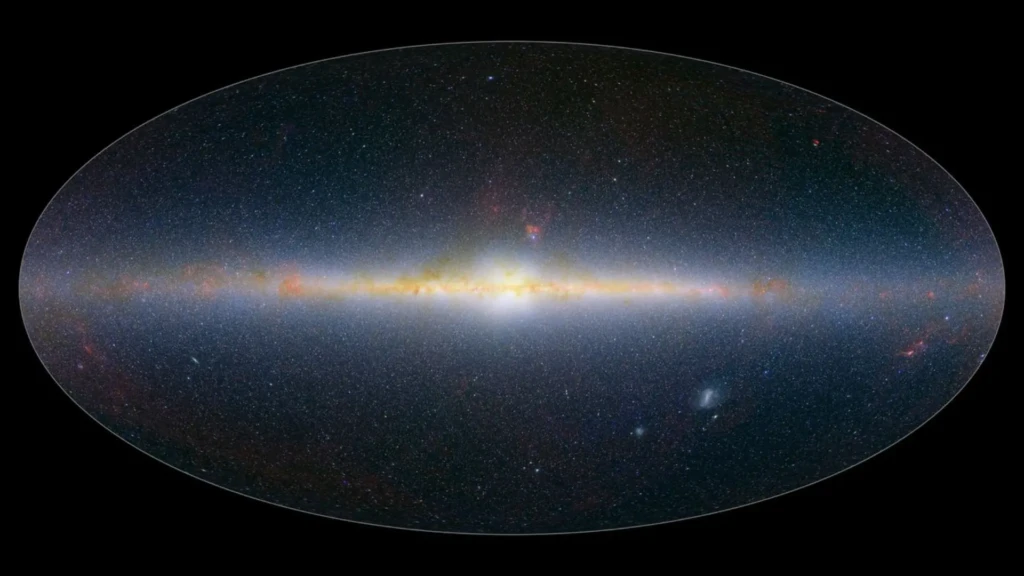
The SPHEREx telescope built by NASA has completed its first all-sky map of the universe. Made over the last eight months, the map was composed in 102 different colours of infrared light which is invisible to the human eye.

“We essentially have 102 new maps of the entire sky, each one in a different wavelength and containing unique information about the objects it sees,” Shawn Domagal-Goldman, director of NASA’s Astrophysics Division, said in a statement.


NASA has released a video produced using the map which features different colours emitted by stars (blue, green and white) and hot hydrogen gas (blue) and cosmic dust (red).

What’s the use of NASA SPHEREx’s cosmic map?

The SPHEREx telescope orbits Earth over the poles 14.5 times every day and collects 3600 images along one strip of the sky. As Earth moves around the Sun, the telescope’s field of view shifts and allows its to create a 360-degree mosaic covering the entire sky. And since this map is 3D, it will enable scientists to measure subtle variations in the way galaxies are clustered and distributed.

The infrared observatory circles the Earth, taking 3600 images per day along one strip of the sky. As the planet moves around the Sun, SPHEREx’s field of view shifts so that, in six months, the observatory creates a 360-degree mosaic that covers the entire sky, like this! pic.twitter.com/yzdnW3UEOF

— NASA JPL (@NASAJPL) December 18, 2025

Spectroscopy is a key aspect of SPHEREx’s observation. This process involves studying light by splitting it into different colours. Each of the 102 colours represent a particular wavelength of infrared light and they provide unique information about the galaxies, stars, planet-forming regions, and other cosmic features.
NASA SPHEREx
SPHEREx telescope’s infrared view of the universe. Image: NASA

These colours could also help measure the distance to hundreds of millions of galaxies and ultimately offer insights into an event called ‘inflation’ – wherein the universe expanded by a trillion-trillionfold in fraction of a second after the big bang.

In a way, SPHEREx or Spectro-Photometer for the History of the Universe, Epoch of Reionization, and Ices Explorer is better than the James Webb Space Telescope (JWST). While the Webb telescope can do spectroscopy in more wavelengths of light, its field of view is thousands of times smaller than SPHEREx. Its combination of colours with a wide field of view puts SPHEREx among one of the most powerful telescopes ever.

Launched in May, SPHEREx has an objective of studying the change in galaxies since the big bang and the distribution of key ingredients for life in the Milky Way.

ALSO READ: NASA Unveils 100000th Image Captured By Its Mars Reconnaissance Orbiter

ALSO READ: Comet 3I/ATLAS Entered The Oort Cloud 8000 Years Ago. What Was Earth Like Then?

TAGGED:James Webb Space TelescopeNASASpaceSPHEREx
Share This Article
Facebook Pinterest Whatsapp Whatsapp LinkedIn Copy Link Print

Latest News

NASA's SLS rocket.
NASA’s Artemis II Rocket Plagued By Leaks Again; Administrator Jared Isaacman Reacts
Artemis
SpaceX Dragon spacecraft for NASA's Crew-12 mission.
SpaceX Rolls Out Dragon Spacecraft For NASA’s Crew-12 Mission While Falcon 9 Remains Grounded
Spaceflight
NASA's Artemis II SLS Rocket
NASA Delays Artemis II Moon Mission Launch To March – Here’s Why
Artemis
NASA's SLS rocket.
Astronauts In Quarantine, Rocket Powered On – How NASA Is Preparing For Artemis II
Artemis

You Might Also Like

Blue Origin NS-37 mission
Spaceflight

Blue Origin To Attempt Launch Of NS-37 Mission With Six Humans Again On Dec 20

December 20, 2025
SpaceX Starship on flight 11.
Spaceflight

SpaceX CEO Elon Musk Reveals When Starship Will Launch On Next Test Flight

January 29, 2026
Blue Origin SpaceX
Spaceflight

How Does Blue Origin’s Monstrous New Glenn Rocket Compare To Starship?

November 23, 2025
Apollo 17 NASA
Spaceflight

Apollo 17 At 53: When NASA Landed Astronauts On The Moon For The Final Time

December 11, 2025
© 2026, Blue Terra Journal
  • About
  • Privacy Policy
  • Terms
  • Contact
Welcome Back!

Sign in to your account

Username or Email Address
Password

Lost your password?