Blue Terra Journal

  • Home
  • Spaceflight
    SpaceflightShow More
    SpaceX Dragon spacecraft for NASA's Crew-12 mission.
    SpaceX Rolls Out Dragon Spacecraft For NASA’s Crew-12 Mission While Falcon 9 Remains Grounded
    February 4, 2026
    NASA partners with Axiom Space
    NASA And Axiom Space Announce 5th Private Crew Mission To International Space Station In 2027
    February 1, 2026
    Blue Origin Mark 1 lander.
    Blue Origin Halts New Shepard Missions For At Least 2 Years To Land Humans On The Moon
    February 1, 2026
    SpaceX Starship on flight 11.
    SpaceX CEO Elon Musk Reveals When Starship Will Launch On Next Test Flight
    January 29, 2026
    NOAA's SOLAR-1 observatory.
    NOAA’s Sun Spying SOLAR-1 Observatory Reaches Its Destination 1.5 Million Km From Earth
    January 31, 2026
  • Astronomy
    AstronomyShow More
    Voyager 1 illustration
    NASA’s Voyager 1 Will Be One Light-Day Away From Earth In 2026 – What This Means
    January 26, 2026
    Auroras triggered by CMEs.
    Auroras Flood The Night Skies After Largest Solar Radiation Storm In Over 20 Years | Photos
    January 20, 2026
    Hubble discovers Cloud-9.
    Hubble Telescope Uncovers New Object ‘Cloud-9’ – A ‘Failed Galaxy’ With No Stars
    January 13, 2026
    SpaceX launches NASA telescope.
    SpaceX Launches NASA’s Exoplanet Exploring Telescope Pandora On Twilight Mission
    January 19, 2026
    Comet 3I/ATLAS by Hubble telescope
    Comet 3I/ATLAS Is Not An Alien Spacecraft – This Research Likely Confirms It
    January 10, 2026
  • India
    IndiaShow More
    Shubhanshu Shukla aboard the ISS.
    ISRO Astronaut Shubhanshu Shukla Awarded Ashoka Chakra For Heroic Ax-4 Mission
    January 25, 2026
    ISRO's PSLV lifts off to space.
    ISRO’s PSLV Rocket Suffers Third Stage Failure After Successful Liftoff; Payloads Lost
    January 23, 2026
    Dhruva Space team at ISRO facility.
    India’s Dhruva Space To Launch 10 Missions, Including 1st Northeastern Satellite, On ISRO’s PSLV
    January 12, 2026
    ISRO's PSLV rocket
    ISRO To Seek Redemption With PSLV-C62 Mission Launch On January 12
    January 12, 2026
    ISRO SSLV
    ISRO’s SSLV Rocket Just Got Better After Latest Third Stage Test Fire
    December 31, 2025
  • Artemis
    ArtemisShow More
    NASA's SLS rocket.
    NASA’s Artemis II Rocket Plagued By Leaks Again; Administrator Jared Isaacman Reacts
    February 5, 2026
    NASA's Artemis II SLS Rocket
    NASA Delays Artemis II Moon Mission Launch To March – Here’s Why
    February 3, 2026
    NASA's SLS rocket.
    Astronauts In Quarantine, Rocket Powered On – How NASA Is Preparing For Artemis II
    February 3, 2026
    NASA's Artemis II crew
    Inside Artemis II: How NASA Will Study Astronaut Health And Deep Space Radiation
    January 30, 2026
    NASA's SLS rocket at launch pad.
    NASA’s Artemis II To Carry Relic Of Humanity’s First Flight And More To The Moon
    January 27, 2026
  • More
    • About
    • Privacy Policy
    • Terms
    • Contact

Blue Terra Journal

  • Home
  • Spaceflight
  • Astronomy
  • India
  • Artemis
Search
  • Pages
    • About
    • Contact
    • Privacy Policy
    • Terms

Home - Astronomy - Alaknanda: Why This Ancient Spiral Galaxy’s Discovery By Indian Scientists Matters

Astronomy

Alaknanda: Why This Ancient Spiral Galaxy’s Discovery By Indian Scientists Matters

We're seeing this galaxy as it was 12 billion years ago.

Harsh Vardhan
Last updated: December 18, 2025 10:50 PM
Harsh Vardhan
Share
5 Min Read
Alaknanda galaxy
The Alaknanda spiral galaxy. Image: NASA/ESA/CSA/CASR- Rashi Jain, Yogesh Wadadekar
SHARE

Contents
  • About the Alaknanda galaxy
  • Significance of Alaknanda’s discovery 

A team of Indian scientists has discovered a spiral galaxy almost from the beginning of time, challenging our present understanding of the early universe. In a study published in Astronomy & Astrophysics, Rashi Jain and Yogesh Wadadekar, researchers from Pune’s National Centre for Radio Astrophysics, noted that they’ve named the galaxy ‘Alaknanda‘ after a Himalayan river. It is “one of the headstreams of the Ganga and sister river of the Mandakini, which, in turn, lends its name to the Milky Way galaxy,” the authors wrote.

Indian astronomers, using the powerful James Webb Space Telescope, have discovered “Alaknanda” — a beautifully formed spiral galaxy dating back to when the universe was just 1.5 billion years old.

A proud moment for India’s growing leadership in space science and cosmic… pic.twitter.com/vRDzcPm5ZD

— Dr Jitendra Singh (@DrJitendraSingh) December 4, 2025

About the Alaknanda galaxy

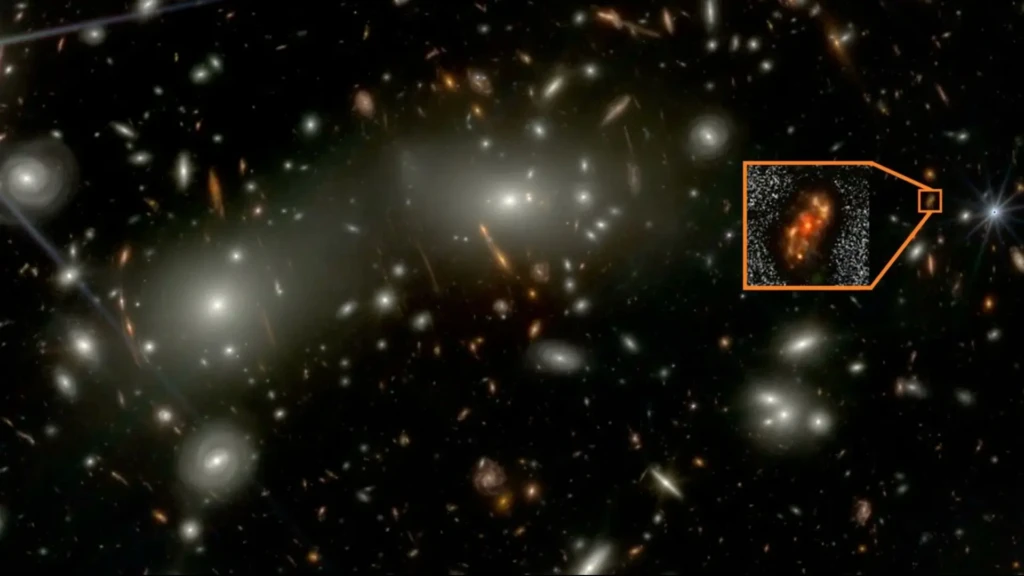
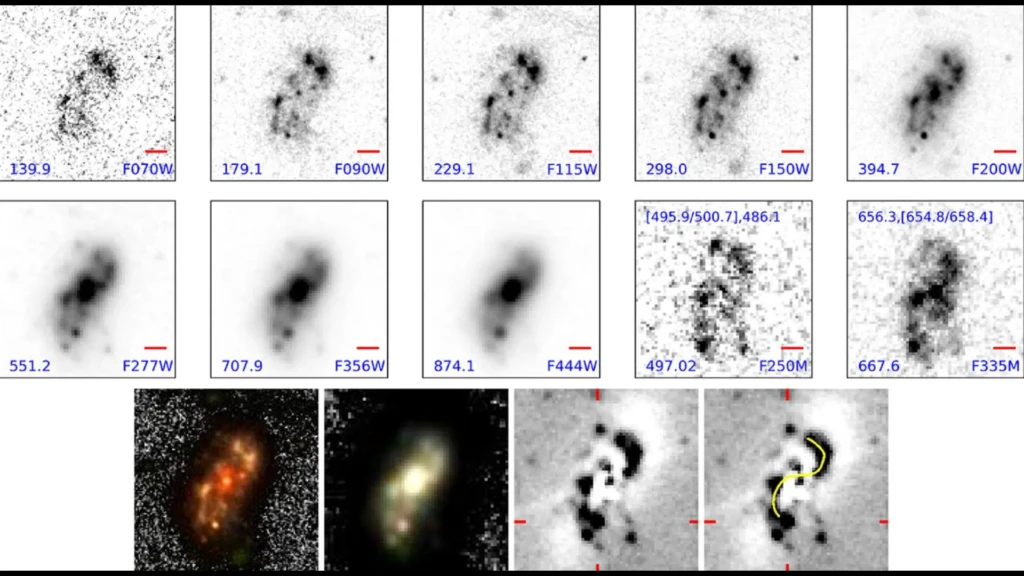
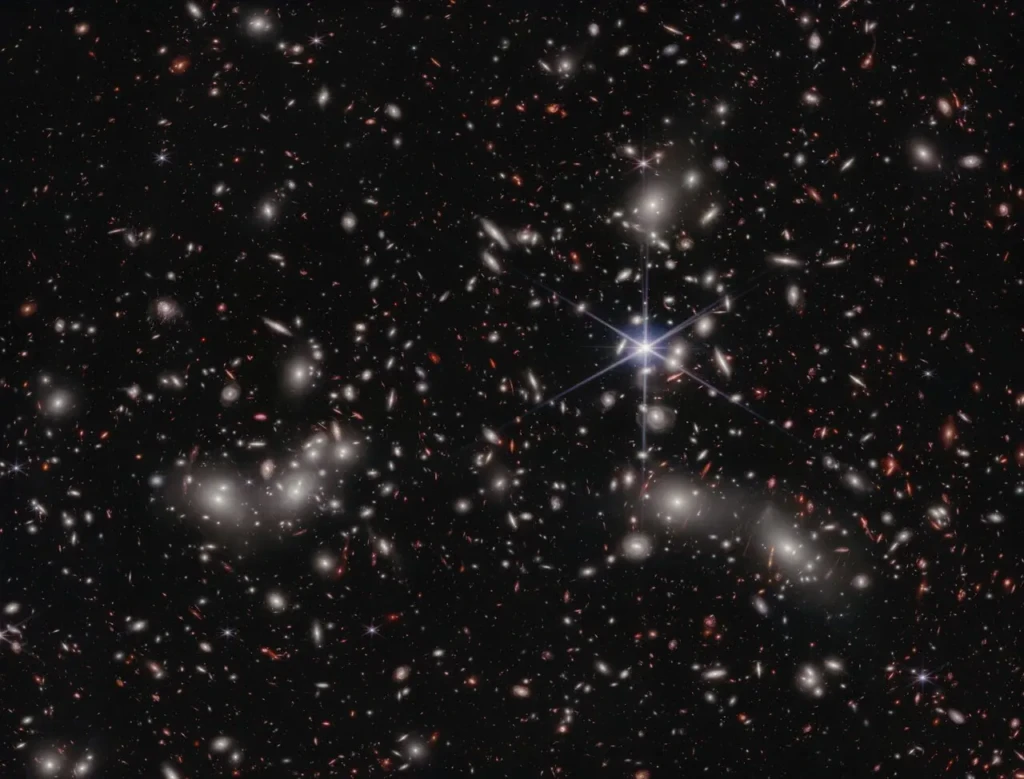
The Alaknanda galaxy was discovered when the duo was studying the UNCOVER survey data of the Abell 2744 galaxy cluster collected by James Webb Space Telescope‘s Near-Infrared Camera (NIRcam). They were able to spot Alaknanda due to a phenomenon called gravitational lensing caused by Abell 2744, that magnified the background galaxies up to dozens of times by bending the light emerging from them. Alaknanda was one of the galaxies in the background and its discovery wouldn’t have been possible without the lensing phenomenon.
Alaknanda galaxy
The Alaknanda galaxy captured in Webb telescope’s images. Image: NASA/ESA/NCRA- Rashi Jain, Yogesh Wadadekar

Alaknanda has surprised scientists because it has two symmetrical spiral arms with star-forming regions appearing like “beads on a string.” This hasn’t been seen before in early galaxies. It is estimated to have been born just 1.5 billion years after the big bang (which birthed the universe around 13.8 billion years ago) and it spans about 33,000 light-years across.

According to the authors, Alaknanda has a mass 10 billion times greater than the Sun and it’s producing stars at a much higher rate than the Milky Way. The rate is estimated to be 63 Sun per year, which is strange for a galaxy so young. What’s even more surprising is that Alaknanda’s stars are only about 200 million years old, meaning this galaxy built itself rapidly in the early universe.
Alaknanda galaxy
Webb telescope’s view of the Abell 2744 galaxy cluster. Image: NASA/ESA/CSA

It is worth noting that we’re seeing Alaknanda as it was over 12 billion years ago – because that’s how long it took the light emerging from it to reach us. It’s possible that the galaxy has evolved to a great extent, grew much larger in size, merged with another galaxy or may not exist anymore. We don’t know its present state today because that would take another 12.5 billion years.

Significance of Alaknanda’s discovery 

This discovery is significant because it challenges earlier theories that spiral galaxies emerged at a much later stage after the big bang. Alaknanda has proved that stable, rotating disks may have formed much earlier than once believed. It has also posited new questions about the formation of spiral galaxies – do their arm form naturally from the galaxy’s own rotation or from the gravitational pull by a small companion galaxy? The assembly of such a large disk by itself soon after the birth of the universe is currently a mystery.

The study authors say that Alaknanda will be investigated further by the Webb telescope’s NIRSpec (Near-infrared Spectrograph) instrument and the ALMA observatory to answer key questions about the galaxy’s disk rotation and whether the disk is cold and stable like modern spirals or hot and turbulent.

ALSO READ: NASA’s PUNCH Mission Spies Newly Discovered Comet SWAN In Thrilling Footage

ALSO READ: What Webb Telescope’s Triple-Star System Discovery Reveals About The Universe
TAGGED:AlaknandaAlaknanda galaxyJames Webb Space TelescopeMilky Way
Share This Article
Facebook Pinterest Whatsapp Whatsapp LinkedIn Copy Link Print

Latest News

NASA's SLS rocket.
NASA’s Artemis II Rocket Plagued By Leaks Again; Administrator Jared Isaacman Reacts
Artemis
SpaceX Dragon spacecraft for NASA's Crew-12 mission.
SpaceX Rolls Out Dragon Spacecraft For NASA’s Crew-12 Mission While Falcon 9 Remains Grounded
Spaceflight
NASA's Artemis II SLS Rocket
NASA Delays Artemis II Moon Mission Launch To March – Here’s Why
Artemis
NASA's SLS rocket.
Astronauts In Quarantine, Rocket Powered On – How NASA Is Preparing For Artemis II
Artemis

You Might Also Like

NASA Parker Solar Probe
Astronomy

NASA’s Parker Solar Probe Saw Something Strange On The Sun – All About It

December 15, 2025
Comet 3I/ATLAS NASA Avi Loeb
Astronomy

Comet 3I/ATLAS Entered The Oort Cloud 8000 Years Ago. What Was Earth Like Then?

December 15, 2025
image 14 1
Astronomy

ESA’s Euclid Telescope Spies Nebula Birthing Stars 1,300 Light-Years Away

November 7, 2025
Comet 3I/ATLAS pre-perihelion.
Astronomy

Comet 3I/ATLAS Is NOT Changing Colours, But Sudden Brightness Remains A Mystery

November 19, 2025
© 2026, Blue Terra Journal
  • About
  • Privacy Policy
  • Terms
  • Contact
Welcome Back!

Sign in to your account

Username or Email Address
Password

Lost your password?