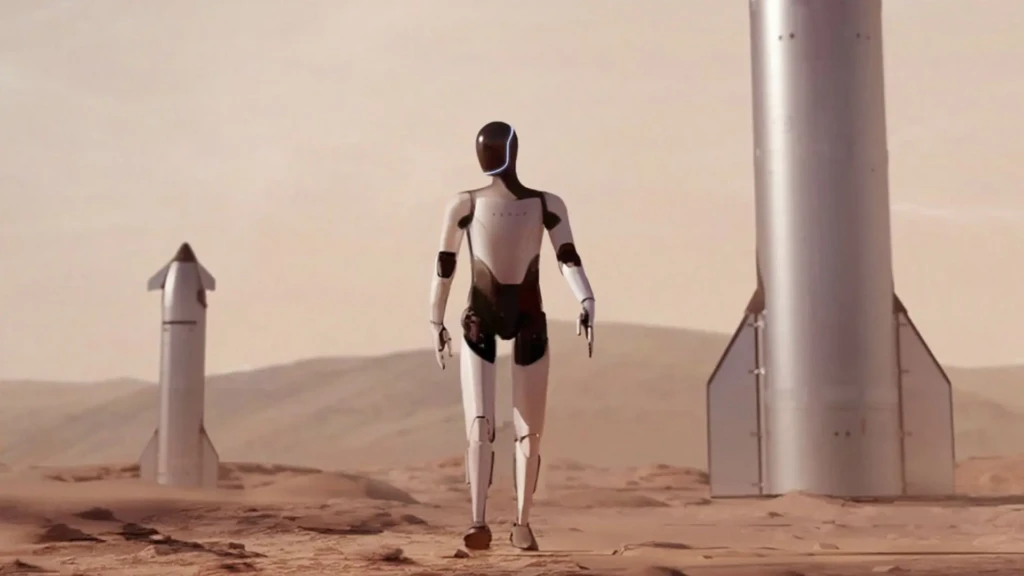
Elon Musk-owned Tesla’s Optimus robot might be the carrier of human legacy to other stars. The billionaire had announced earlier this year that his aerospace company SpaceX may launch Optimus to Mars in late 2026, and he has now put forth another bold idea. In a post on X Saturday, Elon Musk said – “Optimus will be the Von Neumann probe,” bringing to light this incredible concept of colonising deep space with little to no human intervention.
Optimus will be the Von Neumann probe
— Elon Musk (@elonmusk) November 30, 2025
What is a Von Neumann probe?
A Von Neumann probe is a well-defined theoretical concept about a hypothetical self-replicating machine or spacecraft that can make copies of itself. It was proposed by physicist John von Neumann in the 1940s-1950s.
The concept involves sending a probe to another planet, moon, asteroid or interstellar worlds where the probe would use local resources to replicate. Those copies will then travel onward and replicate again, continuing the cycle. This ‘seeding’ is at the core of Von Neumann that could potentially enable large-scale exploration or colonisation of alien worlds with minimal human intervention.
According to a study published in the International Journal of Astrobiology – “A space-faring civilization could conceivably use such constructs to occupy much or all of the Milky Way galaxy and perhaps the entire universe.”
Optimus on Mars
This wild process will most likely begin with the Optimus robot which Tesla manufactures to handle tasks that are “repetitive, boring and dangerous.” Optimus uses Tesla’s AI neural network, also used in the company’s electric cars, that enables it to navigate the world.
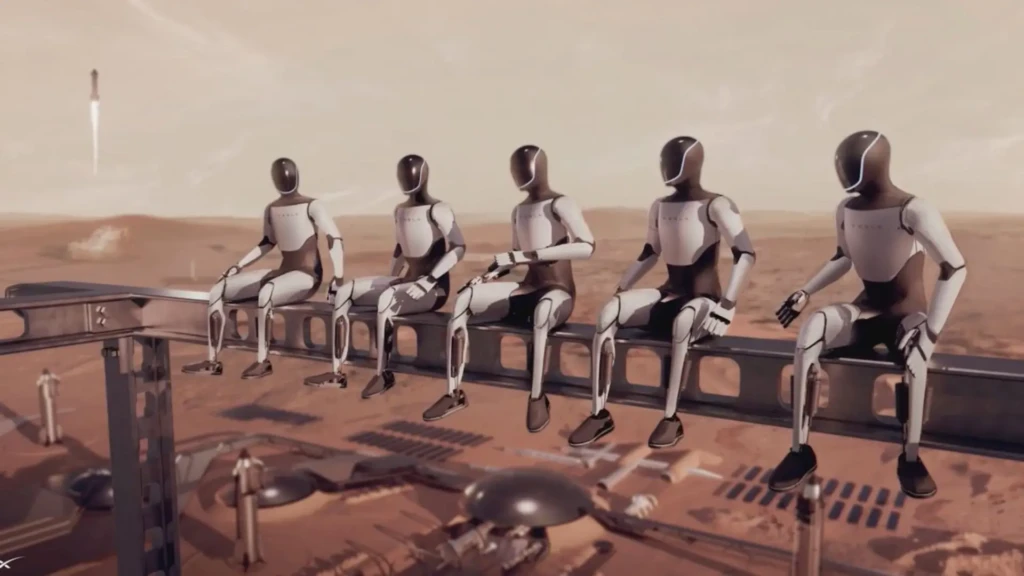
If Optimus actually were to become a Von Neumann probe, it will build replicas of itself in manufacturing units set up on another world, by a team of Optimus robots. This team could eventually grow into an army that is capable of carrying out monumental tasks like building infrastructure and mining. Nothing could be better than this as it would reduce the risk and cost before sending humans.
Earlier in March, Musk said that SpaceX will launch Starship to Mars with Optimus robots next year, followed by human missions between 2029-2031.
ALSO READ: Neil deGrasse Tyson Shares The Only Reasons Humans May Reach Mars
How practical is a Von Neumann probe?
A Von Neumann probe is not just hype. A self-replicating machine is theoretically feasible but there are limitations in this age. Tesla Optimus, for example, is far from gaining full autonomy and is not robust enough to operate on its own, especially in a Martian environment. At the time, Tesla is not producing Optimus at scale; it’s likely to begin next summer.
The robot’s electronics and critical components may fail quickly on Mars which gets bombarded with radiation, undergoes wild temperature swings and encounters global storms bigger than continents on Earth. Besides, humans also have yet to develop robotics advanced enough to ensure the robots need no human intervention in tasks like mining, processing raw materials, assembling complex machines millions of kilometres away.
Emphasising the limitations, a study published in Science Direct says – “Although the theoretical feasibility of a self-replicating machine has been formally proven, an actual construction, even in the form of a computer program, is difficult and computationally expensive. Hence, constructing a self-replicating probe is not only challenging at the level of the hardware but also the software.”
ALSO READ: ‘Mars Is Not A Great Place’: Avi Loeb Derides Elon Musk’s Colonisation Dream