Blue Terra Journal

  • Home
  • Spaceflight
    SpaceflightShow More
    SpaceX Dragon spacecraft for NASA's Crew-12 mission.
    SpaceX Rolls Out Dragon Spacecraft For NASA’s Crew-12 Mission While Falcon 9 Remains Grounded
    February 4, 2026
    NASA partners with Axiom Space
    NASA And Axiom Space Announce 5th Private Crew Mission To International Space Station In 2027
    February 1, 2026
    Blue Origin Mark 1 lander.
    Blue Origin Halts New Shepard Missions For At Least 2 Years To Land Humans On The Moon
    February 1, 2026
    SpaceX Starship on flight 11.
    SpaceX CEO Elon Musk Reveals When Starship Will Launch On Next Test Flight
    January 29, 2026
    NOAA's SOLAR-1 observatory.
    NOAA’s Sun Spying SOLAR-1 Observatory Reaches Its Destination 1.5 Million Km From Earth
    January 31, 2026
  • Astronomy
    AstronomyShow More
    Voyager 1 illustration
    NASA’s Voyager 1 Will Be One Light-Day Away From Earth In 2026 – What This Means
    January 26, 2026
    Auroras triggered by CMEs.
    Auroras Flood The Night Skies After Largest Solar Radiation Storm In Over 20 Years | Photos
    January 20, 2026
    Hubble discovers Cloud-9.
    Hubble Telescope Uncovers New Object ‘Cloud-9’ – A ‘Failed Galaxy’ With No Stars
    January 13, 2026
    SpaceX launches NASA telescope.
    SpaceX Launches NASA’s Exoplanet Exploring Telescope Pandora On Twilight Mission
    January 19, 2026
    Comet 3I/ATLAS by Hubble telescope
    Comet 3I/ATLAS Is Not An Alien Spacecraft – This Research Likely Confirms It
    January 10, 2026
  • India
    IndiaShow More
    Shubhanshu Shukla aboard the ISS.
    ISRO Astronaut Shubhanshu Shukla Awarded Ashoka Chakra For Heroic Ax-4 Mission
    January 25, 2026
    ISRO's PSLV lifts off to space.
    ISRO’s PSLV Rocket Suffers Third Stage Failure After Successful Liftoff; Payloads Lost
    January 23, 2026
    Dhruva Space team at ISRO facility.
    India’s Dhruva Space To Launch 10 Missions, Including 1st Northeastern Satellite, On ISRO’s PSLV
    January 12, 2026
    ISRO's PSLV rocket
    ISRO To Seek Redemption With PSLV-C62 Mission Launch On January 12
    January 12, 2026
    ISRO SSLV
    ISRO’s SSLV Rocket Just Got Better After Latest Third Stage Test Fire
    December 31, 2025
  • Artemis
    ArtemisShow More
    NASA's SLS rocket.
    NASA’s Artemis II Rocket Plagued By Leaks Again; Administrator Jared Isaacman Reacts
    February 5, 2026
    NASA's Artemis II SLS Rocket
    NASA Delays Artemis II Moon Mission Launch To March – Here’s Why
    February 3, 2026
    NASA's SLS rocket.
    Astronauts In Quarantine, Rocket Powered On – How NASA Is Preparing For Artemis II
    February 3, 2026
    NASA's Artemis II crew
    Inside Artemis II: How NASA Will Study Astronaut Health And Deep Space Radiation
    January 30, 2026
    NASA's SLS rocket at launch pad.
    NASA’s Artemis II To Carry Relic Of Humanity’s First Flight And More To The Moon
    January 27, 2026
  • More
    • About
    • Privacy Policy
    • Terms
    • Contact

Blue Terra Journal

  • Home
  • Spaceflight
  • Astronomy
  • India
  • Artemis
Search
  • Pages
    • About
    • Contact
    • Privacy Policy
    • Terms

Home - India - Skyroot Aerospace’s First Commercial Rocket Vikram-I Unveiled; Launch Soon

India

Skyroot Aerospace’s First Commercial Rocket Vikram-I Unveiled; Launch Soon

India's first private commercial rocket is here.

Harsh Vardhan
Last updated: December 10, 2025 8:12 PM
Harsh Vardhan
Share
4 Min Read
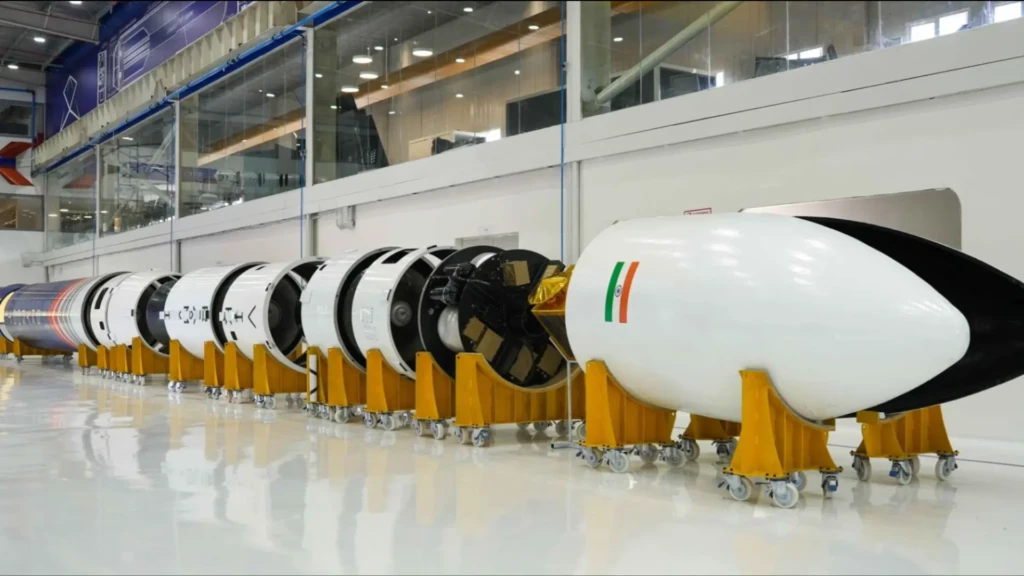
Skyroot Aerospace Vikram-I rocket.
Skyroot Aerospace is planning to debut Vikram-I in early 2026. Image: Skyroot Aerospace
SHARE

Prime Minister Narendra Modi inaugurated Hyderabad-based Skyroot Aerospace‘s Infinity Campus on Thursday and unveiled the company’s Vikram-I rocket designed for low-cost satellite launches. Named after father of India’s space programme, Dr. Vikram Sarabhai, Vikram-I builds on the success of of Vikram-S, which launched as India’s first private rocket during the Prarambh mission in November 2022.

Vikram-I: India’s first private commercial rocket

Vikram-I is a four-stage rocket that is built for dedicated and rideshare launches and custom orbital deployment of small satellites. The launch vehicle stands 20 meters tall and 1.7 meters in diameter, and its payload capacity depends on orbit type, inclination and mission profile [up to 350 kg to LEO and up to 260 kg to Sun-synchronous orbit, per Skyroot].
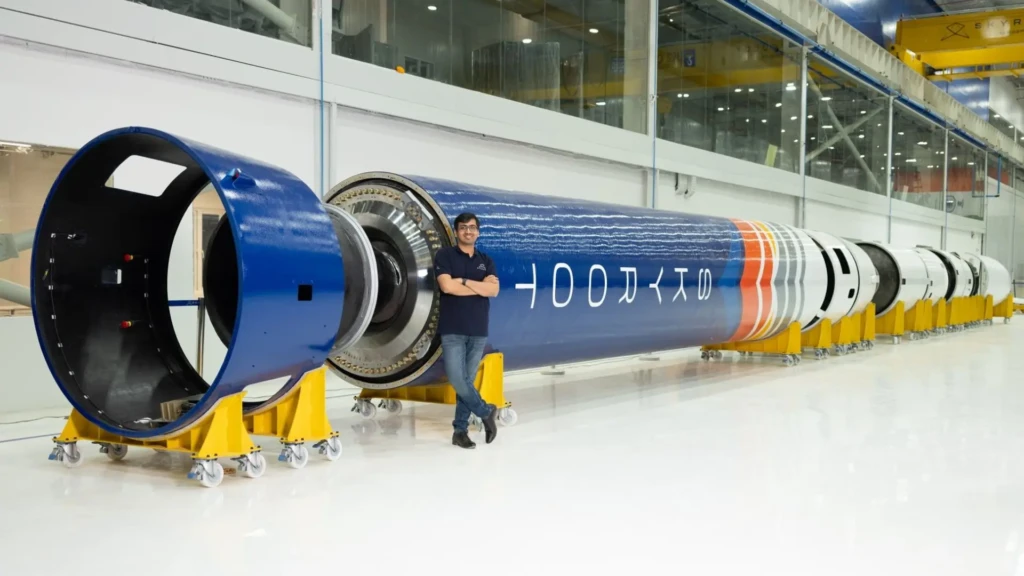
Skyroot Aerospace Vikram-I rocket
Skyroot Aerospace’s CEO and co-founder Pawan Chandana standing next to Vikram-I rocket’s full-scale structural mockup. Image: X/@PawanKChandana

According to Skyroot, Vikram-I has an all carbon-composite structure which makes it significantly lighter than metallic rockets. Lower mass means the rocket will use less propellant during liftoff and yield greater launch efficiency. It will also enable higher payload capacity per launch, lower manufacturing and operating costs and offer higher launch cadence by reducing turnaround time. 

🚀 India’s first private orbital launch is closer than ever: Vikram-1’s first stage, Kalam-1200, has been fully validated, with 236 data channels confirming flawless performance.

💥 This powerhouse motor lifts the rocket from the launchpad to 50+ km altitude. Watch it roar for… pic.twitter.com/iJw9PLTw6E

— Skyroot Aerospace (@SkyrootA) August 10, 2025

Vikram-I is a four-stage rocket and the first three stages use solid propellant. The first stage is powered by Kalam-1200 engine which produces 1200 kN of peak thrust whereas the second stage uses Kalam-250. Measuring 11 meters tall, the first stage was fully validated in August after a full-duration test at ISRO‘s Satish Dhawan Space Center. The third stage, powered by Kalam-100, has a thrust capacity of 100 kN. Finally, the 3D printed fourth stage is powered by a cluster of four Raman engines that use liquid propellant. The fourth stage will give Skyroot flexibility, and room for adjustments during satellite deployment and perhaps even allow multiple burns, which is not possible with solid propellant stages.

The fourth stage uses the classic hypergolic propellant combo of monomethylhydrazine and nitrogen tetroxide (oxidiser) which ignite spontaneously without a spark when they’re mixed.

All stages of Vikram-I have been fully tested and its maiden launch is reportedly targeted in early 2026. Skyroot is also preparing to debut Vikram-II next year. Powered by a cryogenic engine, this rocket will provide greater lift and payload capacity of up to 900 kg to LEO.

ALSO READ: ISRO Gears Up To Launch SpaceX Rival’s Broadband Satellite On Dec 15

ALSO READ: ISRO Completes Parachute Air Drop Test Of Gaganyaan Crew Module | Video

TAGGED:Narendra ModiSkyroot AerospaceVikram SarabhaiVikram-I rocket
Share This Article
Facebook Pinterest Whatsapp Whatsapp LinkedIn Copy Link Print

Latest News

NASA's SLS rocket.
NASA’s Artemis II Rocket Plagued By Leaks Again; Administrator Jared Isaacman Reacts
Artemis
SpaceX Dragon spacecraft for NASA's Crew-12 mission.
SpaceX Rolls Out Dragon Spacecraft For NASA’s Crew-12 Mission While Falcon 9 Remains Grounded
Spaceflight
NASA's Artemis II SLS Rocket
NASA Delays Artemis II Moon Mission Launch To March – Here’s Why
Artemis
NASA's SLS rocket.
Astronauts In Quarantine, Rocket Powered On – How NASA Is Preparing For Artemis II
Artemis

You Might Also Like

Dhruva Space team at ISRO facility.
India

India’s Dhruva Space To Launch 10 Missions, Including 1st Northeastern Satellite, On ISRO’s PSLV

January 12, 2026
ISRO's PSLV rocket
India

ISRO To Seek Redemption With PSLV-C62 Mission Launch On January 12

January 12, 2026
ISRO
India

ISRO’s Bahubali Milestone: Cryogenic Edge To Power Multiple Satellite Injections

November 17, 2025
Blue Origin New Glenn BlueBird 7 mission.
India

ISRO’s LVM3 Rocket Launches Heaviest Satellite Ever From Indian Soil; Watch

December 27, 2025
© 2026, Blue Terra Journal
  • About
  • Privacy Policy
  • Terms
  • Contact
Welcome Back!

Sign in to your account

Username or Email Address
Password

Lost your password?