Blue Terra Journal

  • Home
  • Spaceflight
    SpaceflightShow More
    NASA's MAVEN orbiter
    NASA’s MAVEN Orbiter Confirmed Dead On Mars; What Did It Achieve In 11 Years?
    June 5, 2026
    Blue Origin's New Glenn rocket.
    What Blue Origin’s New Glenn Explosion Means For NASA And Its Moon Ambitions
    June 10, 2026
    Elon Musk SpaceX Starship
    Elon Musk’s SpaceX launches new Starship V3 on 12th mission, but it wasn’t flawless
    June 5, 2026
    SpaceX Starship
    SpaceX Starship’s 12th Test Flight Targeted On May 20; No Booster Catch This Time
    May 31, 2026
    SpaceX's Starship during launch rehearsal.
    SpaceX Completes Starship’s Launch Rehearsal For Flight 12 This Week; What To Expect?
    May 13, 2026
  • Astronomy
    AstronomyShow More
    The galactic bulge by Euclid telescope. Credit: European Space Agency
    This Euclid Telescope Image Of Milky Way’s Centre With 60 Million Stars May Break Your Brain
    June 27, 2026
    UFO videos shared by US government
    UFO Alert! US Government Releases New Videos Of Glowing Orbs Floating In The Sky
    June 13, 2026
    Meteor over Mayon volcano
    Watch: Flashy Green Meteor Streaks Over Erupting Volcano In The Philippines
    May 27, 2026
    Artist's impression of NASA's Psyche spacecraft.
    NASA’s Psyche Spacecraft Will Zoom Past Mars Today On Its Way To Metal-Rich Asteroid
    May 15, 2026
    Comet MAPS image
    Video: Comet MAPS destroyed after plunging into the Sun; event caught by NASA missions
    April 18, 2026
  • India
    IndiaShow More
    Shubhanshu Shukla aboard the ISS.
    ISRO Astronaut Shubhanshu Shukla Awarded Ashoka Chakra For Heroic Ax-4 Mission
    February 9, 2026
    ISRO's PSLV lifts off to space.
    ISRO’s PSLV Rocket Suffers Third Stage Failure After Successful Liftoff; Payloads Lost
    January 23, 2026
    Dhruva Space team at ISRO facility.
    India’s Dhruva Space To Launch 10 Missions, Including 1st Northeastern Satellite, On ISRO’s PSLV
    January 12, 2026
    ISRO's PSLV rocket
    ISRO To Seek Redemption With PSLV-C62 Mission Launch On January 12
    January 12, 2026
    ISRO SSLV
    ISRO’s SSLV Rocket Just Got Better After Latest Third Stage Test Fire
    December 31, 2025
  • Artemis
    ArtemisShow More
    NASA Artemis III crew
    NASA Artemis III: Meet The Astronauts Who Will Set The Stage For 2028 Moon Landing
    June 10, 2026
    Blue Origin's New Glenn rocket.
    What Blue Origin’s New Glenn Explosion Means For NASA And Its Moon Ambitions
    June 10, 2026
    NASA Artemis II mission
    Welcome Home! NASA’s Artemis II Astronauts Are Back After Historic Moon Voyage
    April 22, 2026
    NASA Artemis II iPhone image
    iPhones Reigned Supreme On NASA’s Artemis II Moon Mission
    April 10, 2026
    Artemis II NASA
    All Eyes On Scary Artemis II Reentry As NASA Moon Mission Nears Completion
    April 9, 2026
  • More
    • About
    • Privacy Policy
    • Terms
    • Contact

Blue Terra Journal

  • Home
  • Spaceflight
  • Astronomy
  • India
  • Artemis
Search
  • Pages
    • About
    • Contact
    • Privacy Policy
    • Terms

Home - Astronomy - When NASA’s DART Mission Proved We Could Stop Armageddon

Astronomy

When NASA’s DART Mission Proved We Could Stop Armageddon

'So you're telling me there's a chance?'

Harsh Vardhan
Last updated: December 28, 2025 12:06 PM
Harsh Vardhan
Share
5 Min Read
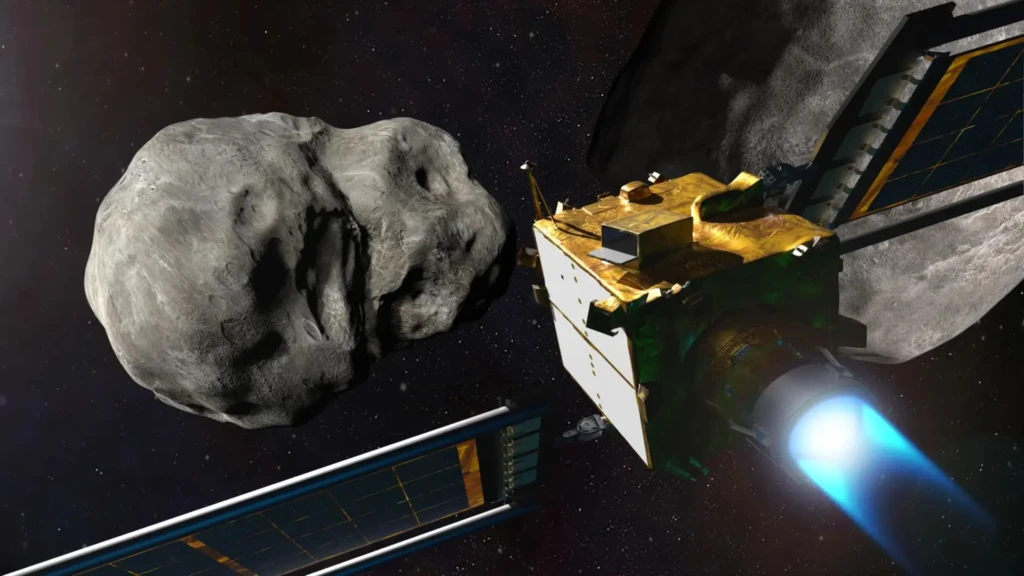
NASA DART
Artist's impression of DART impacting an asteroid. Image: NASA
SHARE


Contents
  • Killer rocks: The threat is real
  • Can asteroids be neutralised?

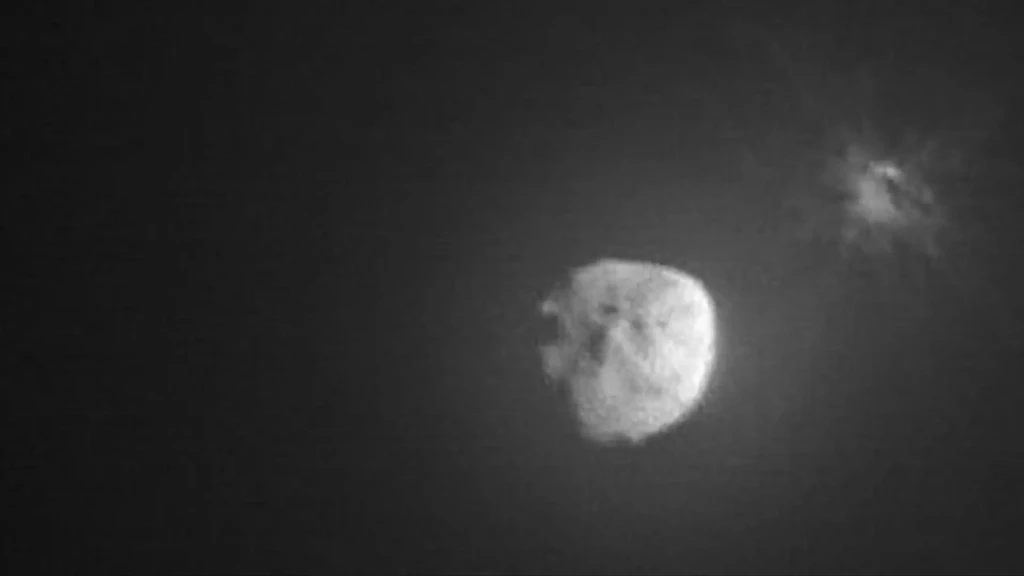
In November 2021, NASA launched a daring mission to smack a space rock lying 27 million kilometres from Earth. About 10 months later, the world saw, for the first time, a spacecraft deliberately slamming into an asteroid, in what was a bold step to build a planetary defense technology.

The mission was the Double Asteroid Redirection Test (DART) and the target was Dimorphos, a 525 feet or 160 meters wide rock that was orbiting another asteroid Didymos (measuring 2,559 feet or 780 meters).
NASA DART mission.
Dimorphos (right) next to Didymos (center) after DART’s impact. Image: NASA

When the impact occurred on September 26, 2022, it didn’t just prove a concept, it demonstrated that humanity can deflect a threatening asteroid and fundamentally enhance our planetary defense capabilities.

Killer rocks: The threat is real

The NASA’s Planetary Defense Coordination Office leads the search for potentially hazardous asteroids using telescopes like Catalina Sky Survey, Pan-STARRS and ATLAS, and space-based observatories such as NEOWISE. As of September 2025, the agency has discovered 39,123 near-Earth asteroids of all sizes, out of which 873 are larger than 1 km wide and 11,343 are larger than 140 meters.

Between October and September alone, as many as 12 near-Earth asteroids passed closer to the Earth than the Moon, and there were 176 asteroids which made their closest approach to our planet in the last 365 days. NASA says that their flybys bombarded Earth with 100 tons of dust and sand-sized particles, but since most of them burnup in the atmosphere, they never make it to the surface.

However, there have been instances when we were not so lucky. The Tunguska event of 1908 is one of the most talked about when one discusses the threat of asteroid impacts (other than the Chicxulub that killed the dinosaurs).

Tunguska asteroid impact.
Fallen trees after Tunguska asteroid event. Image: NASA

It was a quiet morning of June 30, 1908 when an asteroid exploded in the sky over Tunguska in Russia, at 7:15 am. The space rock was estimated to be between 30-40 meters wide and was travelling at approximately 1,00,000 km per hour. Even though it exploded between 6-10 km above the surface, the explosion released energy equivalent to 10-15 megatons of TNT. An expedition team, which went to explore the site nearly 20 years after the event, discovered that the asteroid had knocked over 80 million trees and completely destroyed more than 2,200 square km of forest area.

While there were no confirmed deaths from the explosion, several locals were knocked unconscious and herds of reindeers in the forest perished.

Russia witnessed a similar event in 2013, now remembered as the Chelyabinsk Impact, due to an explosion caused by an asteroid that impacted Earth’s atmosphere.

Chelyabinsk asteroid
The Chelyabinsk asteroid entering Earth’s atmosphere. Image: NASA

This also occurred several kilometres above the ground releasing energy equivalent to 4,40,000 tons of TNT and injuring 1,600 people within a radius of over 500 square km.

ALSO READ: Artemis 3 Delayed To 2028? Report Says SpaceX’s Starship May Hurt NASA Again

Can asteroids be neutralised?

It may have seemed impossible before but DART proved it can be done. With this mission, NASA wanted to test and demonstrate a method of changing an asteroid’s motion in space using a ‘kinetic impactor.’

When the small car-sized DART spacecraft impacted Dimorphos at 21,960 km per hour, it managed to change the asteroid’s orbital period from 11 hours and 55 minutes to 11 hours and 23 minutes, shortening it by 32 minutes. The mission was flawlessly successful, proving that a mission like DART could be used to protect Earth from a collision with an asteroid.

Space agencies are now doubling down on this defense technique. In October 2024, the European Space Agency (ESA) launched the Hera mission that will rendezvous with Dimorphos in December 2026. The objective is to examine the twin-asteroid system post-collision and measure Dimorphos’s mass, study the crater left behind by DART and analyse the asteroid’s composition.

NASA is also building the NEO Surveyor space telescope to locate hazardous near-Earth asteroids that are hard to spot from the ground because they approach Earth from the direction of the Sun.

ALSO READ: The Fermi Paradox: Why We’ve Never Seen Aliens

TAGGED:asteroidDARTEuropean Space AgencyNASA
Share This Article
Facebook Pinterest Whatsapp Whatsapp LinkedIn Copy Link Print

Latest News

The galactic bulge by Euclid telescope. Credit: European Space Agency
This Euclid Telescope Image Of Milky Way’s Centre With 60 Million Stars May Break Your Brain
Astronomy
UFO videos shared by US government
UFO Alert! US Government Releases New Videos Of Glowing Orbs Floating In The Sky
Astronomy
NASA Artemis III crew
NASA Artemis III: Meet The Astronauts Who Will Set The Stage For 2028 Moon Landing
Artemis
NASA's MAVEN orbiter
NASA’s MAVEN Orbiter Confirmed Dead On Mars; What Did It Achieve In 11 Years?
Spaceflight

You Might Also Like

NASA Artemis II mission
Artemis

Welcome Home! NASA’s Artemis II Astronauts Are Back After Historic Moon Voyage

April 22, 2026
Mars NASA ISRO
Spaceflight

From Moon & Mars Missions To Starship Flights, A Recap Of 2025’s Biggest Spaceflight Moments

January 8, 2026
NASA's Crew-11 astronauts.
Spaceflight

NASA Crew-11 Evacuation LIVE: Watch Four Astronauts Depart From The ISS On Jan. 15

January 17, 2026
NASA Boeing Starliner
Spaceflight

NASA Switches Boeing Starliner’s 2026 Crew Flight To Cargo-Only Mission

November 25, 2025
© 2026, Blue Terra Journal
  • About
  • Privacy Policy
  • Terms
  • Contact
Welcome Back!

Sign in to your account

Username or Email Address
Password

Lost your password?