Blue Terra Journal

  • Home
  • Spaceflight
    SpaceflightShow More
    SpaceX Dragon spacecraft for NASA's Crew-12 mission.
    SpaceX Rolls Out Dragon Spacecraft For NASA’s Crew-12 Mission While Falcon 9 Remains Grounded
    February 4, 2026
    NASA partners with Axiom Space
    NASA And Axiom Space Announce 5th Private Crew Mission To International Space Station In 2027
    February 1, 2026
    Blue Origin Mark 1 lander.
    Blue Origin Halts New Shepard Missions For At Least 2 Years To Land Humans On The Moon
    February 1, 2026
    SpaceX Starship on flight 11.
    SpaceX CEO Elon Musk Reveals When Starship Will Launch On Next Test Flight
    January 29, 2026
    NOAA's SOLAR-1 observatory.
    NOAA’s Sun Spying SOLAR-1 Observatory Reaches Its Destination 1.5 Million Km From Earth
    January 31, 2026
  • Astronomy
    AstronomyShow More
    Voyager 1 illustration
    NASA’s Voyager 1 Will Be One Light-Day Away From Earth In 2026 – What This Means
    January 26, 2026
    Auroras triggered by CMEs.
    Auroras Flood The Night Skies After Largest Solar Radiation Storm In Over 20 Years | Photos
    January 20, 2026
    Hubble discovers Cloud-9.
    Hubble Telescope Uncovers New Object ‘Cloud-9’ – A ‘Failed Galaxy’ With No Stars
    January 13, 2026
    SpaceX launches NASA telescope.
    SpaceX Launches NASA’s Exoplanet Exploring Telescope Pandora On Twilight Mission
    January 19, 2026
    Comet 3I/ATLAS by Hubble telescope
    Comet 3I/ATLAS Is Not An Alien Spacecraft – This Research Likely Confirms It
    January 10, 2026
  • India
    IndiaShow More
    Shubhanshu Shukla aboard the ISS.
    ISRO Astronaut Shubhanshu Shukla Awarded Ashoka Chakra For Heroic Ax-4 Mission
    January 25, 2026
    ISRO's PSLV lifts off to space.
    ISRO’s PSLV Rocket Suffers Third Stage Failure After Successful Liftoff; Payloads Lost
    January 23, 2026
    Dhruva Space team at ISRO facility.
    India’s Dhruva Space To Launch 10 Missions, Including 1st Northeastern Satellite, On ISRO’s PSLV
    January 12, 2026
    ISRO's PSLV rocket
    ISRO To Seek Redemption With PSLV-C62 Mission Launch On January 12
    January 12, 2026
    ISRO SSLV
    ISRO’s SSLV Rocket Just Got Better After Latest Third Stage Test Fire
    December 31, 2025
  • Artemis
    ArtemisShow More
    NASA's Artemis II SLS Rocket
    NASA Delays Artemis II Moon Mission Launch To March – Here’s Why
    February 3, 2026
    NASA's SLS rocket.
    Astronauts In Quarantine, Rocket Powered On – How NASA Is Preparing For Artemis II
    February 3, 2026
    NASA's Artemis II crew
    Inside Artemis II: How NASA Will Study Astronaut Health And Deep Space Radiation
    January 30, 2026
    NASA's SLS rocket at launch pad.
    NASA’s Artemis II To Carry Relic Of Humanity’s First Flight And More To The Moon
    January 27, 2026
    NASA's SLS rocket
    NASA’s SLS Rocket Rolls Out To The Launch Pad For Artemis II – Here’s What’s Next
    January 27, 2026
  • More
    • About
    • Privacy Policy
    • Terms
    • Contact

Blue Terra Journal

  • Home
  • Spaceflight
  • Astronomy
  • India
  • Artemis
Search
  • Pages
    • About
    • Contact
    • Privacy Policy
    • Terms

Home - Spaceflight - NASA Marks 58th Anniversary Of Apollo 4 Which Debuted Saturn V Moon Rocket

Spaceflight

NASA Marks 58th Anniversary Of Apollo 4 Which Debuted Saturn V Moon Rocket

Apollo 4 is a comeback story.

Harsh Vardhan
Last updated: November 9, 2025 6:27 PM
Harsh Vardhan
Share
4 Min Read
NASA's Saturn V rocket.
NASA's Saturn V rocket launches to space on Apollo 4 mission. Image: NASA
SHARE

NASA is celebrating the 58th anniversary of the historic Apollo 4 mission, which saw the Saturn V rocket take its first flight. The uncrewed mission lifted off on November 9, 1967 from the Kennedy Space Center in Florida and ended on the same day, 8 hours and 27 minutes later.

According to NASA, the mission was aimed at testing the Apollo Command and Service Module (CSM) and verify the durability and performance of the spacecraft’s heat shield.
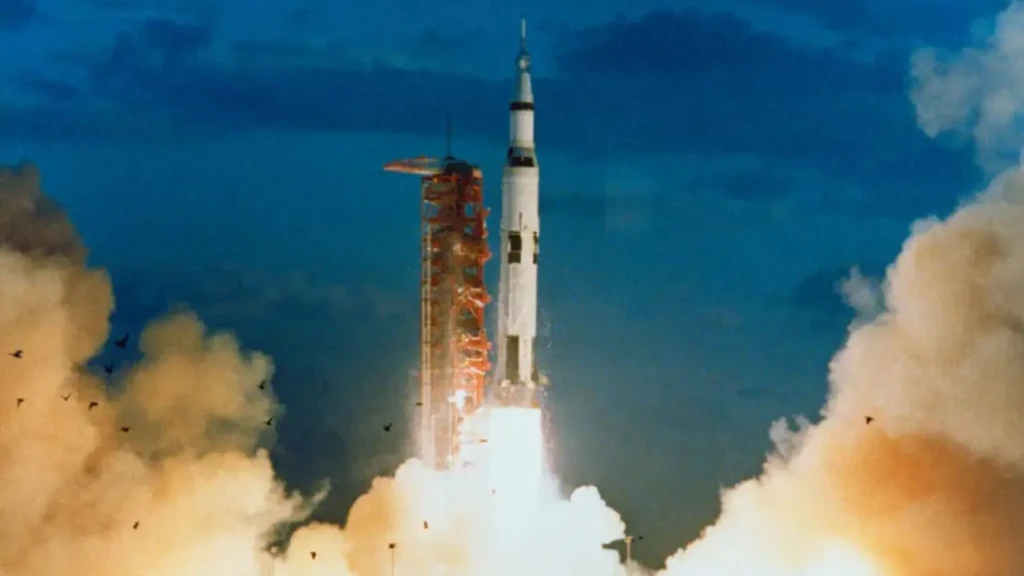
NASA's Saturn V rocket.
NASA’s Saturn V rocket lifting off for Apollo 4 mission. Image: NASA

Apollo 4 also tested all three stages of the 363-feet-tall Saturn V that later took 12 men to the Moon between Apollo 11 and Apollo 17. According to NASA, all three stages performed just as desired and pushed the spacecraft beyond 18,000 kilometres altitude in 10 minutes. While orbiting Earth, the spacecraft’s onboard camera took several pictures of our planet pre and post apogee (farthest distance), before splashing down in the Pacific Ocean.
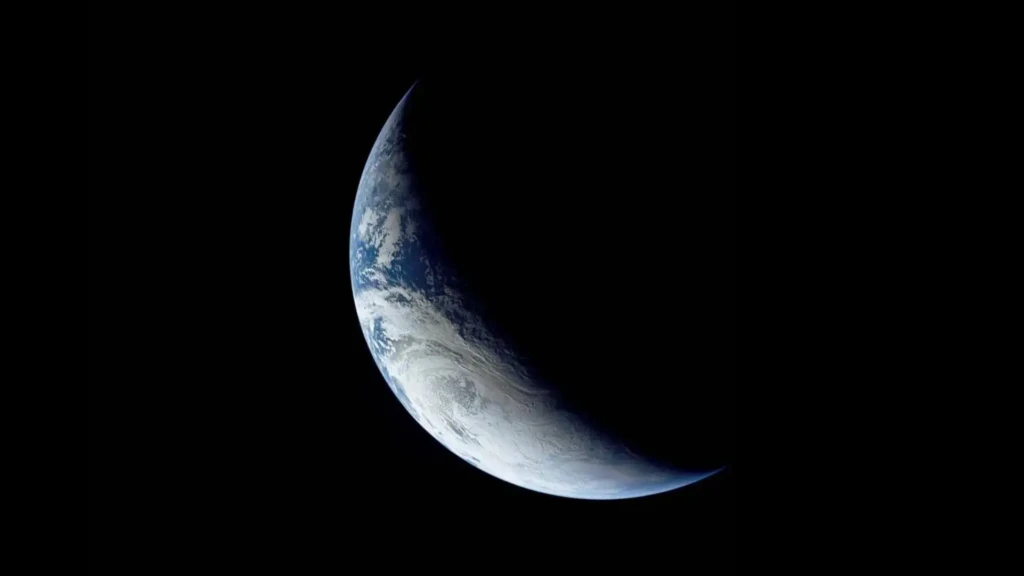
Apollo 4 image of Earth.
Image of Earth captured by Apollo 4 spacecraft camera. Image: NASA

“The whole world could see the awesome sight of the first launch of what is now the largest rocket ever flown. This launching symbolizes the power this nation is harnessing for the peaceful exploration of space,” then US President Lyndon B. Johnson had said about the mission. 

The milestone achieved with Apollo 4 paved the way for first crewed Saturn V launch – Apollo 8 – and restored NASA’s confidence after the Apollo 1 tragedy, which led to the loss of three astronauts in January 1967. 

ALSO READ: When Is Blue Origin’s New Glenn Launching NASA ESCAPADE Mission On Nov 10?

Fast forward to 2025, NASA is working to get back to the Moon with the Artemis program. Instead of the Saturn V, it is now relying on the Space Launch System (SLS) rocket which debuted with the uncrewed Artemis 1 mission on November 16, 2022.

The launch was flawless, somewhat justifying the billions of dollars the US government is spending on its development. Despite the initial success, many industry experts including NASA administrator nominee Jared Isaacman is against the agency manufacturing its own rockets when private companies are providing launch services at much lower cost and guaranteed success.

Artemis 2, which is targeted for launch in 2026, will also employ the SLS rocket which has faced years long delay in its development and enormous cost overruns. Similar to Apollo 4, Artemis 2 will retest not only the rocket but the Orion spacecraft which launched without humans in 2022, but will carry four astronauts next year. In the previous mission, Orion faced a few hiccups in space including loss of communication and unexpected damage to its heatshield during re-entry.

ALSO READ: Comet 3I/ATLAS Is NOT Changing Colours, But Sudden Brightness Remains A Mystery

Share This Article
Facebook Pinterest Whatsapp Whatsapp LinkedIn Copy Link Print

Latest News

SpaceX Dragon spacecraft for NASA's Crew-12 mission.
SpaceX Rolls Out Dragon Spacecraft For NASA’s Crew-12 Mission While Falcon 9 Remains Grounded
Spaceflight
NASA's Artemis II SLS Rocket
NASA Delays Artemis II Moon Mission Launch To March – Here’s Why
Artemis
NASA's SLS rocket.
Astronauts In Quarantine, Rocket Powered On – How NASA Is Preparing For Artemis II
Artemis
NASA partners with Axiom Space
NASA And Axiom Space Announce 5th Private Crew Mission To International Space Station In 2027
Spaceflight

You Might Also Like

NASA ESCAPADE
Spaceflight

NASA’s ESCAPADE Mars Spacecraft Receives ‘First Light’ In Space; Images Released

November 27, 2025
Russia Soyuz
Spaceflight

Russia’s Baikonur Pad Collapses After Soyuz Launch To International Space Station

November 28, 2025
SpaceX Starlink
Spaceflight

SpaceX’s Starlink Satellite Is Breaking Apart In Orbit, Will Crash Within Weeks

December 22, 2025
NASA Roscosmos
Spaceflight

NASA Drops Russian Cosmonaut From Crew-12 Amid Reports of ‘Leaked’ SpaceX Secrets

December 12, 2025
© 2026, Blue Terra Journal
  • About
  • Privacy Policy
  • Terms
  • Contact
Welcome Back!

Sign in to your account

Username or Email Address
Password

Lost your password?