Blue Terra Journal

  • Home
  • Spaceflight
    SpaceflightShow More
    NASA's SR-1 Freedom spacecraft.
    What Is NASA’s SR-1 Freedom Mission? The First Nuclear Reactor In Space Explained
    March 27, 2026
    Artist's impression of a NASA Moon base.
    NASA Moon Base: How The US Will Spend $20 Billion On This Ambitious Project
    March 25, 2026
    Russia's Soyuz rocket ascending to space.
    Russia’s Progress Spacecraft Suffers Mystery Glitch On Its Way To ISS; What Happened?
    March 23, 2026
    Robert Goddard
    Celebrating Robert Goddard – The Man Who Changed Rocketry 100 Years Ago
    March 17, 2026
    International Space Station gets extension to beat China
    Watch Out China! US Proposes Extending International Space Station Lifespan To 2032
    March 10, 2026
  • Astronomy
    AstronomyShow More
    Meteor spotted over Houston.
    Video Captures 1-Ton Meteor Exploding Over Houston Skies, NASA Releases Statement
    March 22, 2026
    NASA black hole simulation
    Fall Into A Black Hole With This Incredibly Scary Simulation Made By NASA
    March 18, 2026
    Comet C/2026 A1 MAPS
    Comet C/2026 A1 MAPS: What Are ‘Sun-Grazer’ Comets And Why Are They Special?
    March 12, 2026
    Moon is safe from asteroid 2024 YR4.
    The Moon Is Safe! James Webb Space Telescope Rules Out Asteroid 2024 YR4’s Collision
    March 6, 2026
    NASA Moon orbiter
    NASA Prepares To Save Its Orbiter During Total Solar Eclipse On The Moon
    March 3, 2026
  • India
    IndiaShow More
    Shubhanshu Shukla aboard the ISS.
    ISRO Astronaut Shubhanshu Shukla Awarded Ashoka Chakra For Heroic Ax-4 Mission
    February 9, 2026
    ISRO's PSLV lifts off to space.
    ISRO’s PSLV Rocket Suffers Third Stage Failure After Successful Liftoff; Payloads Lost
    January 23, 2026
    Dhruva Space team at ISRO facility.
    India’s Dhruva Space To Launch 10 Missions, Including 1st Northeastern Satellite, On ISRO’s PSLV
    January 12, 2026
    ISRO's PSLV rocket
    ISRO To Seek Redemption With PSLV-C62 Mission Launch On January 12
    January 12, 2026
    ISRO SSLV
    ISRO’s SSLV Rocket Just Got Better After Latest Third Stage Test Fire
    December 31, 2025
  • Artemis
    ArtemisShow More
    NASA Artemis II crew
    NASA’s Christina Koch Turns ‘Space Plumber’ To Fix $30 Million Toilet On Artemis II Mission
    April 3, 2026
    NASA Orion spacecraft
    NASA’s Artemis II Astronauts Are Moon-Bound After Successful Trans-Lunar Injection Burn
    April 3, 2026
    NASA Artemis II lifts off.
    Artemis II Lifts Off! NASA Launches 4 Astronauts To The Moon After Over 50 Years
    April 2, 2026
    NASA's Artemis II astronauts
    NASA Artemis II Launch Live: Watch Humanity Return To The Moon On April 2
    April 2, 2026
    NASA Apollo 8 image
    NASA Artemis II: Why This Moon Mission Is Our Generation’s Apollo 8
    March 30, 2026
  • More
    • About
    • Privacy Policy
    • Terms
    • Contact

Blue Terra Journal

  • Home
  • Spaceflight
  • Astronomy
  • India
  • Artemis
Search
  • Pages
    • About
    • Contact
    • Privacy Policy
    • Terms

Home - Astronomy - Comet 3I/ATLAS: Should We Take Avi Loeb’s Alien Theory Seriously?

Astronomy

Comet 3I/ATLAS: Should We Take Avi Loeb’s Alien Theory Seriously?

Avi Loeb is weathering the storm over his claims on 3I/ATLAS.

Harsh Vardhan
Last updated: November 6, 2025 12:10 PM
Harsh Vardhan
Share
6 Min Read
Image 9
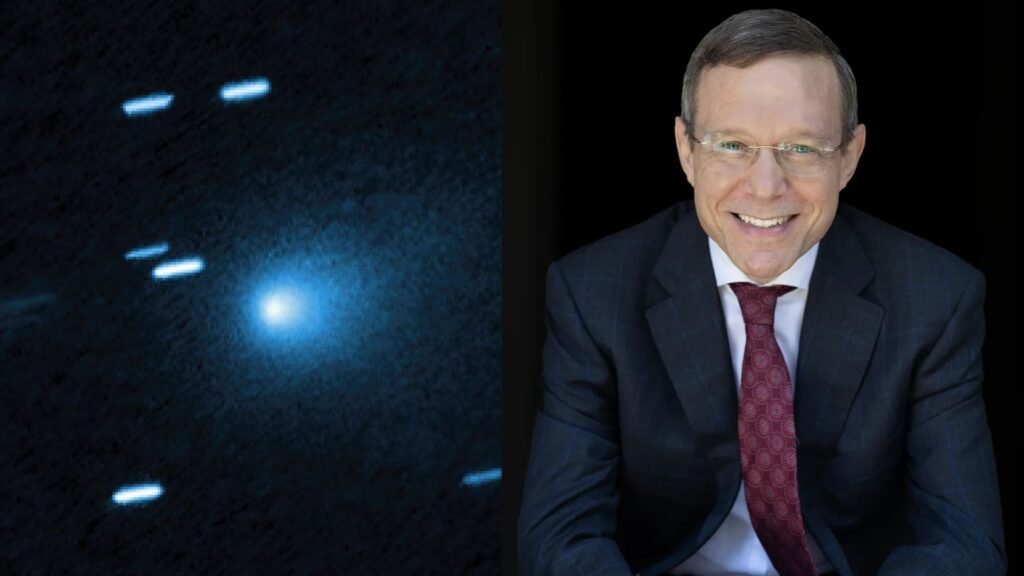
Avi Loeb believes comet 3I/ATLAS is more than just an interstellar icy object. (Image: NASA/Avi Loeb)
SHARE

The interstellar comet 3I/ATLAS has triggered an intense debate and research frenzy in the scientific community due to its fascinating behaviour. While a majority of scientists insist it is nothing but an odd comet, Harvard physicist Avi Loeb believes it could be more than just that. For the unversed, 3I/ATLAS is the third confirmed object from outside our solar system and it was discovered by the NASA-funded Asteroid Terrestrial-impact Last Alert System (ATLAS) telescope in Río Hurtado, Chile.
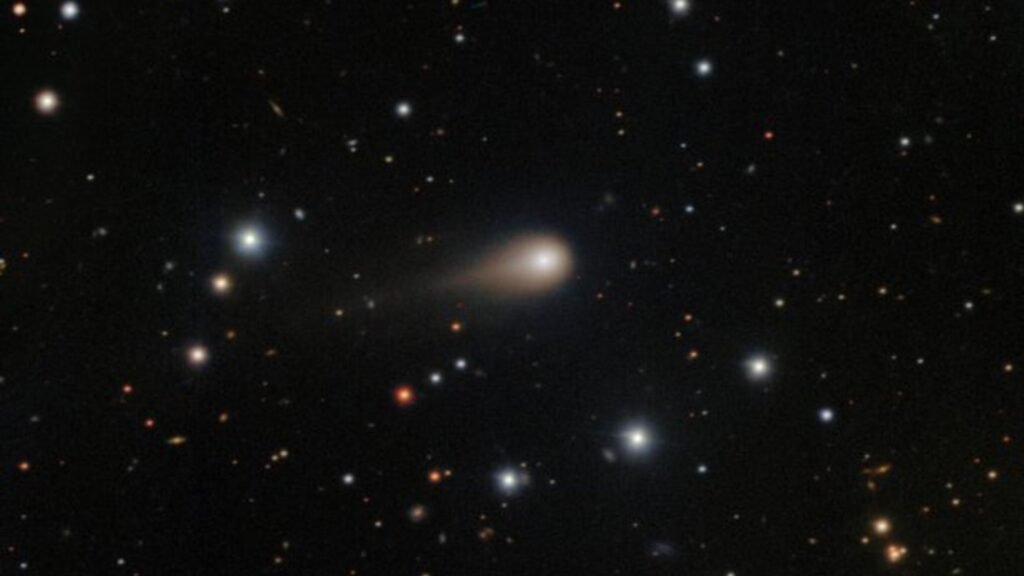
Image 6
The Comet 3I/ATLAS. Image: NOIRLab

Ever since the comet’s discovery, Loeb has published 11 scientific papers, outlining nine anomalies of the comet which could prove its extraterrestrial origin. Loeb believes that 3I/ATLAS’s arrival could be a “Black Swan Event” which could have huge implications for humanity.

“If we ever encounter alien technology, everything will change. It will affect the financial markets, it will affect politics in a major way,” the physicist said on the Joe Rogan Experience (JRE). “So my point is, this is different from other scientific matters because intelligence agencies know very well that events with very small probability have to be considered seriously because they could have major implications.”

Interestingly, he is on the verge of adding another anomaly to the list.

Comet 3I/ATLAS and its anomalies
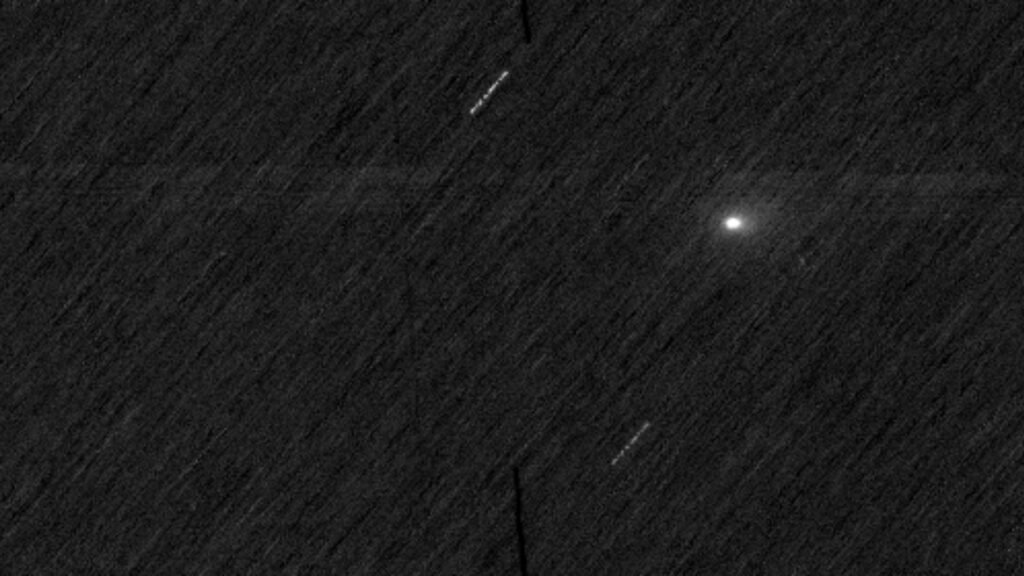
Image 7
Comet 3I/ATLAS spotted by ESA’s ExoMars orbiter. Image: European Space Agency

In one of his recent blogs, Loeb says that he is looking forward to the comet’s observations by ground-based telescopes when it arrives at its closest point to Earth on December 19. Based on his calculations, Loeb calculated that if the comet is indeed natural, it must have lost 15 percent of its total mass at perihelion (closest point to the Sun) on October 29 and therefore built a massive cloud of dust around its nucleus.

According to Loeb’s calculations, 3I/ATLAS is about 5 km in diameter and has a mass of 33 billion tons, with a nucleus about a million times more massive than 1I/Oumuamua (2017) and a thousand times more massive than 2I/Borisov (2019) [first and second confirmed interstellar objects, respectively]. Notably, Loeb had then suggested that Oumuamua might also be alien technology citing anomalies like lack of cometary features, unexplained acceleration and unusual high brightness but it wasn’t conclusive.

Image 8
Comet 3I/ATLAS photographed by the Hubble Space Telescope. Image: NASA

“If we do not observe a massive cloud of gas around 3I/ATLAS in December, then the reported non-gravitational acceleration near perihelion might be regarded as a technological signature of a propulsion system,” Loeb wrote, meaning a lack of gas cloud could mean that the object is being powered by alien technology. He arrived at this conclusion after noting a ‘non-gravitational acceleration’ of the comet, which pushed it a few degrees away from where it’s supposed to be in its trajectory around the Sun.

In his blog, Loeb noted that one of the comet’s several anomalies is its composition. Its gas plume contains more nickel than iron which is unusual for comets when you compare it to 2I/Borisov. He pointed out that alloys with more nickel than iron are industrially produced on Earth and specifically used in aerospace industry. “Maybe the skin of this object is industrially produced,” Loeb told Joe Rogan. He further elaborated on the anomalies saying the comet’s tail, as considered by his colleagues, was pointing toward the Sun (also known as anti-tail) instead of extending away from it like a jet. Loeb, however, mentioned that the jet transformed into a tail by September. Loeb said there have been cases of anti-tail spotting but they were optical illusions (perspective-wise) unlike 3I/ATLAS.

Moreover, the comet’s direction of arrival was within 9 degrees of the “Wow! Signal,” which was the mysterious radio signals that were detected in 1977. “All of these are interesting indications that may imply that some intelligence designed the trajectory. It could be a Black Swan event,” Loeb said. Another interesting anomaly observed by Loeb was the comet’s unusual brightness when it shone bluer than the Sun near perihelion. “It could be something that affects the future of humanity and if we behave very conservatively, we may not last very long,” he added.

Loeb also addressed his critics who are against the idea of 3I/ATLAS being alien technology. “I’m not willing to change what I say just to be liked,” he told Rogan asking scientists to be more open-minded to the possibility. 

He said he was surprised over lack of curiosity among other scientists and their unwillingness to consider alternatives to the interstellar visitor’s origin. “They’re afraid of taking risks,” Loeb said adding that he is working to inspire a debate to collect as much data as possible on the comet. He has also objected to NASA delaying the release of images captured from Mars recently due to the US government shutdown. 

TAGGED:AliensAvi LoebComet 3I/ATLASNASASpace
Share This Article
Facebook Pinterest Whatsapp Whatsapp LinkedIn Copy Link Print

Latest News

NASA Artemis II crew
NASA’s Christina Koch Turns ‘Space Plumber’ To Fix $30 Million Toilet On Artemis II Mission
Artemis
NASA Orion spacecraft
NASA’s Artemis II Astronauts Are Moon-Bound After Successful Trans-Lunar Injection Burn
Artemis
NASA Artemis II lifts off.
Artemis II Lifts Off! NASA Launches 4 Astronauts To The Moon After Over 50 Years
Artemis
NASA's Artemis II astronauts
NASA Artemis II Launch Live: Watch Humanity Return To The Moon On April 2
Artemis

You Might Also Like

University of Sydney space dust
Astronomy

Universe In A Bottle: How Lab Made Space Dust Will Shape Our Understanding Of The Cosmos

February 24, 2026
SpaceX Starship
Spaceflight

SpaceX Starship’s V3 Booster Damaged During Pressure Testing; Picture Surfaces

November 23, 2025
NASA Artemis 1.
Artemis

Artemis 1 Launch Anniversary: Revisiting NASA’s Historic Moon Mission

November 17, 2025
Blue Origin SpaceX
Spaceflight

How Does Blue Origin’s Monstrous New Glenn Rocket Compare To Starship?

November 23, 2025
© 2026, Blue Terra Journal
  • About
  • Privacy Policy
  • Terms
  • Contact
Welcome Back!

Sign in to your account

Username or Email Address
Password

Lost your password?