Blue Terra Journal

  • Home
  • Spaceflight
    SpaceflightShow More
    SpaceX Starship V3 rocket.
    SpaceX’s Starship V3 Heads To Pre-launch Operations Ahead Of Test Flight 12 | Photos
    February 27, 2026
    NASA's Crew-11 astronauts.
    NASA Finally Reveals Which Crew-11 Astronaut Fell Sick Aboard International Space Station
    February 26, 2026
    SpaceX Dragon spacecraft
    Watch SpaceX’s Dragon Spacecraft Return From ISS With NASA Payload On Feb. 26
    February 25, 2026
    NASA Boeing mission astronauts
    NASA Admits Mistake, Designates Boeing’s Crew Mission ‘Type A’ Mishap
    February 20, 2026
    NASA Crew-12 astronauts
    Welcome Aboard! Watch Astronauts Welcome NASA’s Crew-12 On International Space Station
    February 21, 2026
  • Astronomy
    AstronomyShow More
    A Blood Moon
    Blood Moon 2026: When And Where To See The Total Lunar Eclipse On March 3?
    March 2, 2026
    University of Sydney space dust
    Universe In A Bottle: How Lab Made Space Dust Will Shape Our Understanding Of The Cosmos
    February 24, 2026
    Donald Trump UFO files
    Donald Trump Has Ordered Release Of Files On Aliens And UFOs; What Should We Expect?
    February 23, 2026
    Comet C/2026 A1
    A New Comet Is Set To Dive Into The Sun And May Be Visible During The Day
    February 19, 2026
    Comet Wierzchoś
    A Hefty Green Comet Just Flew By Earth. Here’s How You Can Still Spot It
    February 20, 2026
  • India
    IndiaShow More
    Shubhanshu Shukla aboard the ISS.
    ISRO Astronaut Shubhanshu Shukla Awarded Ashoka Chakra For Heroic Ax-4 Mission
    February 9, 2026
    ISRO's PSLV lifts off to space.
    ISRO’s PSLV Rocket Suffers Third Stage Failure After Successful Liftoff; Payloads Lost
    January 23, 2026
    Dhruva Space team at ISRO facility.
    India’s Dhruva Space To Launch 10 Missions, Including 1st Northeastern Satellite, On ISRO’s PSLV
    January 12, 2026
    ISRO's PSLV rocket
    ISRO To Seek Redemption With PSLV-C62 Mission Launch On January 12
    January 12, 2026
    ISRO SSLV
    ISRO’s SSLV Rocket Just Got Better After Latest Third Stage Test Fire
    December 31, 2025
  • Artemis
    ArtemisShow More
    NASA Artemis mission
    Four Moon Missions By 2028? How NASA Envisions Artemis Program After Sweeping Changes
    March 1, 2026
    NASA's SLS rocket
    NASA Shifts Moon Landing To Artemis IV, Alters Artemis III To Test Mission
    February 28, 2026
    NASA Artemis II mission
    Artemis II Delayed Again! NASA To Remove SLS Rocket From Launch Pad Due To Second Stage Problem
    February 22, 2026
    NASA's SLS rocket
    NASA Confirms Launch Date For Artemis II After SLS Rocket’s Wet Dress Rehearsal
    February 22, 2026
    NASA's SLS rocket at launch pad.
    NASA Ready For Second Wet Dress Rehearsal Of Artemis II Moon Rocket On Feb. 18
    February 20, 2026
  • More
    • About
    • Privacy Policy
    • Terms
    • Contact

Blue Terra Journal

  • Home
  • Spaceflight
  • Astronomy
  • India
  • Artemis
Search
  • Pages
    • About
    • Contact
    • Privacy Policy
    • Terms

Home - Spaceflight - Meet Blue Origin’s Mars Orbiter Designed To Serve NASA’s Red Planet Connectivity Goals

Spaceflight

Meet Blue Origin’s Mars Orbiter Designed To Serve NASA’s Red Planet Connectivity Goals

It could launch in 2028.

Harsh Vardhan
Last updated: February 12, 2026 11:01 AM
Harsh Vardhan
Share
4 Min Read
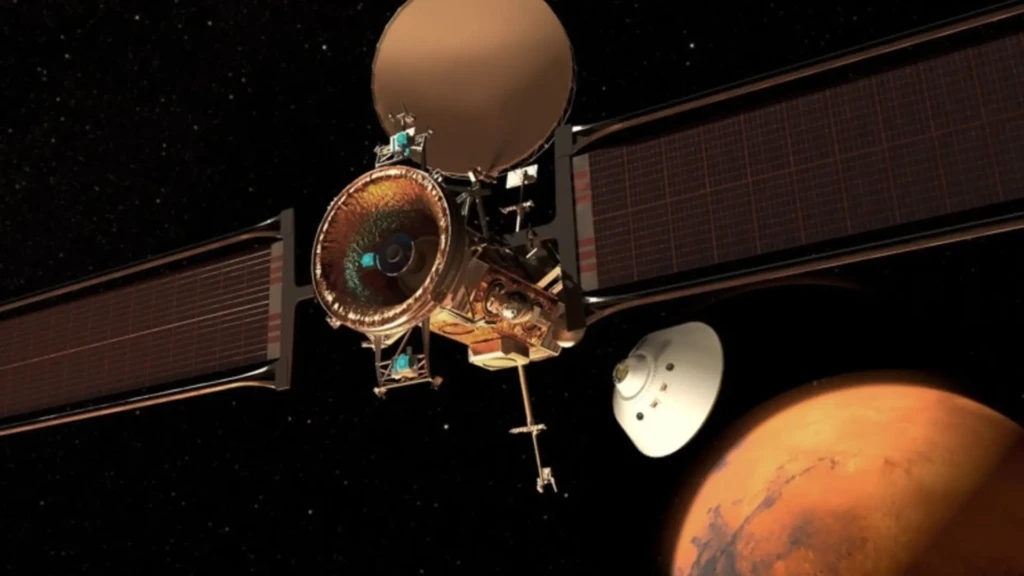
Blue Origin's Mars orbiter
Artist's concept of Blue Origin's Mars orbiter. Image: Blue Origin
SHARE

Blue Origin is aggressively pushing to be the primary choice for NASA when it comes to establishing communications to Mars. As a strategy, the company is marketing its Mars Telecommunications Orbiter (MTO) which it says is already in production and ready to support NASA’s mission in 2028.

The orbiter is based on the Blue Ring platform which was tested on the New Glenn rocket’s debut mission in January 2025. Blue Ring is a hybrid solar electric and chemical propelled spacecraft that can maneuver, host, and deploy payloads and infrastructure services in Earth orbits, the Moon, Mars, interplanetary, and near-Earth asteroids.

Meet Blue Origin’s Mars Telecommunications Orbiter (MTO), a high-performance spacecraft built upon our existing and affordable Blue Ring platform that is ready to support NASA’s Mars mission in 2028. The orbiter builds upon Blue Origin’s Mars Next-Generation Relay and Mars Sample… pic.twitter.com/cvlt3PNqMA

— Blue Origin (@blueorigin) August 12, 2025

On the MTO’s promotional page, Blue Origin says that the orbiter will be built upon the success of Blue Ring and it’s designed to establish a high-speed communications relay network for continuous coverage between Earth and Mars.

What makes Blue Origin’s MTO special?

According to Blue Origin, its orbiter offers several advantages that puts it ahead of its competitors. The MTO can provide continuous “high-speed communications between Earth and Mars through multiple, steerable high-rate links supported by a broad beam that offers wide-area coverage.” This will be supplemented by ultra-high frequency (UHF) relay satellites that will be deployed from the orbiter for better connectivity.

The MTO’s hybrid propulsion (solar electric and chemical) would expand launch windows to Mars and improve maneuvering capability. It can also carry over 1,000 kg of payload mass to Mars orbit depending on the mission requirements. Since its architecture is scalable, the orbiter can grow based on mission demands. It also boasts onboard edge processing, data storage and AI for efficient data transfer to Earth.

Blue Origin had proposed the orbiter in August 2025 and it’s currently in production in Huntsville, Alabama.

NASA currently relies on its aging fleet of orbiters that act as a relay between ground team and the rovers operating on the Martian surface. Spacecraft such as NASA’s Mars Reconnaissance Orbiter (MRO), Mars Odyssey, Mars Atmosphere and Volatile Evolution (MAVEN) and the European Space Agency’s (ESA) Trace Gas Orbiter and Mars Express have so far served as the link between Earth and the red planet. Some of these orbiters have been operational for decades and with MAVEN in trouble, NASA wants a timely and reliable replacement of others as well to support future missions including potential sample return and human exploration.

ALSO READ: Blue Origin Halts New Shepard Missions For At Least 2 Years To Land Humans On The Moon

ALSO READ: Blue Origin Launches First Wheelchair User Michaela Benthaus To Space On NS-37 Mission


TAGGED:Blue OriginMarsMars Telecommunications OrbiterNASA
Share This Article
Facebook Pinterest Whatsapp Whatsapp LinkedIn Copy Link Print

Latest News

A Blood Moon
Blood Moon 2026: When And Where To See The Total Lunar Eclipse On March 3?
Astronomy
NASA Artemis mission
Four Moon Missions By 2028? How NASA Envisions Artemis Program After Sweeping Changes
Artemis
NASA's SLS rocket
NASA Shifts Moon Landing To Artemis IV, Alters Artemis III To Test Mission
Artemis
SpaceX Starship V3 rocket.
SpaceX’s Starship V3 Heads To Pre-launch Operations Ahead Of Test Flight 12 | Photos
Spaceflight

You Might Also Like

Saturn NASA
Astronomy

Saturn’s Rings Have Disappeared Again Due To This Cosmic Illusion

November 24, 2025
SpaceX Falcon 9
Spaceflight

SpaceX Falcon 9 Launches 140 Satellites On Transporter-15 Mission; Aces 30th Flight

November 29, 2025
NASA's Artemis II crew.
Artemis

NASA’s Artemis II Crewed Moon Mission May Launch On Feb 8 – All The Records It Will Set

February 3, 2026
Blue Origin NS-37 mission
Spaceflight

Watch Blue Origin Launch NS-37 Mission With Six Tourists Live On Dec 18

December 18, 2025
© 2026, Blue Terra Journal
  • About
  • Privacy Policy
  • Terms
  • Contact
Welcome Back!

Sign in to your account

Username or Email Address
Password

Lost your password?