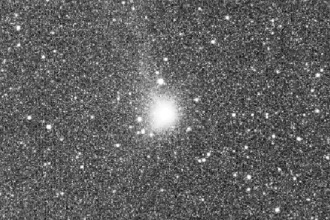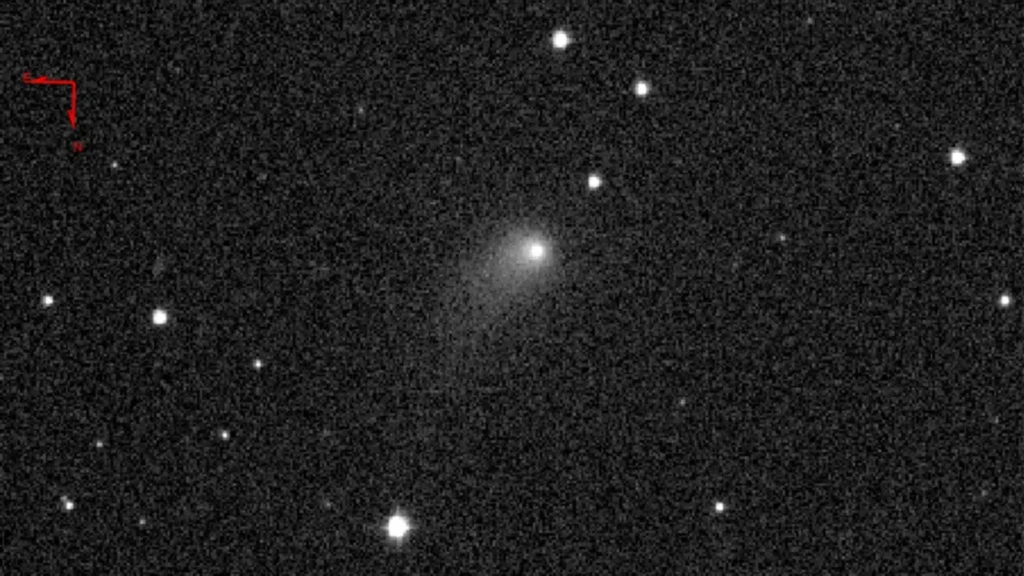
A hefty space rock just made its close flyby past Earth. Comet Wierzchoś, also known as C/2024 E1, was around 151 million kilometres from our planet on February 17 and it’s rapidly moving out of the solar system. The comet was discovered in March 2024 by Polish astronomer Kacper Wierzchoś using the 1.5 meter telescope at the Mount Lemmon Observatory in Arizona.
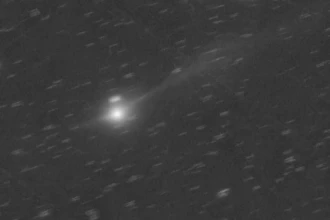
#Comet C/2024 E1 (Wierzchos)
Taken by Gerald Rhemann & Michael Joger on Feb 2, 2026 Namibia. pic.twitter.com/Jii8vJtz4F— Peter the Great Space Science☀️ (@Space_PHD) February 5, 2026
Its size, believed to be around 13.7 kilometres, is debatable but what’s confirmed is that it originated from the Oort cloud – a region packed with billions of icy objects and debris at the edge of the solar system. Astronomers have also reportedly confirmed that this comet has a hyperbolic (flat) trajectory meaning its does not repeatedly orbit the Sun.
How to spot the comet?
Telescopic observations of the comet is possible for the next few weeks. It is expected to be best visible above the southwestern horizon after dusk near the constellation Sculptor in the northern hemisphere. However, spotting it in the southern hemisphere would be much easier.
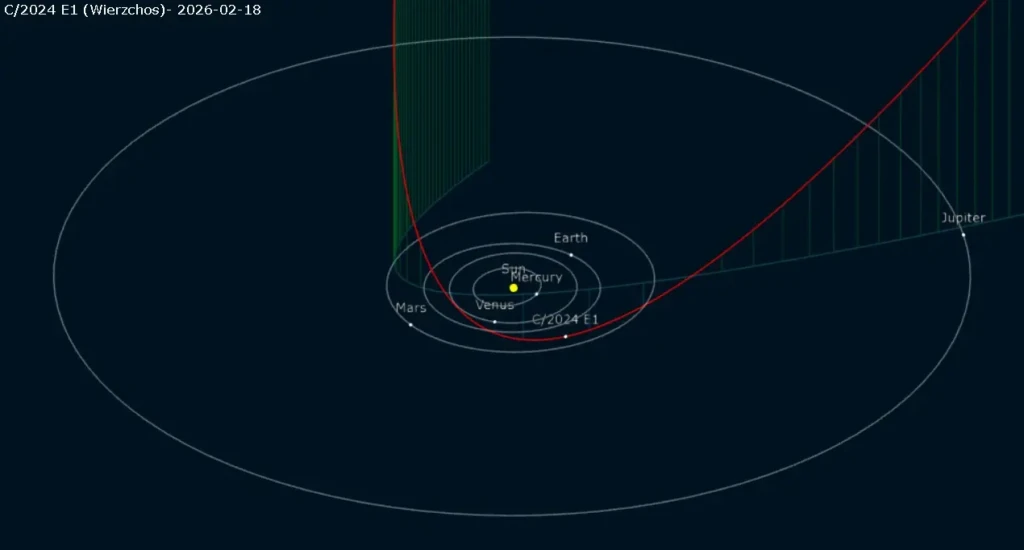
Viewers in the northern hemisphere including India could spot it within a limited time frame and a clear unobstructed view since the comet will be just a few degrees above the horizon. You can use apps like SkySafari or Stellarium to locate the Sculptor constellation.
Comet Wierzchoś achieved peak brightness on January 20 when it was closest to the Sun and was visible even with binoculars.
More comets incoming
When the Wierzchoś show is over, there are two more comets that will be at perigee (closest to Earth) soon. The first is C/2026 A1 (MAPS) – the first comet discovered in 2026 – that could be visible with the naked eye during the daytime in April. Since its a ‘Sun-grazer’ comet, it may disintegrate and get even brighter briefly during the closest approach to the Sun.
The second is C/2025 R2 (PanSTARRS) that is also set to make its closest approach to Earth and the Sun in late April.
ALSO READ: NASA Releases New Comet 3I/ATLAS Pictures As It Glows Up On An Outbound Journey
ALSO READ: What Does The CIA Know About Comet 3I/ATLAS? Avi Loeb Seeks Answers