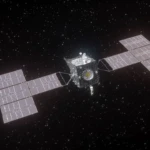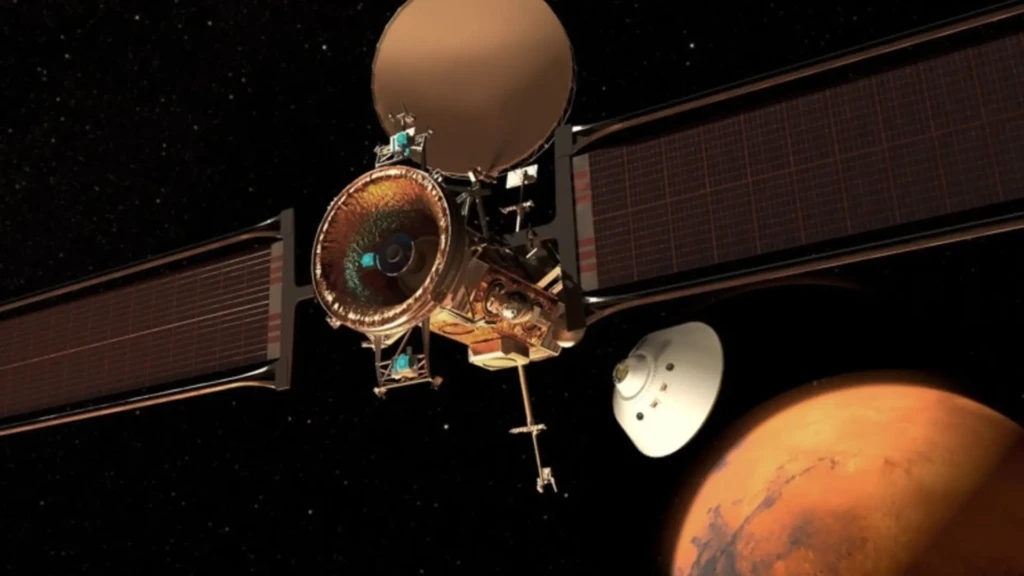
Blue Origin is aggressively pushing to be the primary choice for NASA when it comes to establishing communications to Mars. As a strategy, the company is marketing its Mars Telecommunications Orbiter (MTO) which it says is already in production and ready to support NASA’s mission in 2028.
The orbiter is based on the Blue Ring platform which was tested on the New Glenn rocket’s debut mission in January 2025. Blue Ring is a hybrid solar electric and chemical propelled spacecraft that can maneuver, host, and deploy payloads and infrastructure services in Earth orbits, the Moon, Mars, interplanetary, and near-Earth asteroids.
Meet Blue Origin’s Mars Telecommunications Orbiter (MTO), a high-performance spacecraft built upon our existing and affordable Blue Ring platform that is ready to support NASA’s Mars mission in 2028. The orbiter builds upon Blue Origin’s Mars Next-Generation Relay and Mars Sample… pic.twitter.com/cvlt3PNqMA
— Blue Origin (@blueorigin) August 12, 2025
On the MTO’s promotional page, Blue Origin says that the orbiter will be built upon the success of Blue Ring and it’s designed to establish a high-speed communications relay network for continuous coverage between Earth and Mars.
What makes Blue Origin’s MTO special?
According to Blue Origin, its orbiter offers several advantages that puts it ahead of its competitors. The MTO can provide continuous “high-speed communications between Earth and Mars through multiple, steerable high-rate links supported by a broad beam that offers wide-area coverage.” This will be supplemented by ultra-high frequency (UHF) relay satellites that will be deployed from the orbiter for better connectivity.
The MTO’s hybrid propulsion (solar electric and chemical) would expand launch windows to Mars and improve maneuvering capability. It can also carry over 1,000 kg of payload mass to Mars orbit depending on the mission requirements. Since its architecture is scalable, the orbiter can grow based on mission demands. It also boasts onboard edge processing, data storage and AI for efficient data transfer to Earth.
Blue Origin had proposed the orbiter in August 2025 and it’s currently in production in Huntsville, Alabama.
NASA currently relies on its aging fleet of orbiters that act as a relay between ground team and the rovers operating on the Martian surface. Spacecraft such as NASA’s Mars Reconnaissance Orbiter (MRO), Mars Odyssey, Mars Atmosphere and Volatile Evolution (MAVEN) and the European Space Agency’s (ESA) Trace Gas Orbiter and Mars Express have so far served as the link between Earth and the red planet. Some of these orbiters have been operational for decades and with MAVEN in trouble, NASA wants a timely and reliable replacement of others as well to support future missions including potential sample return and human exploration.
ALSO READ: Blue Origin Halts New Shepard Missions For At Least 2 Years To Land Humans On The Moon
ALSO READ: Blue Origin Launches First Wheelchair User Michaela Benthaus To Space On NS-37 Mission