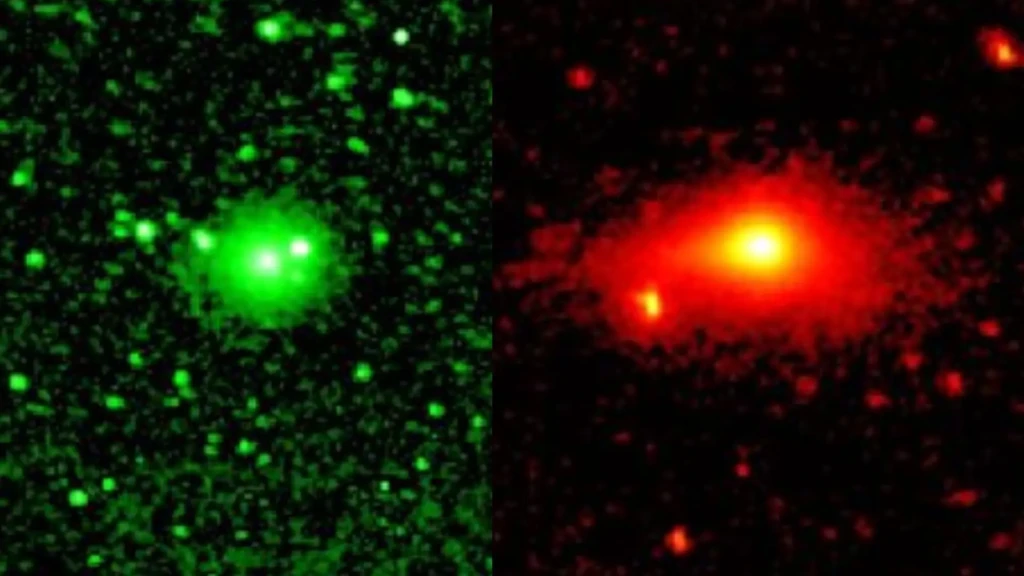
NASA has released new pictures of the interstellar comet 3I/ATLAS. Captured by the Spectro-Photometer for the History of the Universe, Epoch of Reionization and Ices Explorer or SPHEREx telescope, these pictures show the comet in its high activity phase long after it reached perihelion (closest point to the Sun) on October 29. SPHEREx orbits the Earth in a near-polar orbit which enables it to observe the universe from a unique vantage point.
🚨 NASA space telescope sees interstellar comet 3I/ATLAS flare up while exiting the solar system
The images were taken by SPHEREx as the object headed back into deep space
Instead of fading as it moved away from the Sun, the comet unexpectedly increased in activity pic.twitter.com/Ywb9YmnJGw
— Latest in space (@latestinspace) February 8, 2026
It was at the right place at the right time in December 2025 when these observations were being carried out. Astronomers studying the data have confirmed the detection of organic molecules, such as methanol, cyanide, and methane (which are made by both biologically and non-biologically on Earth) in the dust ejected by 3I/ATLAS.
The comet’s brightness has also increased more than two months after made its closest pass to the Sun.
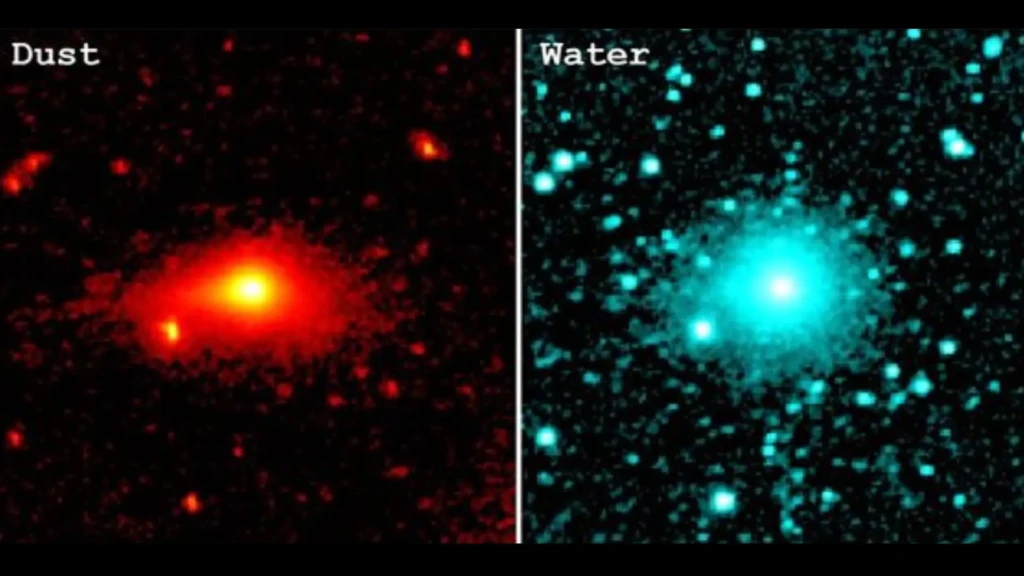
“Comet 3I/ATLAS was full-on erupting into space in December 2025, after its close flyby of the Sun, causing it to significantly brighten. Even water ice was quickly sublimating into gas in interplanetary space,” said study lead Carey Lisse of Johns Hopkins Applied Physics Laboratory in a statement. Lisse explained that since comets consist of about one-third bulk water ice, it was releasing an abundance of new, carbon-rich material that was locked in ice deep below the surface.
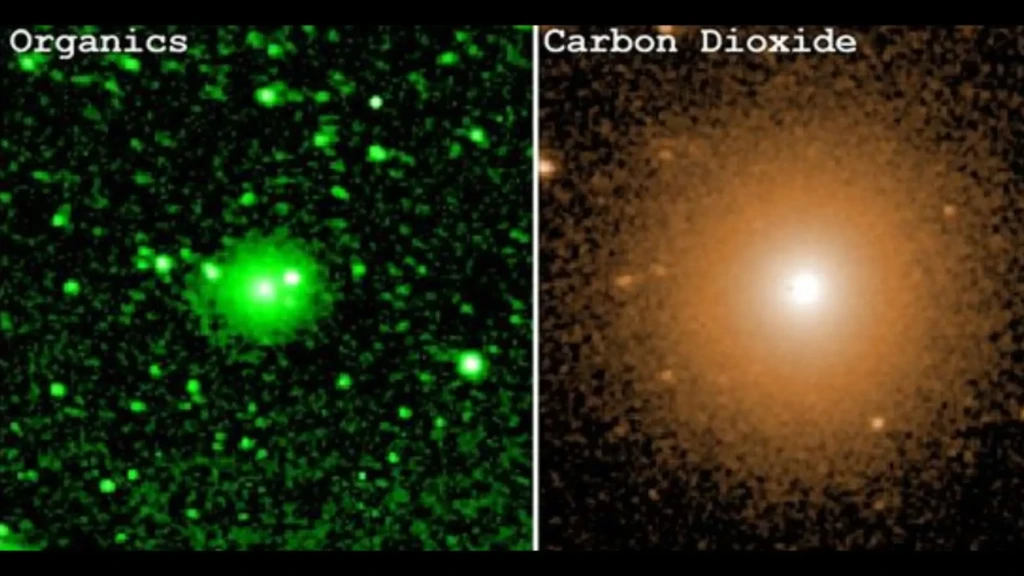
SPHEREx pictures show what scientists say is a release of early solar system materials, including organic molecules, soot, and rock dust.
They also observed a delayed venting of materials from the comet as opposed to during perihelion – the period of peak heating. Sometimes ices deep below the cometary surface may not begin sublimating (changing from solid to gas) until long after perihelion because the Sun’s heat takes time to travel through the outer layers of the comet. That’s exactly the case with 3I/ATLAS.

“Now that the Sun’s energy has had time to penetrate deep into the comet, the pristine ices below the surface are warming up and erupting, releasing a cocktail of chemicals that haven’t been exposed to space for billions of years,” Phil Korngut, the SPHEREx mission’s instrument scientist at Caltech.
The lack of a conventional long tail behind 3I/ATLAS has also been a subject of debate, with some experts even floating the idea of an alien spacecraft, but actually it does have a pear-shaped tail behind shaped by solar radiation pressure. 3I/ATLAS is ejecting large grains and relatively bigger chunks of material that are too massive to be pushed far from the comet’s nucleus to form a tail.
Comet 3I/ATLAS was discovered on July 1, 2025 and it’s the third confirmed interstellar object. Scientists from around the world are eager to study it because it may have formed in an ancient part of the universe outside our solar system and it could provide insights about the chemistry and environment of other planet forming regions. It was at its closest point to Earth on December 19, and it’s heading out of the inner solar system.
ALSO READ: What Does The CIA Know About Comet 3I/ATLAS? Avi Loeb Seeks Answers
ALSO READ: Comet 3I/ATLAS Is Not An Alien Spacecraft – This Research Likely Confirms It