Blue Terra Journal

  • Home
  • Spaceflight
    SpaceflightShow More
    NASA's SR-1 Freedom spacecraft.
    What Is NASA’s SR-1 Freedom Mission? The First Nuclear Reactor In Space Explained
    March 27, 2026
    Artist's impression of a NASA Moon base.
    NASA Moon Base: How The US Will Spend $20 Billion On This Ambitious Project
    March 25, 2026
    Russia's Soyuz rocket ascending to space.
    Russia’s Progress Spacecraft Suffers Mystery Glitch On Its Way To ISS; What Happened?
    March 23, 2026
    Robert Goddard
    Celebrating Robert Goddard – The Man Who Changed Rocketry 100 Years Ago
    March 17, 2026
    International Space Station gets extension to beat China
    Watch Out China! US Proposes Extending International Space Station Lifespan To 2032
    March 10, 2026
  • Astronomy
    AstronomyShow More
    Meteor spotted over Houston.
    Video Captures 1-Ton Meteor Exploding Over Houston Skies, NASA Releases Statement
    March 22, 2026
    NASA black hole simulation
    Fall Into A Black Hole With This Incredibly Scary Simulation Made By NASA
    March 18, 2026
    Comet C/2026 A1 MAPS
    Comet C/2026 A1 MAPS: What Are ‘Sun-Grazer’ Comets And Why Are They Special?
    March 12, 2026
    Moon is safe from asteroid 2024 YR4.
    The Moon Is Safe! James Webb Space Telescope Rules Out Asteroid 2024 YR4’s Collision
    March 6, 2026
    NASA Moon orbiter
    NASA Prepares To Save Its Orbiter During Total Solar Eclipse On The Moon
    March 3, 2026
  • India
    IndiaShow More
    Shubhanshu Shukla aboard the ISS.
    ISRO Astronaut Shubhanshu Shukla Awarded Ashoka Chakra For Heroic Ax-4 Mission
    February 9, 2026
    ISRO's PSLV lifts off to space.
    ISRO’s PSLV Rocket Suffers Third Stage Failure After Successful Liftoff; Payloads Lost
    January 23, 2026
    Dhruva Space team at ISRO facility.
    India’s Dhruva Space To Launch 10 Missions, Including 1st Northeastern Satellite, On ISRO’s PSLV
    January 12, 2026
    ISRO's PSLV rocket
    ISRO To Seek Redemption With PSLV-C62 Mission Launch On January 12
    January 12, 2026
    ISRO SSLV
    ISRO’s SSLV Rocket Just Got Better After Latest Third Stage Test Fire
    December 31, 2025
  • Artemis
    ArtemisShow More
    NASA Artemis II crew
    NASA’s Christina Koch Turns ‘Space Plumber’ To Fix $30 Million Toilet On Artemis II Mission
    April 3, 2026
    NASA Orion spacecraft
    NASA’s Artemis II Astronauts Are Moon-Bound After Successful Trans-Lunar Injection Burn
    April 3, 2026
    NASA Artemis II lifts off.
    Artemis II Lifts Off! NASA Launches 4 Astronauts To The Moon After Over 50 Years
    April 2, 2026
    NASA's Artemis II astronauts
    NASA Artemis II Launch Live: Watch Humanity Return To The Moon On April 2
    April 2, 2026
    NASA Apollo 8 image
    NASA Artemis II: Why This Moon Mission Is Our Generation’s Apollo 8
    March 30, 2026
  • More
    • About
    • Privacy Policy
    • Terms
    • Contact

Blue Terra Journal

  • Home
  • Spaceflight
  • Astronomy
  • India
  • Artemis
Search
  • Pages
    • About
    • Contact
    • Privacy Policy
    • Terms

Home - Spaceflight - Blue Origin Postpones NASA’s ESCAPADE Mission Launch Due To Solar Storm

Spaceflight

Blue Origin Postpones NASA’s ESCAPADE Mission Launch Due To Solar Storm

New launch date will be announced soon.

Harsh Vardhan
Last updated: November 13, 2025 11:36 AM
Harsh Vardhan
Share
5 Min Read
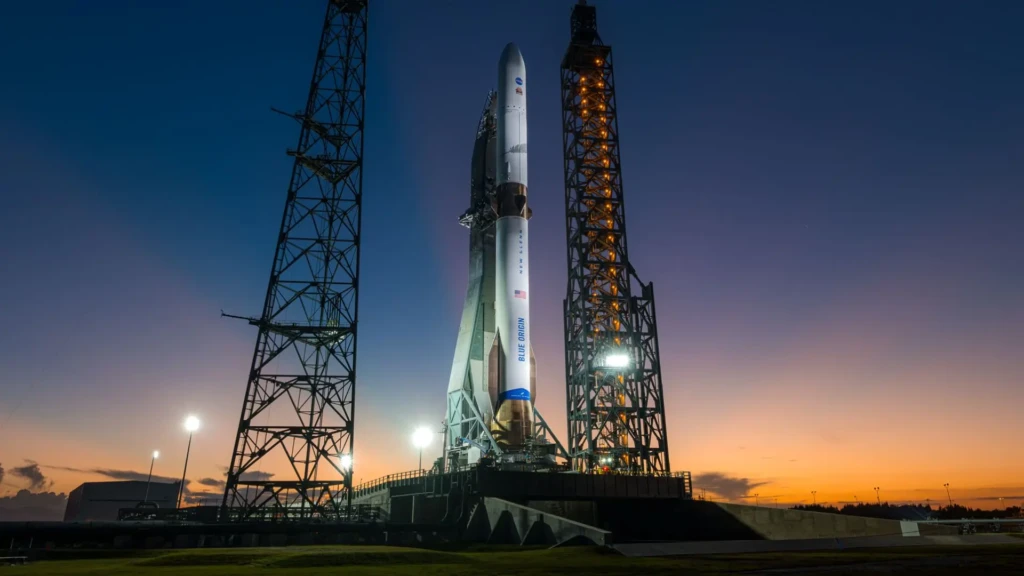
Blue Origin's New Glenn rocket.
New Glenn at the launch pad in Florida. Image: Blue Origin
SHARE

Blue Origin has delayed the launch of NASA’s ESCAPADE Mars mission again, this time due to the ongoing solar storm. In a statement on Wednesday, the company said the launch is being postponed until space weather improves and the new launch date will be announced soon. The liftoff was planned between a narrow window opening at 1:20 am IST on November 13 (2:50 pm EST on November 12).

“NG-2 Update: New Glenn is ready to launch. However, due to highly elevated solar activity and its potential effects on the ESCAPADE spacecraft, NASA is postponing launch until space weather conditions improve,” Blue Origin posted on X. “We are currently assessing opportunities to establish our next launch window based on forecasted space weather and range availability.”

NG-2 Update: New Glenn is ready to launch. However, due to highly elevated solar activity and its potential effects on the ESCAPADE spacecraft, NASA is postponing launch until space weather conditions improve. We are currently assessing opportunities to establish our next launch…

— Blue Origin (@blueorigin) November 12, 2025

The twin-satellite ESCAPADE mission will launch atop the 321-feet-tall New Glenn rocket which is preparing for its second-ever flight. The launch was first scheduled for November 10 but got scrubbed due to unfavourable weather over the launch pad at Cape Canaveral Space Force Station in Florida.

Worsening space weather delays ESCAPADE launch

NASA and Blue Origin are exercising caution as the worsening space weather could affect both the rocket and the spacecraft.

In the last couple of days, scientists have recorded high solar activity, with the Sun releasing the strongest flares this year on November 12. Earth is also experience overwhelming streams of charged particles being expelled from the Sun during the recent coronal mass ejection event from the sunspot named AR4274. It has reportedly caused radio blackouts across Africa and Europe, and triggered auroras as far south as Mexico from the north pole.

Here is a view of today’s eruption from the Sun, currently en route to Earth. You can see a full ‘halo’ in the data, indicating the plasma is coming our way. You can also see the ‘fuzzy snow’ in the images, caused by particles from the solar flare hitting the camera! pic.twitter.com/CqbNG1kRH6

— Dr. Ryan French (@RyanJFrench) November 11, 2025

The National Oceanic and Atmospheric Administration’s (NOAA) Space Weather Prediction Center revealed on Wednesday that geomagnetic storm conditions are currently at G3 (strong), after peaking at G4 (severe) earlier. “G3 conditions are currently being observed. G4 conditions with a chance for higher levels remain possible throughout the day as another CME is expected to arrive midday (EST),” the agency posted on X.

G3 conditions are currently being observed. G4 conditions with a chance for higher levels remain possible throughout the day as another CME is expected to arrive midday (EST). pic.twitter.com/XcBmeNns4J

— NOAA Space Weather Prediction Center (@NWSSWPC) November 12, 2025

It is wise to forgo launch opportunities during heightened solar activity because charged solar particles and intense radiation can damage sensitive avionics, guidance systems of rockets and also affect the payloads. Since solar eruptions can disrupt radio signals, ground control may lose communication with the spacecraft after it is deployed in orbit and even damage its critical components. Both ESCAPADE satellites will rely on solar energy and prolonged exposure to space weather could cause total failure of their solar arrays.

The ESCAPADE mission was funded by NASA and the twin satellites were built by Rocket Lab. Their job is to study the Martian magnetosphere and how it interacts and gets affected by solar particles and radiation. Both the probes will reach Mars in 2027 and operate in separate orbits for 11 months. The objective to find out how Mars lost its atmosphere and eventually all its water. 

ALSO READ: Strongest Solar Eruption Of 2025 Lights Up Skies With Auroras, Triggers Blackouts

ALSO READ: ESCAPADE: Why It May Be NASA’s Most Important Mars Mission In Years
TAGGED:Blue OriginESCAPADEMarsNASASolar Storm
Share This Article
Facebook Pinterest Whatsapp Whatsapp LinkedIn Copy Link Print

Latest News

NASA Artemis II crew
NASA’s Christina Koch Turns ‘Space Plumber’ To Fix $30 Million Toilet On Artemis II Mission
Artemis
NASA Orion spacecraft
NASA’s Artemis II Astronauts Are Moon-Bound After Successful Trans-Lunar Injection Burn
Artemis
NASA Artemis II lifts off.
Artemis II Lifts Off! NASA Launches 4 Astronauts To The Moon After Over 50 Years
Artemis
NASA's Artemis II astronauts
NASA Artemis II Launch Live: Watch Humanity Return To The Moon On April 2
Artemis

You Might Also Like

NASA's SLS rocket
Artemis

NASA Confirms Launch Date For Artemis II After SLS Rocket’s Wet Dress Rehearsal

February 22, 2026
Neil deGrasse Tyson's thoughts on Mars.
Spaceflight

Neil deGrasse Tyson Shares The Only Reasons Humans May Reach Mars

November 14, 2025
NASA-SpaceX ready for Crew-12
Spaceflight

NASA Crew-12 LIVE: Watch SpaceX Launch Astronauts To International Space Station Today

February 15, 2026
Jared Isaacman NASA
Artemis

NASA Chief Nominee Jared Isaacman Reiterates Pledge To Beat China In Moon Race

December 12, 2025
© 2026, Blue Terra Journal
  • About
  • Privacy Policy
  • Terms
  • Contact
Welcome Back!

Sign in to your account

Username or Email Address
Password

Lost your password?