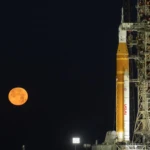
NASA is targeting the launch of its Artemis II crew Moon mission in March but the problems that entail fuelling the Space Launch System (SLS) rocket seem hard to solve. During the first Wet Dress Rehearsal (WDR) in early February, teams encountered liquid hydrogen leaks while loading the rocket with propellant among other issues.
This leak is something NASA had to deal with before on Artemis I (Nov. 2022) as well and the engineers still haven’t been able to contain it. It’s the reason why the WDR had to end prematurely.
Following last week’s fueling test for Artemis II, engineers replaced seals in an area where a hydrogen leak was seen and remated the connections to the rocket. This week teams are conducting a range of tests in advance of the next rehearsal including at cryogenic temperatures… pic.twitter.com/Pdjy6dmRMD
— NASA Artemis (@NASAArtemis) February 12, 2026
Following the WDR, NASA conducted a confidence test on February 12 where they partially filled the rocket’s core stage with liquid hydrogen to asses the newly replaced seals used to stop the leakage.
In a statement, the agency said that during the test, “teams encountered an issue with ground support equipment that reduced the flow of liquid hydrogen into the rocket.” It is suspected that a filter may have caused the reduced flow and work needs to be done to achieve the optimal level.

“Engineers will examine findings before setting a timeline for the next test, a second wet dress rehearsal this month. March remains the earliest potential launch window for Artemis II,” the statement further read. This hurdle also caused the confidence test to end sooner than planned.
The mission comprising four astronauts was initially supposed to launch on February 8 but the leaks forced NASA to consider March. The possible dates for launch next month are March 6,7,8,9 and 11.

‘We will cryoproof the rocket’: NASA chief
NASA administrator Jared Isaacman weighed in on the buzz around the new problem which may make March 8 launch implausible. Reacting to journalist Eric Berger on X, Isaacman explained the nature of the complication and NASA’s commitment to transparency. “The confidence test related to the seals we repaired and replaced after WDR-1 provided a great deal of data, and we observed materially lower leak rates compared to prior observations during WDR-1,” he replied. “I would not say something broke that caused the premature end to the test, as much as we observed enough and reached a point where waiting out additional troubleshooting was unnecessary.”
I will just say we are leaning forward with transparency, sharing the blemishes and the successes, because for a program as costly and important to national security as Artemis, the public is entitled to the facts.
– The confidence test related to the seals we repaired and…
— NASA Administrator Jared Isaacman (@NASAAdmin) February 14, 2026
He also said “near-conclusively” that the SLS rocket would be cryoproofed before Artemis III – the crewed Moon landing mission – and the interface currently used for propellant loading will be redesigned.
“There is still a great deal of work ahead to prepare for this historic mission. We will not launch unless we are ready and the safety of our astronauts will remain the highest priority. We will keep everyone informed as NASA prepares to return to the Moon,” Isaacman further wrote.
Meanwhile, the Artemis II astronauts – Reid Wiseman, Christina Koch, Victor Glover and Jeremy Hansen – have been released from quarantine and NASA is preparing for the next wet dress rehearsal this month. Artemis II, the first crewed Moon mission since 1972, will last ten days and the crew will return after taking a trip around the Moon.
ALSO READ: NASA’s Artemis II Astronauts Will Launch With Smartphones To The Moon, So Will Other Fliers
ALSO READ: NASA’s Artemis II To Carry Relic Of Humanity’s First Flight And More To The Moon